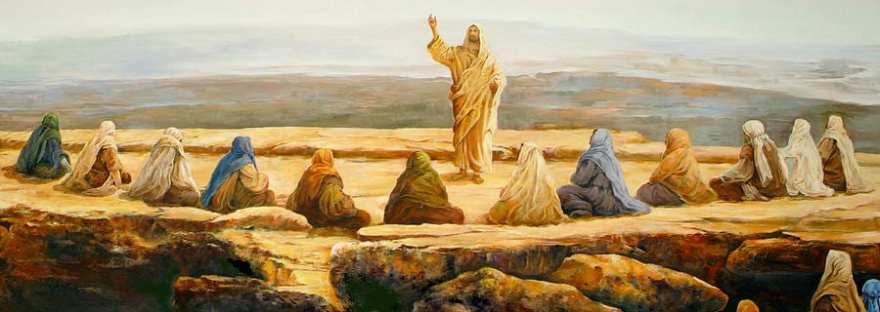
Sermon on the Mount: A Model Prayer and Some Perplexing Advice

Verse: Matthew 6

Matthew 6:33 “Seek first his kingdom and his righteousness, and all these things will be given to you as well.”

Matthew 6, a continuation of the Sermon on the Mount, contains the Lord’s Prayer, perhaps the most famous prayer of all time. This model prayer by Jesus captures well the message of the kingdom: “Your kingdom come, your will be done on earth as it is in heaven” (Matthew 6:10). Jesus seeks to bring the two worlds together, and the Sermon on the Mount explains how.

At first glance, some of Jesus’ advice may seem downright foolish: Give to everyone who asks, love your enemies, turn the other cheek, grant interest-free loans, don’t worry about clothes or food. Can such idealism ever work in the “real,” or visible, world? That is precisely Jesus’ point: Break your obsession with safety, security, thriftiness, self-righteousness. Depend instead on the Father, letting God take care of the personal injustices that come your way, trusting God to look after your daily needs. In a nutshell, the message of the kingdom is this: Live for God rather than for yourself.

The message applies to rewards as well. Most of us look to friends and colleagues for our rewards: a slap on the back, a raise, applause, a generous compliment. According to Jesus, far more important rewards will come in God’s heavenly kingdom. Therefore, the most significant acts may be carried out in secret, seen and rewarded by no one but God.

Future Savings Account

As Jesus explains it, we are accumulating a kind of savings account, storing up treasures in heaven rather than on Earth—treasures great enough to pay back any amount of suffering in this life (see Matthew 6:19). The Old Testament has dropped a few scant hints about an afterlife, but Jesus speaks plainly about a place where “the righteous will shine like the sun in the kingdom of their Father” (Matthew 13:43).

In their quest for a kingdom, the Jews of Jesus’ day have been looking for signs of God’s approval in this life, primarily through prosperity and political power. Beginning with this speech, Jesus changes the focus to the life to come. He discounts success in this visible world. Invest in the future life, he cautions; for rust, a burglar or even an insect can destroy all the accumulated things of this present one.

Life Questions

Among the people you know, who best puts these principles into practice?

This devotion is from the NIV Student Bible by Zondervan. Used with permission.

God is our Provider

In a nutshell, the gospel is this: Christ took our place, bearing our sin, dying our death—so that we might share his place, be made his righteousness, taste his vindication, and experience his life.

Through wisdom a house is built, and by understanding it is established; by knowledge the rooms are filled with all precious and pleasant riches. — Proverbs 24:3-4

In the Scriptures, wisdom is portrayed as valuable as precious treasure and riches. We all know of foolish people who lost a great deal of wealth due to unwise choices. But God gives wisdom to those of us who ask. The book of James says,

If any of you lacks wisdom, let him ask of God, who gives to all liberally and without reproach, and it will be given to him. — James 1:5

God’s wisdom guides us in building a good and productive life and a way of living that is admirable. “Through wisdom a house is built, and by understanding it is established; by knowledge the rooms are filled with all precious and pleasant riches” (Proverbs 24:3–4). We need wisdom to be good stewards of our money, time, and resources. It’s an excellent habit to continually ask God for more wisdom. The Scriptures instruct us to ask, and if we do, we can be confident that God will provide the wisdom we need.

Father, please make me wiser than I am and teach me things I couldn’t know apart from You. Teach me to steward my resources in a way that is pleasing to You.

Then Jesus said to the apostles, “When I sent you out without a purse, a bag, or sandals, did you need anything?” They said, “No.” — Luke 22:35 NCV

When Jesus sent out His disciples on a preaching tour, He instructed them to take little to nothing with them (Luke 9:3). The Twelve had been given the power to heal diseases and alleviate suffering, but they were not to collect money or acquire wealth at the expense of those who were suffering. Jesus instructed them,

You received without paying; give without pay. — Matthew 10:8 ESV

Jesus wanted the disciples not only to avoid taking advantage of the sick but also to live by faith and trust Him for their daily needs. Later, when the spiritual climate of Israel was changing and Christ’s death on the cross was imminent, Jesus pointed back to that time as a teaching tool to remind the disciples that God had always provided for their needs. Jesus knew things would change after His death and resurrection, and people would not be as receptive to the disciples’ teaching.1 But God is our provider, and regardless of what is going on in modern culture, we can trust Him to provide.

Father, thank You for being my provider. Help me to be mindful that I can always rely on You to meet my needs.

  1. John MacArthur, The MacArthur New Testament Commentary: Luke 18–24 (Chicago: Moody Publishers, 2000), 297.

Excerpted with permission from The God Who Provides, copyright Zondervan.

The Rewards of Humility

Psalm 119: In verse 26 the psalmist says, “When I told of my ways, you answered me” and then says, “Put false ways far from me” (v. 29). He has opened his heart to the Lord, honestly confessing, and now that the Lord has answered him he is looking for correction from what is false within him. I find it hard to admit when I’m wrong, but it is vital to embrace my limited capacity and value what is right and true over what made sense to me in the past.

Luke 18:14 NLT

“I tell you, this sinner, not the Pharisee, returned home justified before God. For those who exalt themselves will be humbled, and those who humble themselves will be exalted.”

The great evangelist Dwight L. Moody said, “I have had more trouble with D. L. Moody than with any other man who has crossed my path. If I can keep him right, I don’t have any trouble with other people.”

We love to blame things on other people when, in reality, the problem lies with us. We can point fingers and complain about this person doing that thing and that person doing another thing. But the truth is that our own hearts aren’t right.

It’s no different than Adam and Eve shifting blame in the Garden of Eden. Adam said, “It was the woman you gave me who gave me the fruit, and I ate it.” Then Eve said, “The serpent deceived me. . . . That’s why I ate it” (Genesis 3:12–13 nlt).

All too often we blame other people or our circumstances rather than admit that we’re responsible for what we do.

Jesus told a parable about two men who went into the temple to pray. One was a sinner, and the other was a Pharisee. The sinner would not even lift his eyes to Heaven. Instead, he said, “O God, be merciful to me, for I am a sinner” (Luke 18:13 nlt). This guy was bad, and he knew it.

Meanwhile, the Bible says, “The Pharisee stood and prayed thus with himself, God, I thank thee, that I am not as other men are, extortioners, unjust, adulterers, or even as this publican” (verse 11 kjv).

Jesus said, “I tell you, this sinner, not the Pharisee, returned home justified before God. For those who exalt themselves will be humbled, and those who humble themselves will be exalted” (verse 14 nlt).

The one who admitted his sin, the one who owned it, is the one who went home justified before God.

Copyright © 2020 by Harvest Ministries. All rights reserved.

For more relevant and biblical teaching from Pastor Greg Laurie, go to http://www.harvest.org

Building character: Care about what God cares about

“Whoever claims to live in him must live as Jesus did” (1 John 2:6 NIV).

The starting point for developing the character of Jesus is to care about what God cares about.

For instance, God cares about the world, so we should care about the world. The Bible says, “For God so loved the world, that he gave his only begotten Son” (John 3:16 KJV). That little word “so” adds an extra dimension to the verse’s meaning. God doesn’t just love the world; he so loves the world!

And God didn’t just say he loves us. He acted upon his love. He said, in effect, “I’ll do anything I can to bring you home to heaven, even if it means my only Son dying on the cross.”

God also cares about the church, so we should care about the church. Why? The church is God’s family, and he loves his family. God created everything because he wanted a family. Without that desire, there would be no universe, solar system, earth, or human race.

One day everything else in the universe will be destroyed. There will be a new heaven and a new earth. But God’s family will last forever. It’s more important than anything else on the planet because it’s going to outlast everything else.

To become more like Jesus, ask him to help you love the world and its people—and ask him to help you love God’s family, the church.

Reference: By Rick Warren — January 15, 2020

My Redeemer Lives

The book of Job answers the question of how we process through and respond to suffering, and Job 19:25 sums up the hope we have in the Lord as we experience trials.

Job’s three friends come to his aid as they engage in a dialogue about why this turmoil has come about. They come to the general conclusion that Job must have sinned in order to be receiving this heavy consequence. Job wrestles with the need to know and understand his suffering, but God remains silent through most of the book. Towards the end, God, finally answers Job with two challenges, the created world and sovereign justice.

Job’s first response to God is silence, and the second is submission. We then see God rebuke Job’s friends for an incorrect understanding of who He is, and the book ends with God graciously restoring all of Job’s fortunes.

Although this is such a well-known, and well-loved book of the Bible, the author is anonymous. Scholars have come to understand certain things about the author by reading between the lines.

The author is believed to be a Hebrew, wise (due to his quotes from Proverbs), knowledgeable about the constellations, meteorology, animals, and is a man who makes great use of nature analogies to proclaim the truth.

The book of Job seeks to speak into humanity’s suffering and its relation to a sovereign God. Questions of God’s trustworthiness and justice are brought about through the dialogue of Job and his friends. Throughout all the back and forth of why this terrible turmoil has come upon Job, we ultimately see that a lack of understanding of God’s reasoning does not dismiss faithfulness amidst immense suffering.

As we near chapter 19, we see a sad Job thoroughly beat down by his friends. The last interaction came from Bildad, where he spends 21 verses trying to convince Job that he is being punished for some unconfessed wickedness (Job 18:1-21). Job, knowing he hasn’t done any wrong, calls out the pride and hurt of his friends (Job 19:1-6). In Job 19:9-11, he then moves into being treated by God as God’s enemy:

“He has stripped me of my honor and removed the crown from my head. He tears me down on every side till I am gone; he uproots my hope like a tree. His anger burns against me; he counts me among his enemies.”

It is in this utter despair that we find a beautiful nugget of truth. Job 19:25 signifies God as our only hope amidst immense suffering. Job moves out of begging for mercy to be delivered both from the hand of God and the hurt of his community into stating:

“I know that my redeemer lives, and that in the end he will stand on the earth. And after my skin has been destroyed, yet in my flesh I will see God; I myself will see him with my own eyes — I, and not another. How my heart yearns within me!” (Job 19:25-27).

Although a beautiful testament to the hope we have in God as our redeemer, the verse is still highly debated. The difficulty for scholars comes in the interpreting of the Hebrew, with the debate being around the translation of verse 26. Scholars cannot say for certain that Job had a definite understanding of the future resurrection found in Christ. However, one thing scholars are firm on, is that the “redeemer” is God himself. The ESV Study Bible takes this approach: “The Hebrew noun (go’el) translated ‘Redeemer’ is the same word used frequently in the OT to refer to a ‘kinsman-redeemer,’ who had both rights and responsibilities for vindicating a family member (see Ruth 4:1–6). In the OT, God says that he will ‘redeem’ his people from slavery (Ex. 6:6) and is thus later referred to as ‘the Redeemer of Israel’ (Isa. 43:14; 44:6). For God as an individual’s ‘Redeemer,’ see Gen. 48:16; Ps. 19:14. Job’s description of his ‘Redeemer’ as one who ‘lives’ (Job 19:25) and his following reference to ‘God’ (v. 26) indicate he believes that God is the one who ultimately will vindicate him… Because of the content of Job’s earlier laments and the difficulty of the Hebrew in v. 26, interpreters have questioned the likelihood that Job is expressing in these verses a belief that God will redeem him after death. However, while the focus of Job’s dialogue and lament is the desire that what he believes to be true ‘in heaven’ (i.e., before God) would also be shown to be true on earth, such a desire makes sense only if it is grounded in a belief that God is his Redeemer and that he will vindicate Job even in death.”

Regardless of the uncertainty of some of the interpretation, we can stand on the fact that from the beginning of God’s word, to the end, God is seen as the redeemer of His people.

Although Job did not have factual knowledge of Jesus’ life, death, and resurrection – we do. We know our Savior has risen from the dead and provides hope and comfort for those who trust Him (John 14:26-27). We can look at Job and empathize with his suffering, but during our most difficult days, we must remember that Jesus endured worse. Job had three friends who surrounded him amidst his suffering, but Jesus was fully abandoned by those He loved, and by God the Father on our account (Matthew 27:32-56). We practically do this by clinging to God’s word, singing in remembrance of Him, and allowing community to serve us and point us back to the redeemer who lives.

Job and his friends had the understanding that all suffering comes in direct correlation to sin. However, we see at the end of the book that that’s a MERIT-BASED THEOLOGY as God rebukes them and accepts Jobs prayer. We, as believers, need to point people to Jesus as their only hope and saving grace both on the good days and the bad. Whether the trial is self-induced via sin, or complete coincidence, the only hope we have on earth is in Christ Jesus the Lord. We must call people back to repentance (James 5:15-16, Ephesians 4:1-6), and to lean into Him as he works all things together for the good of those who love him (Romans 8:28).

Both His loving sovereign grace, and His sovereign reign of sin and suffering. As we look at the end of Job, we see two responses from Job after God speaks. Silence is the first, but submission is the second. We should consider taking Job’s lead as we respond to the sovereign King Jesus. We are not all-knowing beings, and often our pride gets in the way of our understanding (as God so graciously pointed out to Job in Chapters 38-42). However, we must consider coming to God’s word in silence and submission to the sovereignty of God. We must see his sovereign hand as a wing to hide ourselves in (Psalm 91:4), and we must trust His word as the only hope we have (2 Corinthians 4:16-18). When we do this, we can walk the earth with great courage that our God is for us, and not against us.

“For those God foreknew he also predestined to be conformed to the image of his Son, that he might be the firstborn among many brothers and sisters.  And those he predestined, he also called; those he called, he also justified; those he justified, he also glorified. What, then, shall we say in response to these things? If God is for us, who can be against us? He who did not spare his own Son, but gave him up for us all—how will he not also, along with him, graciously give us all things? Who will bring any charge against those whom God has chosen? It is God who justifies. Who then is the one who condemns? No one. Christ Jesus who died — more than that, who was raised to life — is at the right hand of God and is also interceding for us. Who shall separate us from the love of Christ? Shall trouble or hardship or persecution or famine or nakedness or danger or sword? … No, in all these things we are more than conquerors through him who loved us” (Romans 8:29-37).

Although Satan reigns on earth now, as he did in the book of Job, we can look to the promises of Scripture that one day there will be no more sin and suffering. Job, whether he had some understanding of the future resurrection or not, knew that the Living God (YAHWEH) would vindicate him.

If we believe that Jesus is the one true God, then there will be a day coming, where there will be no more tears, no more suffering, no more pain, and no more death. Jesus will and is sovereignly working to right every wrong and bring justice to our oppressed world. When we know that our Redeemer lives, we know that God is good, just, gracious, sovereign, and that His mercy endures forever.

References

https://www.biblestudytools.com/bible-study/topical-studies/what-did-job-mean-when-he-said-i-know-that-my-redeemer-lives.html?utm_source=today%27s+topical+bible+study&utm_campaign=today%27s+topical+bible+study+-+biblestudytools.com&utm_medium=email&utm_content=3050204&bcid=6fd36d2c4984deb491599514588ab2ed&recip=528989851+

Crossway Bibles. (2008). The ESV Study Bible (p. 869-899). Wheaton, IL: Crossway Bibles.

Andersen, F. I. (1976). Job: An Introduction and Commentary (Vol. 14, pp. 15–23). Downers Grove, IL: InterVarsity Press.

Andersen, F. I. (1976). Job: An Introduction and Commentary (Vol. 14, pp. 208–210). Downers Grove, IL: InterVarsity Press.