
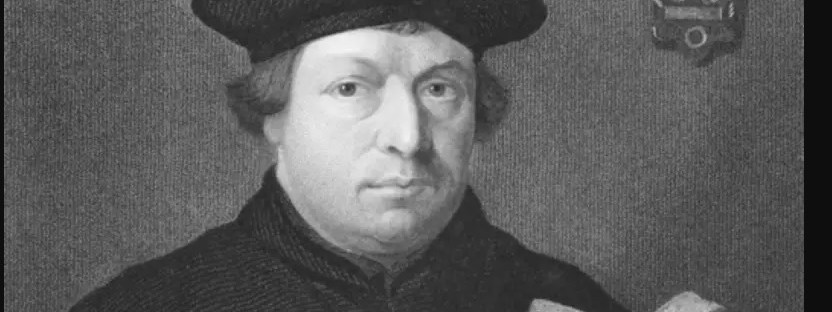
One verse that help shape Reformation:
For in the gospel a righteousness from God is revealed, a righteousness that is by faith from first to last, just as it is written: ‘the righteous shall live by faith. (Romans 1:17)
Luther’s five Solas:
- Sola Scriptura (Scripture alone)
- Sola Fide (Faith alone)
- Sola Gratia (Grace alone)
- Sola Christus or Solo Christo (Christ alone)
- Soli Deo Gloria (Glory to God alone)
On October 31, 1517, Luther posted Ninety-Five Theses to the front door of the Castle Church in Wittenberg, which listed 95 issues he could not reconcile between Roman Catholic doctrine and the Bible. This was a political act as much as it was theological, and it nearly cost him his life. Eventually, Luther stood trial at the Diet of Worms, where he was forced to recant or be excommunicated; which he could not do, and was.
Fearing for his life, Frederick the Wise requested that Luther be taken under his protection at Wartburg Castle. Luther hid there for nearly one year under a false name (Junker Jorg, “the Knight George”) and translated the New Testament into German in just a few months.
The first “Lutheran” New Testament was published in 1522. The complete Bible, containing the Old and New Testaments and Apocrypha, was published in 1534.
New believers called themselves Protestants, marked by their protest of and separation from the Roman Catholic Church and empire. Luther’s protest and what became known as the Protestant Reformation, sparked reformation movements throughout the continent. His courage continues to inspire Protestants 500 years later worldwide.
“Sola Scriptura” means 3 things:
- The Bible is God’s Wordcommunicated to humankind so that they may know and love their Creator. It offers wisdom, hope and guidance for all areas of life.
The Bible is inspired by God, or “God-breathed,” meaning it is God’s Word:
All Scripture is breathed out by God and profitable for teaching, for reproof, for correction, and training in righteousness, that the man of God may be competent, equipped for every good work. (1 Tim. 1:16-17)
- God’s Word is the sole authority over all of life, the only source of truth about life, and clearly communicates how one can know, love, and spend eternity with God. (Rom. 1:16-17). J. I. Packer clarifies:
. . . the Bible is both fully human and fully divine. So all its manifested contents – histories, prophecies, poems, songs, wisdom writings, sermons, statistics, letters, and whatever else, should be received as God’s authoritative instruction.
The Apostle Paul in his letter to Timothy (1 Tim. 5:8) quotes Jesus, identifying the reference of his quote– the Gospel of Luke– (Luke 10:7) as “Scripture.” Likewise, the Apostle Peter referred to Paul’s letters as “Scripture” (2 Pet. 3:15-16), describing Paul’s teachings about Jesus to be Spirit-taught: “This is what we speak, not in words taught us by human wisdom but in words taught by the Spirit, expressing spiritual truths in spiritual words.” (1 Cor. 2:13)
Scripture is not only authoritative, but also trustworthy. The faithful preaching and teaching of the whole counsel of God must be central to all worship. (2 Tim. 4:1-2)
- Anyone can freely read the Bibleand have direct access to God. The Pope is not the sole authority on scripture, or anything else for that matter. The “universal priesthood of believers” (the saints), means that every Christian has direct access to God– to pray to God directly, to receive forgiveness from God directly, and to worship God directly. God’s grace and mercy is free. (1 Pet. 2:5, 9-10)
As such, only the Lord Jesus Christ is the only mediator between God and man. (1 Tim. 2:5) No one need pray to, or pay for, prayer or access to God through a priest or anyone else. Likewise, the only sacraments believers should follow are those instituted by Jesus himself: water baptism (Matt. 28: 19-20) and the Lord’s Supper (1 Cor. 11:23-26).
Righteousness could not be bought, as the Roman Catholic Church advocated on the streets through the sale of indulgences and a piece of paper stamped by the Pope. Instead, after studying the book of Romans, Luther affirmed that he (and no one) could ever attain “the righteousness of God.” It was only by God’s mercy; only through faith in Jesus and his imputed righteousness that anyone could be saved. Salvation was already purchased by the blood of Jesus on the Cross.
After meditating on Romans 1:17, he wrote:
There I began to understand that the righteousness of God is that by which the righteous lives by a gift of God, namely by faith. And this is the meaning: The righteousness of God is revealed by the gospel, namely the passive righteousness with which the merciful God justifies us by faith. … Here I felt that I was altogether born again and had entered paradise itself through open gates.
Justification through faith alone in Jesus, and through God’s grace alone, not through baptism or penance or purchasing indulgences or Hail Mary’s, but through Jesus alone, could anyone be saved. Thus, the first two Solas, Sola fide (Faith alone) and Sola gratia (Grace alone)– became the foundational principle for the identity of believers even today who now have to clarify their faith with the qualifying adjectives: “conservative, evangelical, born again, Bible-believing Protestant followers of Jesus Christ.”
Following Sola Scriptura, Sola Fide, and Sola Gratia, Martin Luther clarified the ultimate distinction between Protestantism and every other belief: salvation was possible through Christ alone: Sola Christus. Truth comes from scripture alone. Faith comes from Christ alone.
At the heart of the matter lies the answer to the question: is saving faith in Jesus Christ enough? Or does one need to contribute something to atone for one’s sins– in addition to Christ’s death on the Cross and resurrection from the grave?
By the early mid-16th century, the Roman Catholic Church had instituted seven sacraments necessary for salvation:
- baptism,
- confirmation, or Chrismation,
- communion (partaking of the Eucharist),
- acts of penance,
- anointing the sick,
- Holy Orders,
- and matrimony.
Martin Luther’s reformation reduced these to two: baptism and communion. His reasoning was based on the centrality of the person and work of Jesus Christ as taught in the Bible.
Martin Luther argued that Christian theology was “the theology of the Cross.” This meant that salvation from eternal death and separation from God was achieved only through faith alone (sola fide), grace alone (sola gratia), and Christa alone, Solus Christus.
Jesus, Martin Luther argued, was enough. There is no need for priests, Roman Catholic saints, or praying to or asking for blessings from Jesus’s mother, Mary. There is no need to ritually perform sacraments to earn salvation (baptism, penance, communion). And there definitely is no need to pay for anyone’s “unpaid-for- sins” who the Roman Catholic Church claims are trapped in the non-biblical “purgatory.” In fact, belief in Jesus in alone brought such relief and joy to Luther that he wrote,
If you have true faith that Christ is your Savior, then at once you have a gracious God, for faith leads you in and opens up God’s heart and will, that you should see pure grace and overflowing love.
The last of Martin Luther’s Five Solas, Soli Deo Gloria, puts into perspective the purpose of life for all Christians: to glorify and enjoy God forever. One’s vocation, or calling and purpose, is to glorify God– no matter their ethnic, religious, cultural, or socio-economic background. No distinctions exist within Christianity; no one Christian is above another.
This was another revolutionary concept Luther introduced– and mind-blowing– coming from an ordained priest and monk– who rallied against one of the Roman Catholic Church’s sacraments, the Holy Orders (becoming a bishop, priest, or deacon). Luther renounced his ordination and later married, arguing there was nothing biblical about the Holy Orders or a requirement of celibacy for ordination.
Neither bishops nor priests had the power to grant absolution, grace, or anything else. Nor could “the clergy” receive more grace or special favor from God than “the laity.” The divisive and non-biblical Roman Catholic doctrine that had categorized everyone other than bishops and priests as “less than” for centuries– was now declared null and void. One’s highest calling, Luther clarified, wasn’t to the church, but to God.
Therefore, whatever Christians do, Luther argued, should always be motivated by their desire to glorify God, citing the Apostle Paul once again:
So whatever you eat or drink or whatever you do, do it all for the glory of God. (1 Cor. 10:31)
Luther also argued that no distinction between secular or sacred vocations could exist. Every job could be done to the glory of God. He wrote:
God is a butler who sets forth a feast for the sparrows and spends on them annually more than the total revenue of the king of France. Christ worked as a carpenter. ‘I can just imagine,’ said Luther from the pulpit, ‘the people of Nazareth at the judgment day. They will come up to the Master and say, ‘Lord, didn’t you build my house? How did you come to this honor?’ The Virgin Mary worked, and the most amazing example of her humility is that after she had received the astonishing news that she was to be the mother of the Redeemer, she did not vaunt herself but went back and milked the cows, scoured the kettles, and swept the house like any other housemaid. Peter worked as a fisherman and was proud of his skill, though not too proud to take a suggestion from the Master when he told him to cast on the other side.
No matter one’s job, whether it be cleaning, care-taking, teaching, participating in athletic or music competitions, solving mathematic equations or building architectural feats, Christians do so primarily to glorify God. Christians can rejoice and give God the glory, no matter their vocation or circumstance– and no matter the outcome.
Stephen J. Nichols points out in The Reformation: How A Monk and a Mallet Changed the World, that,
a German musician would subscribe to this teaching of Luther. So Johann Sebastian Bach would sign his pieces, both pieces commissioned for the church and his so-called secular works, JSB and SDG. JSB stands, of course, for his initials; SDG stands for Soli Deo Gloria. Luther and Bach, both significant figures from the pages of history, remind us that in our seemingly ordinary work and life we are doing something extraordinary.
Because truth was found in scripture alone, and only Jesus could mediate between God and humanity, every Christian can have immediate access to God, personally serve God, and intercede for others:
You also, like living stones, are being built into a spiritual house to be a holy priesthood, offering spiritual sacrifices acceptable to God through Jesus Christ.
But you are a chosen people, a royal priesthood, a holy nation, a people belonging to God, that you may declare the praises of Him who called you out of darkness into His wonderful light. (1 Pet. 2:5, 9)
Let the word of Christ dwell in you richly as you teach and admonish one another with all wisdom, and as you sing psalms, hymns and spiritual songs with gratitude in your hearts to God. And whatever you do, whether in word or deed, do it all in the name of the Lord Jesus, giving thanks to God the Father through Him. (Col. 3:16-17)
No Holy Order is necessary to serve God. And, with the emphasis on this sola, Luther reoriented the concept of the church to the definition of scripture. The body of believers wasn’t defined by what one could get from the church (absolution, forgiveness, mediation), but what one could give to fellow believers. Soli Deo Gloria reemphasized that the importance of one’s time, talent, and treasure– was how it glorified God.
In 1529 German princes officially “protested” against Rome, thus becoming called Protestants. Their acts following Luther’s initial protest is what Protestants worldwide celebrate and remember 500 years later on this Sunday, called Reformation Sunday.
Martin Luther wrote often about the importance of praising God through music and song. He said:
Next to the Word of God, the noble art of music is the greatest treasure in the world. … music deserves the highest praise. The gift of language combined with the gift of song was given to man that he should proclaim the Word of God through Music.
Music is a gift and grace of God, not an invention of men. Thus it drives out the devil and makes people cheerful. Then one forgets all wrath, impurity, and other devices.
Next to theology I give music the highest place of honor. As long as we live there is never enough singing.
Martin Luther wrote hymns and instituted singing– by the congregation– into all services. This was never done in the Roman Catholic Church. In fact, Luther wrote entire hymnals including carols for holidays. His influence on German hymnody was enormous; his repertoire included 37 hymns. United Methodist Hymnal editor Carlton R. Young remarked:
he “wrote several original hymns and melodies, revised many Latin hymns to German texts set to adaptations of plainsong and folk melodies, and encouraged the composition of new texts and rhythmic hymn melodies. His thirty-seven hymns and paraphrase are cast in simple, plain, and sometimes rough phrases and striking metaphors, qualities that are for the most part lost in English translations.”
Luther wrote five Christmas carols, initially for his children. He wrote From Heaven on High for his five-year-old son Hans, which was published a few years later. As part of his family’s Christmas Eve devotions, the children sang in response to a man dressed as an angel. His hymns and carols are a testament to his creative celebration of music.
His most well-known hymn, “Ein’ Feste Burg,” otherwise known as, A Mighty Fortress is Our God, was based on Psalm 46 and Luther’s own experiences. According to the Psalter Hymnal Handbook:
Stanzas 1-3 of the original text were inspired by Psalm 46; stanza 4 arose directly from Luther’s persecution experience. The text expresses trust in God’s protection amidst the battle that Christians wage against the devil. “Earthly powers” in stanza four undoubtedly referred to the Roman Catholic authorities of Luther’s day, but modern Christians may identity other “powers” that oppose the rule of Christ. The closing line of the text provides much comfort: “God’s truth abideth still; his kingdom is forever!”
A Might Fortress is Our God has been considered “the true National Hymn of Germany.” It was sung on the Leipzig battlefield in 1631 during the Thirty Years’ War (1618-1648). The famous nineteenth-century German poet, Heinrich Heine, considered this hymn comparable to France’s national anthem, calling it, “the Marseillaise Hymn of the Reformation.” It’s still referred to as the Battle Hymn of the Reformation:
Imagine no choirs, no carols, no singing in church. No praise and worship bands. No reading hymnals. Martin Luther, and the Protestant Reformation made this possible. The legacy of singing in church is directly credited to Luther and his counterpart reformers in other European countries.


