
The basis and reason.
THE BODY OF HIS HOLY ONE SHALL NOT SEE DECAY
2 Kings 2 v 9-10
When they had crossed, Elijah said to Elisha, “Tell me, what can I do for you before I am taken from you?” “Let me inherit a double portion of your spirit,” Elisha replied. “You have asked a difficult thing,” Elijah said, “yet if you see me when I am taken from you, it will be yours—otherwise, it will not.”
2 Kings 2 v 15
The company of the prophets from Jericho, who were watching, said, “The spirit of Elijah is resting on Elisha.” And they went to meet him and bowed to the ground before him. “
2 Kings 2 v 23-24
From there Elisha went up to Bethel. As he was walking along the road, some boys came out of the town and jeered at him. “Get out of here, baldy!” they said. “Get out of here, baldy!” He turned around, looked at them and called down a curse on them in the name of the Lord. Then two bears came out of the woods and mauled forty-two of the boys.
2 Kings 4 v 27
When she reached the man of God at the mountain, she took hold of his feet. Gehazi came over to push her away, but the man of God said, “Leave her alone! She is in bitter distress, but the Lord has hidden it from me and has not told me why.”
2 Kings 4 v 32-35
When Elisha reached the house, there was the boy lying dead on his couch. He went in, shut the door on the two of them and prayed to the Lord. Then he got on the bed and lay on the boy, mouth to mouth, eyes to eyes, hands to hands. As he stretched himself out on him, the boy’s body grew warm. Elisha turned away and walked back and forth in the room and then got on the bed and stretched out on him once more. The boy sneezed seven times and opened his eyes.
2 Kings 2 v 11-12
As they were walking along and talking together, suddenly a chariot of fire and horses of fire appeared and separated the two of them, and Elijah went up to heaven in a whirlwind. Elisha saw this and cried out, “My father! My father! The chariots and horsemen of Israel!” And Elisha saw him no more. Then he took hold of his garment and tore it in two.
2 Kings 13 v 14
Now Elisha had been suffering from the illness from which he died. Jehoash king of Israel went down to see him and wept over him. “My father! My father!” he cried. “The chariots and horsemen of Israel!”
2 Kings 13 v 21
Once while some Israelites were burying a man, suddenly they saw a band of raiders; so they threw the man’s body into Elisha’s tomb. When the body touched Elisha’s bones, the man came to life and stood up on his feet.
Psalm 16 v 10
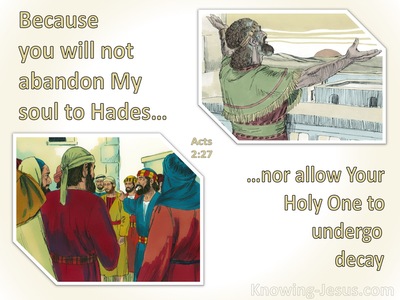
because you will not abandon me to the realm of the dead, nor will you let your faithful one see decay.
David was speaking prophetically of the coming Messiah (Jesus, who was truly God’s “Holy One”), and the manner in which God would raise Jesus from the grave following his crucifixion and burial, without allowing corruption (the normal process of bodily decay) to occur after Jesus’ physical death.
Acts 2 v 17- 21
“‘In the last days, God says, I will pour out my Spirit on all people. Your sons and daughters will prophesy, your young men will see visions, your old men will dream dreams. Even on my servants, both men and women, I will pour out my Spirit in those days, and they will prophesy. I will show wonders in the heavens above and signs on the earth below, blood and fire and billows of smoke. The sun will be turned to darkness and the moon to blood (solar and lunar eclipses) before the coming of the great and glorious day of the Lord. And everyone who calls on the name of the Lord will be saved.’
Acts 2 v 24- 36
But God raised him from the dead, freeing him from the agony of death, because it was impossible for death to keep its hold on him. David said about him: “‘I saw the Lord always before me. Because he is at my right hand, I will not be shaken. Therefore my heart is glad and my tongue rejoices; my body also will rest in hope, because you will not abandon me to the realm of the dead, you will not let your holy one see decay. You have made known to me the paths of life; you will fill me with joy in your presence.’ “Fellow Israelites, I can tell you confidently that the patriarch David died and was buried, and his tomb is here to this day. But he was a prophet and knew that God had promised him on oath that he would place one of his descendants on his throne. Seeing what was to come, he spoke of the resurrection of the Messiah, that he was not abandoned to the realm of the dead, nor did his body see decay. God has raised this Jesus to life, and we are all witnesses of it. Exalted to the right hand of God, he has received from the Father the promised Holy Spirit and has poured out what you now see and hear. For David did not ascend to heaven, and yet he said, “‘The Lord said to my Lord: “Sit at my right hand until I make your enemies a footstool for your feet.”’ “Therefore let all Israel be assured of this: God has made this Jesus, whom you crucified, both Lord and Messiah.”
Bible study Exposition of Psalm 16 v 10
EXPOSITION
Verse 10. Our Lord Jesus was not disappointed in his hope. He declared his Father’s faithfulness in the words, thou wilt not leave my soul in hell, and that faithfulness was proven on the resurrection morning. Among the departed and disembodied Jesus was not left; he had believed in the resurrection, and he received it on the third day, when his body rose in glorious life, according as he had said in joyous confidence, neither wilt thou suffer thine Holy One to see corruption. Into the outer prison of the grave his body might go, but into the inner prison of corruption he could not enter. He who in soul and body was preeminently God’s “Holy One,” was loosed from the pains of death, because it was not possible that he should be holden of it. This is noble encouragement to all the saints; die they must, but rise they shall, and though in their case they shall see corruption, yet they shall rise to everlasting life. Christ’s resurrection is the cause, the earnest, the guarantee, and the emblem of the rising of all his people. Let them, therefore, go to their graves as to their beds, resting their flesh among the clods as they now do upon their couches.
“Since Jesus is mine, I will not fear undressing,
But gladly put off these garments of clay; To die in the Lord is a covenant blessing, Since Jesus to glory through death led the way.”
Wretched will that man be who, when the Philistines of death invade his soul, shall find that, like Saul, he is forsaken of God; but blessed is he who has the Lord at his right hand, for he shall fear no ill, but shall look forward to an eternity of bliss.
EXPLANATORY NOTES AND QUAINT SAYINGS
Verse 10. For thou wilt not leave my soul in hell, etc. The title of this golden text may be – – The embalming of the dead saints: the force whereof is to free the souls from dereliction in the state of death, and to secure the bodies of God’s saints from corruption in the grave. It is the art which I desire to learn, and at this time, teach upon this sad occasion, even the preparing of this confection against our burials. George Hughes, 1642.
A Funeral Sermon.
Verse 10. Many of the elder Reformers held that our Lord in soul actually descended into hell, according to some of them to suffer there as our surety, and according to others to make a public triumph over death and hell. This idea was almost universally, and as we believe, most properly repudiated by the Puritans. To prove this fact, it may be well to quote from Corbet’s witty itinerary of,
“Four clerks of Oxford, doctors two, and two That would be doctors.”
He laments the secularisation of church appurtenances at Banbury, by the Puritans, whom he described as, “They which tell That Christ hath never descended into Hell, But to the grave.”
C.H.S. The quotation is from Richard Corbet’s Poems, 1632.
Verse 10. My soul in hell. Christ in soul descended into hell, when as our surety he submitted himself to bear those hellish sorrows (or equivalent to them), which we were bound by our sins to suffer for ever. His descension is his projection of himself into the sea of God’s wrath conceived for our sins, and his ingression into most unspeakable straits and torments in his soul, which we should else have suffered for ever in hell. This way of Christ’s descending into hell is expressly uttered in the person of David, as the type of Christ. Psalms 86:13 116:3 69:1-3. Thus the prophet Isaiah saith, “His soul was made an offering.” Isaiah 53:10 . And this I take it David means, when he said of Christ, “Thou wilt not leave my soul in hell.” Psalms 16:10 Ac 2:1-47. And thus Christ descended into hell when he was alive, not when he was dead. Thus his soul was in hell when in the garden he did sweat blood, and on the cross when he cried so lamentably, “My God, my God, why hast thou forsaken me?” Matthew 26:38 . Nicholas Byfield’s “Exposition of the Creed,” 1676.
Verse 10. In hell. Sheol here, as hades in the New Testament, signifies the state of the dead, the separate state of souls after death, the invisible world of souls, where Christ’s soul was, though it did not remain there, but on the third day returned to its body again. It seems best of all to interpret this word of the grave as it is rendered; Ge 42:38 Isaiah 38:18 . John Gill.
Verse 10. Thine Holy One. Holiness preserves the soul from dereliction, in the state of death, and the body of the saint from corruption in the grave. If it be desired by any that doubt of it, to see the clear issue of this from the text, I shall guide them to read this text with a great accent upon that term, “Thine Holy One,” that they may take special notice of it, even the quality of that man exempted from these evils. In this the Spirit of God puts an emphasis on holiness, as counter working and prevailing over death and the grave. It is this and nothing but this, that keeps the man, dead and buried, from desertion in death, and corruption in the grave. George Hughes.
Verse 10. The great promise to Christ is, that though he took a corruptible body upon him, yet he should not see corruption, that is, partake of corruption: corruption should have no communion with, much less power over him. Joseph Caryl.
Verse 10. Quoted by the apostle Peter ( Acts 2:27 ); on which Hackett (Com. in loc.) observes: — “The sense then may be expressed thus: Thou wilt not give me up as prey to death; he shall not have power over me, to dissolve the body and cause it to return to dust.”
HINTS FOR PASTORS AND LAYPERSONS
Verse 9-10. Jesus cheered in prospect of death by the safety of his soul and body; our consolation in him as to the same.
Verse 10. Jesus dead, the place of his soul and his body. A difficult but interesting topic.
Verse 10-11. Because he lives we shall live also. The believers, therefore, can also say, Thou wilt show me the path of life. This life means the blessedness reserved in heaven for the people of God after the resurrection. It has three characters. The first regards its source — it flows from his presence. The second regards its plenitude — it is fulness of joy. The third regards its permanency — the pleasures are for evermore. William Jay.


