
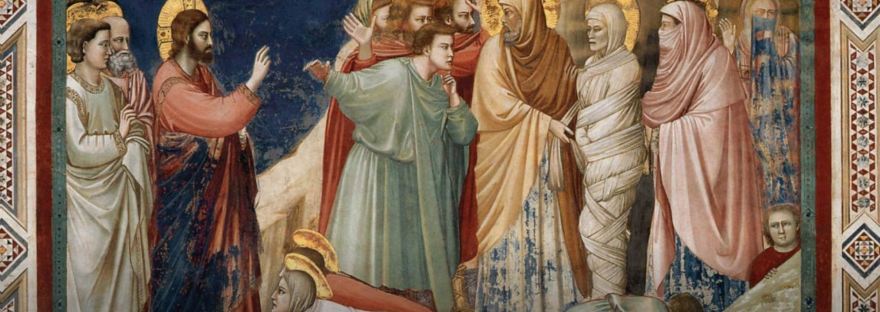
Raising Lazarus from the dead and the resurrection of the body. Some people accept death as a natural part of human life. Others think death to be merely a portal to eternity. Death came into the world through the envy of the devil, not through the plan of God. Death wrenches soul from body. It rips loved ones from the embrace of their families. Jesus’ miracles in the gospels always spring from his compassion for the suffering. But he always has more in mind than helping just the victim lying before him. His miraculous works in John’s gospel are called signs because they point beyond themselves to something even greater he will do to gain a greater benefit for all. His teaching was of course sublime. And his cures were life-changing. But wise and healthy people still face the horror of death. If Jesus were really the saviour, he had to save us from the grave. And the salvation would have to be a permanent one. The raising of Lazarus was only a stay of execution. A few years later, the mourners would have to assemble around his bedside once again. So, in the presence of the great crowd assembled for the funeral, Jesus called Lazarus out of the tomb. This demonstration of Jesus’ power over death was a sign of his own coming resurrection, and of Lazarus’s and ours as well. This is the last recorded miracle or “sign” in John’s gospel. But that was all part of his plan. For he was in total control. He planned to lay his life down willingly, to experience the horrible torture of crucifixion, the bitter wrenching or the sublime unfathomable transition[those who die peacefully in their sleep at old age and sometimes at any age] of body from soul, with the body turning to dust and ashes (though in the case of Jesus; He did not let His Holy One see decay)and the soul moving on, and ultimate separation of friend from friend (in this realm in any case). He was willing to do this because by means of it, he knew he would accomplish more for us than he had for Lazarus–a victory over death that would last forever.
“Christ’s resurrection was not a return to earthly life, as was the case with the raisings from the dead that He had performed before Easter: Jairus’ daughter, the young man of Naim, Lazarus. These actions were miraculous events, but the persons miraculously raised were returned by Jesus’ power to ordinary earthly life. At some particular moment they would die again. “Christ’s resurrection is essentially different. In His risen body He passes from the state of death to another life beyond time and space. At Jesus’ resurrection, His body is filled with the power of the Holy Spirit: He shares the divine life in His glorious state”.
Indications of this transformation are clear in the Gospel accounts. Christ’s resurrected body now has new capabilities: He can appear and reappear suddenly; He can pass through locked doors; He can conceal His identity even from those who know Him well (see Luke 24:13–37; John 20:11–19). Then, at the appointed time of His last appearance, He is able to ascend into heaven in this transformed body (see Luke 24:50–51), bringing about “the irreversible entry of his humanity into divine glory”
Being raised from the dead, like Lazarus, is not the same as resurrection. Lazarus was brought back to his mortal body, and would ultimately die “again”. Resurrection is when our spirit is reunited with an immortal body that will never die again. In the resurrection, we will be resurrected to the glory that we will inherit, or to no glory at all for sons of perdition.
All flesh is not the same flesh: but there is one kind of flesh of men, another flesh of beasts, another of fishes, and another of birds. There are also celestial bodies, and bodies terrestrial: but the glory of the celestial is one, and the glory of the terrestrial is another. There is one glory of the sun, and another glory of the moon, and another glory of the stars: for one star differeth from another star in glory. So also is the resurrection of the dead. It is sown in corruption; it is raised in incorruption: (1 Cor. 15:39-42). Christ was the first to be resurrected on this earth: (Acts 26: 23; Col. 1: 18; Rev. 1: 5).
When it comes to the Christian faith, one of the most important doctrines is the resurrection of the dead/the resurrection of Jesus. Biblical faith is not simply centred in ethical and religious teachings. Instead, it is founded on the person and work of Jesus. From a soteriological perspective, if Jesus was not raised from the dead, we as His followers are still dead in our sins (1Cor.15:7). Jesus said in John 11:25, “I am the resurrection and the life; he who believes in me shall live even if he dies.” Jesus could not have made full atonement for our sins without the resurrection. Also, through the resurrection, Jesus took on the role as advocate and intercessor (1 John. 2:2O; Rom. 8:34). His resurrection also guaranteed us the opportunity of having a resurrected body’s like His (1 Cor.15:20-23, 51-53; 1 Pet.1:3; Phil. 3:20-21; John. 5:25-29).
The Jewish people knew the God of Israel as the only one who could raise the dead (Job 19:26; Ps. 17:15; 49:15; 73:24; Is. 26:19; 53:10; Dn. 12:2;12:13).Therefore, by claiming the authority to raise the dead, Jesus was exemplifying both the same actions and attributes of the God Israel. The resurrection also marked Jesus as the one who will be the judge all men (Acts 17:31).
The Difference between Resuscitation and Resurrection
The Greek word for resurrection is “anatasis” which means “a raising up” or “rising.” The key is to differentiate between a resuscitation and a resurrection. There are resuscitations in the Tanakh (the Old Testament) such as the example of Elijah and Elisha raising a person from death (1 Kings 17-23; 2 Kings 4:34-35).
Likewise, there are three resuscitations in the Gospels (Lk. 8:49-56; Jn. 11:38-44; Lk. 7:11-15). So if look at the life of Lazarus it seems like he was resurrected. He was “raised up.” However, Lazarus went on to live on in his old mode and still had to face a ‘second’ death. Hence, Lazarus and these other accounts are similar to the raising of the dead as already mentioned in the examples of Elijah and Elisha raising a person from death (1 Kings 17-23; 2 Kings 4:34-35).
The Bible gives several specific examples of people who were resuscitated (Acts 20:9-11), or re-animated, back to life. Each of these people who were brought back to life had to die again. This is not the same as the biblical hope of resurrection. When believers are raised from the dead, they will receive a new, glorified body. This body will never perish. The use of the word “resuscitate.” If one were in fact dead, then resuscitation would not be possible. For example, a fire cannot be revived if there are no sparks (seen or unseen). So also, a person cannot be resuscitated (medically)if there is no life (soul) present with reference to the semantically correct modern usage of the terms.
However, in itself, resuscitation does not imply that the person must still have some spark of life. Resuscitation comes from “re” (again) + “suscitater” (to rouse, awaken). [this seems particularly fitting for Lazarus, since Christ himself says that he is going to awaken him]. Resurrection is from the Latin “re” + “surgere” (rise, life). It is worth noting that, in French, the word “ressusciter” is used to mean “to resurrect”. Etymologically, there is little difference in meaning between “resurrection” and “resuscitation”, the use of the two words is an easy way of indicating that Lazarus had not yet experienced the resurrection to glory. In any case, we can be sure of this: Lazarus was dead, his soul had left his body; but Christ called him back to (natural) life. Christ’s resurrection is essentially different. In His risen body He passed from the state of death of the physical body (without His physical body undergoing decay) to another spiritual body of life beyond time and space. From one realm, physical realm govern by laws of nature, to the spiritual realm, a realm not bounded or limited by time and space.
References
(https://www.crossroadsinitiative.com/media/articles/raising-of-lazarus/)
(https://www.stcatherinercc.org/single-post/2018/04/04/Was-Jesus-Resurrection-the-Same-as-Lazarus)
(https://thirdhour.org/forums/topic/30715-resurrection-versus-raised-from-the-dead/)
(https://newtheologicalmovement.blogspot.com/2011/04/lazarus-resuscitation-compared-to-jesus.html)


