
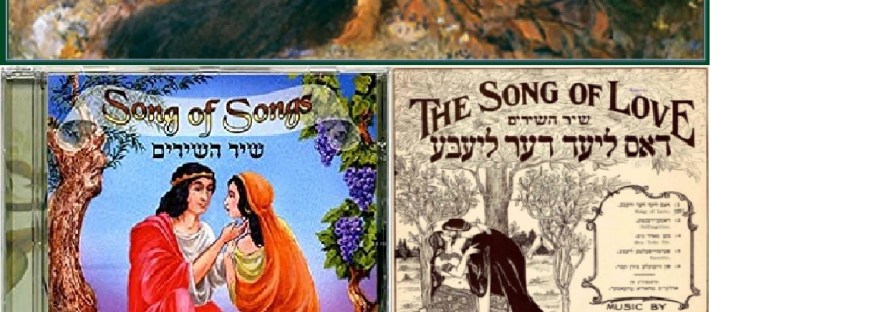
Some critics of King Solomon accused him of being a misogynist because he objectifies women, and he collects women [Solomon, third king of Israel (reigned c. 968–928 B.C.E.), is said to have had a harem that included 700 wives and 300 concubines (1 Kgs 11:3). His wives were to have included the daughter of Pharaoh, as well as women of Moabite, Edomite, Sidonian, and Hittite origins (1 Kgs 7:8; 11:1).]. However, this king with around one thousand wives/concubines was the same person under the influence of the Holy Spirit, who penned one of the most romantic prose, poetry ever written about the love of a man for a woman. Obviously, the criticism of misogyny was unfounded, otherwise, how could a misogynist (contempt for, or ingrained prejudice against women) know so much about love for a woman.
It is written in a very poetic manner, and on the face of it, it is a love poem clearly showing the love, anticipation of, and of the great admiration for, the woman through whose eyes the male object of her affection is perceived. The note in the Catholic RSV version of the Bible tells us that there are three main interpretations of this book: first, a purely allegorical interpretation, where, for the Jews, it stood for God’s love of the Chosen People; for the Church Fathers, it was an allegory showing the loving relationship between Christ and his Church. Secondly, it is seen as an allegory of the love between an unnamed bride and groom, intended to extol married love in the sight of God. Lastly, some, taking the literal sense of the second interpretation—that of married love—say that it is a type of the union between Christ and his Church. This poetry about romance, called Song of Songs is Hebrew love poetry that depicts the beauty and mystery of sexual love within the context of marriage, one of God’s gifts to humanity. The Song of Solomon is also called “The Song of Songs,” suggesting that it is the greatest of all songs. In chapter 8, they reveal that they are fiercely in love with one another, and that love is revealed as a representation of God’s fierce and jealous love for people. In other words, a metaphoric expression for Jesus Christ and His bride, the church.
The ekklēsia is never explicitly called “the bride of Christ” in the New Testament. That is approached in Ephesians 5:22–33. A major analogy is that of the body. Just as husband and wife are to be “one flesh”, this analogy for the writer describes the relationship of Christ and ekklēsia.
Ephesians 5:22-33; Wives, submit yourselves to your own husbands as you do to the Lord. For the husband is the head of the wife as Christ is the head of the church, his body, of which he is the Saviour. Now as the church submits to Christ, so also wives should submit to their husbands in everything. Husbands, love your wives, just as Christ loved the church and gave himself up for her to make her holy, cleansing her by the washing with water through the word, and to present her to himself as a radiant church, without stain or wrinkle or any other blemish, but holy and blameless. In this same way, husbands ought to love their wives as their own bodies. He who loves his wife loves himself. After all, no one ever hated their own body, but they feed and care for their body, just as Christ does the church— for we are members of his body. “For this reason, a man will leave his father and mother and be united to his wife, and the two will become one flesh.” This is a profound mystery—but I am talking about Christ and the church. However, each one of you also must love his wife as he loves himself, and the wife must respect her husband.
God gave everything, His life for His bride, the church. What an expression of perfect, fierce, and jealous love, that is the Love of God, that is in Christ Jesus. In spite of our imperfections and shortcomings, God love us so much. Thank you, Father, for loving me, for saving me, and for counting me worthy of your priceless gift of redemption. You are indeed wonderful Yeshua.


