
Passover, Hebrew Pesaḥ or Pesach, in Judaism, holiday commemorating the Hebrews’ liberation from slavery in Egypt and the “passing over” of the forces of destruction, or the sparing of the firstborn of the Israelites, when the Lord “smote the land of Egypt” on the eve of the Exodus. Passover begins with the 15th and ends with the 21st (or, outside of Israel and among Reform Jews, the 22nd) day of the month of Nisan (March or April). On these seven (or eight) days, all leaven, whether in bread or other mixture, is prohibited, and only unleavened bread, called matzo, may be eaten. The matzo symbolizes both the Hebrews’ suffering while in bondage and the haste with which they left Egypt in the course of the Exodus. Passover is also sometimes called the Festival of Unleavened Bread. The word Pesach or Passover can also refer to the Korban Pesach, the paschal lamb that was offered when the Temple in Jerusalem stood; to the Passover Seder, the ritual meal on Passover night; or to the Feast of Unleavened Bread. One of the biblically ordained Three Pilgrimage Festivals, Passover is traditionally celebrated in the Land of Israel for seven days.
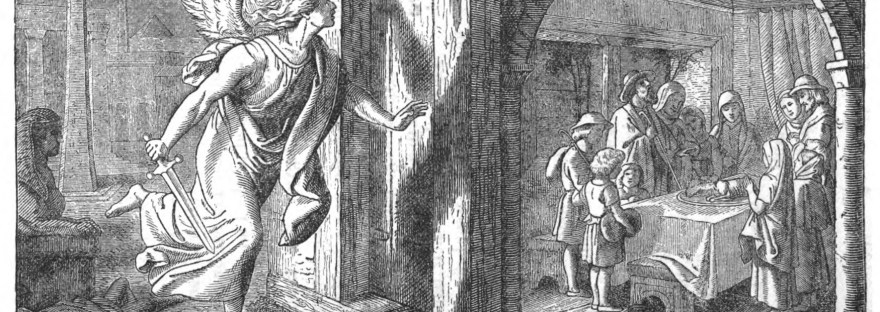
According to the Book of Exodus, God commands Moses to tell the Israelites to mark a lamb’s blood above their doors in order that the Angel of Death will pass over them (i.e., that they will not be touched by the tenth plague, death of the firstborn). After the death of the firstborn Pharaoh, the Israelites were ordered to leave, taking whatever, they want, and Moses was asked to bless him in the name of the Lord. The passage goes on to state that the Passover sacrifice recalls the time when God “passed over the houses of the Israelites in Egypt”. This story is recounted at the Passover meal in the form of the Haggadah, in fulfilment of the command “And thou shalt tell (Higgadata) thy son in that day, saying: It is because of that which the LORD did for me when I came forth out of Egypt. The term Pesach (Hebrew: פֶּסַח, Pesaḥ) may also refer to the lamb or goat which was designated as the Passover sacrifice (called the Korban Pesach in Hebrew). Four days before the Exodus, the Hebrews were commanded to set aside a lamb, and inspect it daily for blemishes. During the day on the 14th of Nisan, they were to slaughter the animal and use its blood to mark their lintels and door posts. Before midnight on the 15th of Nisan they were to consume the lamb. The biblical requirements of slaying the Paschal lamb in the individual homes of the Hebrews and smearing the blood of the lamb on their doorways were celebrated in Egypt. However, once Israel was in the wilderness and the tabernacle was in operation, a change was made in those two original requirements. Passover lambs were to be sacrificed at the door of the tabernacle and no longer in the homes of the Jews. No longer, therefore, could blood be smeared on doorways.
The Passover begins on the 15th day of the month of Nisan, which typically falls in March or April of the Gregorian calendar. The 15th day begins in the evening, after the 14th day, and the seder meal is eaten that evening. Passover is a spring festival, so the 15th day of Nisan typically begins on the night of a full moon after the northern vernal equinox. However, due to leap months falling after the vernal equinox, Passover sometimes starts on the second full moon after vernal equinox, as in 2016. To ensure that Passover did not start before spring, the tradition in ancient Israel held that the lunar new year, the first day of Nisan, would not start until the barley was ripe, being the test for the onset of spring. If the barley was not ripe, or various other phenomena indicated that spring was not yet imminent, an intercalary month (Adar II) would be added. However, since at least the 4th century, the intercalation has been fixed mathematically according to the Metonic cycle.
In Christianity, the celebration of Easter (not to be confused with the pre-Christian Saxon festival from which it derives its English name) and its date in the calendar finds its roots in the Jewish feast of Passover, when, according to Christian interpretation, Jesus was crucified as the Passover Lamb. The coincidence of Jesus’ crucifixion with the Jewish Passover led some early Christians to make a false etymological association between Hebrew Pesach and Greek pascho (“suffer”).
The focus of this piece has to do with the central event of Pesach. In the Hebrew Bible, the destroying angel (Hebrew: מַלְאָך הַמַשְׁחִית, malʾāḵ hamašḥīṯ), also known as mashḥit (מַשְׁחִית mašḥīṯ, ‘destroyer’; plural: מַשְׁחִיתִים, mašḥīṯīm, ‘spoilers, ravagers’), is an entity sent out by YHWH on several occasions to kill the enemies of the Hebrews. These angels (mal’akh) are also variously referred to as memitim (מְמִיתִים, ‘executioners, slayers’), or Angel of the Lord. The latter is found in Job 33:22, as well as in Proverbs 16:14 in the plural, “messengers of death”. Mashchith was also used as an alternate name for one of the seven compartments of Gehenna. In 2 Samuel 24:15-16, the destroying angel kills the inhabitants of Jerusalem. In I Chronicles 21:15, the same “Angel of the Lord” is seen by David to stand “between the earth and the heaven, with a drawn sword in his hand stretched out against Hebrews’s enemies”. Later, in II Kings 19:35, the angel kills 185,000 Assyrian soldiers. In the Book of Enoch, angels of punishment and destruction belong to a group of angels called satans with Satan as their leader. First, they tempt, then accuse and finally punish and torment, both wicked humans and fallen angels. In Judaism, such angels might be seen as created by one’s sins. As long as a person lives, God allows him to repent. However, after death, the angels of destruction are allowed to execute the sentence proclaimed in the heavenly court. There are two possible scenarios regarding the use of sacrificial lamb’s blood during Pesach: first scenario; as Global Positional System markers for the Mashhit, who would have otherwise been lost, whose task is difficult enough even when at the right address, still has to identify the first born in a family. Second scenario; symbolic and metaphoric dry run or test run with regards to the redemption of mankind from sin (death is the wages of sin), through the sacrifice of an unblemished lamb (Lamb of God: Jesus Christ, the First Born, Son of Man, Emmanuel), that occurred some millennia later on the same anniversary as that occurred in Egypt. Neither scenario is mutually exclusive or inclusive of the other. When the reader considers the God that created the Universe with stars and celestial objects with fixed positional locations to the smallest nanometre, it is inconceivable that this God that knows everything and sees everything, would have non-human messengers that requires bloody markings to identify their kill-zones. In any case, the Ascension day is forty days after the Passover (the first Passover Sabbath), that is 26th of May 2022, while Pentecost day is fifty days after Passover, that is 5th of June 2022. Passover, Ascension day, and Pentecost day anniversaries are all derived from the Jewish Calendar and its Pesach.


