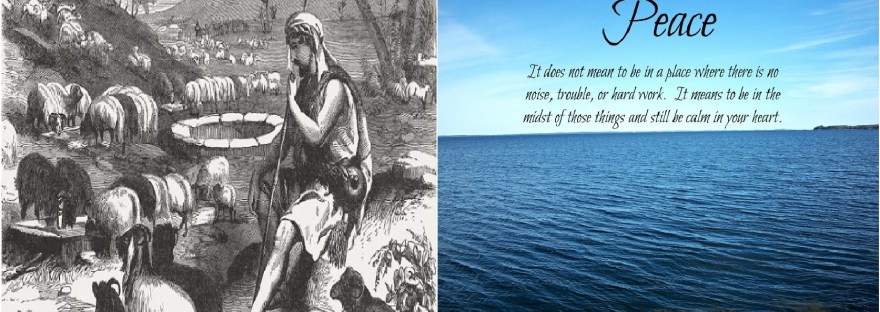
Peace that comes from within

Jacob lived in the land where his father had stayed, the land of Canaan. — Genesis 37:1

Each week in synagogue, Jews read through the Torah from Genesis to Deuteronomy. The Torah portion for this week is Vayeshev, which means “and he lived,” from Genesis 37:1—40:23.

Have you ever noticed that while some people seem to have an easy life, they are in constant tumult on the inside? And then other people have their share of problems, yet they are completely calm? While most people assume that inner peace is a result of a tranquil outer environment, from what I have noticed, that is clearly not the case!

In this week’s Torah portion, we learn that Jacob returned to his homeland in Canaan and settled there. According to Jewish tradition, after decades of difficulties, Jacob prayed to finally have some peace in this next chapter of his life. However, as soon as he asked God for tranquillity, the rift between his beloved son Joseph and his brothers began. Ultimately, the sibling rivalry resulted in Jacob’s sons selling Joseph and telling Jacob that Joseph had been killed.

Instead of the peace that Jacob asked for, he was faced with the most turbulent decades of his life!

It seems like God did not answer Jacob’s prayers, but the Jewish sages explained that when God caused more tumult and difficulty in Jacob’s life, He wasn’t denying Jacob’s request; He was granting it.

Peace in Any Situation

Sure, God could have granted Jacob’s request for peace with the absence of any turmoil. But that would be a conditional peace — one that could be broken at any moment. God wished to give His beloved servant an even greater tranquillity, one that was deeper and more stable.

God wanted Jacob to learn that peace comes from within, not from conditions outside. Once Jacob went through the worst of everything, he could learn to weather anything. God provided him with a way to access peace in any situation of his life.

In the Book of Isaiah we read, “You will keep in perfect peace those whose minds are steadfast, because they trust in you” (26:3). Peace is not a result of our outer conditions, but a result of our inner state. When we learn to trust God in any situation, we will earn an everlasting peace that will accompany us through any circumstance.

Inner peace can be unconditional only when we unconditionally trust in God.
Reference: https://www.ifcj.org/learn/holy-land-moments/daily-devotionals/peace-that-comes-from-within/?s_src=EM1BN1&s_subsrc=ERX2000XXEXXX&utm_medium=email&utm_source=dailydevotional&utm_campaign=HLM-DD&utm_content=EM1BN1&emid=999910&sk=5cac6ab8-c485-4764-9468-2f2cbe935ec1

Nigeria and the majority of the modern day World’s similarity with first century Palestine

The modern day world is almost literally the same as the first century Palestine, in societal structure and inter and intrapersonal relationships dynamics of the ruling class and the ruled. Horsley (1993:21) calls this total domination a ‘politics of violence’ or, more precisely, ‘institutional’ or ‘structural’ violence: the illegitimate or unauthorised use of power against the will or desire of others. Also, as the illegitimate use of power, violence can be physical, psychological, or spiritual, applied directly or indirectly, in an overt or covert manner. Following these distinctions, Horsley argues that first-century Palestine was in a situation of institutional or structural violence: people were dominated and pacified with extensive and widespread violence applied largely in indirect ways (e.g. indirect rule and taxation), both covertly and overtly. In short: Roman rule was institutional or structural violence (Horsley 1993:21).

Violence perpetrated by the Roman [modern day United States and the West] aristocracy [political ruling class] consisted of taking land by force, adhering to a legal system that was biased towards the elite, clamping down on any resistance with excessive force (direct and overt), controlling both land and sea (its yield and the bodies that worked the land and sea by means of taxation), cheap labour and census (direct and covert), maintaining patron-client relationships to enhance honour and status, displaying wealth and power and building dependency (indirect and overt) and controlling various forms of communication (political propaganda) in the form of coins [American dollar], buildings and temples (indirect and covert).

This imperial ideology was based on claiming the favour of the gods. Rome proclaimed that it was chosen by the gods (especially Jupiter) to manifest their rule, will and blessings, to show their presence and favour throughout the world and to rule an ‘empire without end’. As such, Rome claimed sovereignty over sea and land and all its inhabitants. This ideology, logically, included the ‘right’ to domination and power and a belief in Rome’s superiority. Jesus’ stance on this structural violence can be deducted from the Gospel of Thomas 65.38 In this parable Jesus, first of all, challenges indirect violence, that is, the first-century values of wealth and status. The owner, in using his status and power, does not succeed in getting his vineyard back. All ‘self-evident’ or ‘ordinary/normal’ expediencies such as the connection between status and social power, the privileges of ownership and the normalcy of status displays are unsuccessful and ineffective. Put differently, the ‘normal’ elite values of status, honour and power (as indirect overt violence) are questioned by Jesus (Kloppenborg 2006:352).

In the parable, Jesus also criticises the use of direct physical violence. In the Gospel of Thomas 65, the tenants’ resort to physical violence (with its climax in the killing of the owner’s son) reaps no gains. Their violence leads to nothing and in the end the owner is the one who has honour not because he tries to protect his honour by means of status and power, but because he does nothing after his son is killed. Lintott (1968:30) has indicated that in the Roman Empire possession normally was a function ‘of the ability to take, hold, and exploit land. Possession involved force’. The possession of land by using force was seen by the aristocracy as a right. Moreover, ‘possessions which were originally acquired by force will therefore in the end have to be defended by force’ (Lintott 1968:30). In the Gospel of Thomas, the owner refrains from using violence to regain his possession. In other words, honour is gained by acting in precisely the opposite way to that which was regarded as ‘normal’. Status and honour are not retained or gained by using violence; the honourable person is the one who refrains from using violence.

The issue of building an assembly hall for God

Acts 7:48

The issue of building an assembly hall or cathedral for God is explained, not only in Acts 17:24-25; “The God who made the world and everything in it is the Lord of heaven and earth and does not live in temples built by human hands. And he is not served by human hands, as if he needed anything. Rather, he himself gives everyone life and breath and everything else. But this has also previously been stated by the Holy Spirit through prophet Isaiah in Isaiah 66:1-2; This is what the Lord says: “Heaven is my throne, and the earth is my footstool. Where is the house you will build for me? Where will my resting place be? Has not my hand made all these things, and so they came into being?” declares the Lord. “These are the ones I look on with favour: those who are humble and contrite in spirit, and who tremble at my word.

Furthermore, in 2 Samuel 7:5-7; “Go and tell my servant David, ‘This is what the Lord says: Are you the one to build me a house to dwell in? I have not dwelt in a house from the day I brought the Israelites up out of Egypt to this day. I have been moving from place to place with a tent as my dwelling. Wherever I have moved with all the Israelites, did I ever say to any of their rulers whom I commanded to shepherd my people Israel, “Why have you not built me a house of cedar?”’ Subsequently the House that was built for God’s Name was explained in 2 Samuel 7:12-13; When your days are over and you rest with your ancestors, I will raise up your offspring to succeed you, your own flesh and blood, and I will establish his kingdom. He is the one who will build a house for my Name, and I will establish the throne of his kingdom forever. The House [Solomon’s Temple, the Second Temple and Herod’s refurbished and rededicated Temple]that was built and destroyed was not for God to dwell in, or to reside in, or to contain God, but for His Name.

Can a God be made or born?

One of the major criticisms levelled by Islamic scholars against Christianity is that God does not have a child ‘obviously this means literally’. And that the True God of an Abrahamic religion is not made [Anointed]. And that Jesus Christ was a prophet, just as Mohammed was a prophet.

The fact that a person or group of persons’ opinion is different from another person’s or groups’ opinion or beliefs system, does not necessarily invalid one group’s over another’s belief system. Seek knowledge about your belief system.

John 12:41; Isaiah said this because he saw Jesus’ glory and spoke about him.

Isaiah 6:1-3; In the year that King Uzziah died, I saw the Lord, high and exalted, seated on a throne; and the train of his robe filled the temple. Above him were seraphim, each with six wings: With two wings they covered their faces, with two they covered their feet, and with two they were flying. And they were calling to one another: “Holy, holy, holy is the Lord Almighty; the whole earth is full of his glory.”

The gospel account of John with regards to the commissioning of prophet Isaiah, indicates that Jesus Christ is the Lord Almighty. Bearing this in mind, this begs the question, can a God be made or born? This immediately raises additional questions, such as; Can a God be anointed? And can a God die?

Was Jesus Christ born of a man and a woman? Does a God have a father? Does a God have a son? Are the answers to these questions, when stated in the Bible, literal or metaphoric? Find out the answers for yourself in the book written by God Himself through some scribes chosen by Him, called the Bible.

Tolerance, Patience and Submission to God’s Will

Tolerance is a divine nature of God which he also expects all his covenanted children to imbibe and manifest in their daily living. Tolerance is a grace; it is a gift of the Holy Spirit that everybody should desire. Tolerance makes a person to pursue peace with all men at all costs. It makes a person to be gentle and kind at all times. The seed of tolerance enables a person to do good and be longsuffering.

A tolerant person gives allowance for the shortcomings and weaknesses of others. He/she has a compassionate heart and sincerely appreciates people rather than criticize or condemn them. A tolerant being is not self-centred; he willingly recognizes and respects the feelings, values, and dispositions of others. While intolerance is a deliberate and absolute disregard for the feelings, values, and disposition of others.

It is tolerance that strengthens patience which builds up the fibres of submission to God’s will in people. These three corded string unrolls out of the heart on the springtide of love towards others, and this is the reason Apostle Paul prayed in Col 1:9-11, that God should fill us with the knowledge of his will through all the wisdom and understanding that the Spirit gives, so that we can live a life worthy of the Lord and please him in every way: bearing fruit in every good work, growing in the knowledge of God, being strengthened with all power according to his glorious might so that we may have great endurance and patience, which in turn reveals itself through demonstration of genuine love.

The virtues of tolerance, patience, and submission to God’s will [the most taxing or demanding of all virtues- Mark 14:35-36; Going a little farther, he fell to the ground and prayed that if possible the hour might pass from him. “Abba, Father,” he said, “everything is possible for you. Take this cup from me. Yet not what I will, but what you will.”]enables us to grow spiritually. Verse eight of second Peter Chapter One, spanning through nine tells us that, ‘The more you grow like this, the more you will become productive and useful in your knowledge of our Lord Jesus Christ.’ But those who fail to develop these virtues are blind or at least, very shortsighted. They have already forgotten that God has cleansed them from their old life of sin. The Holy Spirit declared through John in 1 John 2:17; The world and its desires pass away, but whoever does the will of God lives forever.

Remain blessed in Jesus’ name.

tflame