History of Dispensationalism

The concept of the arranging of divisions of Biblical history dates back to Irenaeus during the second century. Other Christian writers since then have offered their own arrangements of history, such as Augustine of Hippo and Joachim of Fiore (1135–1202). Many Protestant and Calvinist writers also developed theological schemes and divisions of history, in particular after the Westminster Confession of Faith noted “various dispensations”.

Dispensationalism developed as a system from the teachings of John Nelson Darby, considered by some to be the father of dispensationalism (1800–82), who strongly influenced the Plymouth Brethren of the 1830s in Ireland and England. The original concept came when Darby considered the implications of Isaiah 32 for Israel. He saw that prophecy required a future fulfilment and realization of Israel’s kingdom. The New Testament church was seen as a separate program not related to that kingdom. Thus arose a prophetic earthly kingdom program for Israel and a separate “mystery” heavenly program for the church. In order to not conflate the two programs, the prophetic program had to be put on hold to allow for the church to come into existence. Then it is necessary for the church to be raptured away before prophecy can resume its earthly program for Israel.

In Darby’s conception of dispensations, the Mosaic dispensation continues as a divine administration over earth up until the return of Christ. The church, being a heavenly designated assembly, does not have its own dispensation as per Scofield. Darby conceives of dispensations relating exclusively to the divine government of the earth and thus the church is not associated with any dispensations. While his Brethren ecclesiology failed to catch on in America, his eschatological doctrine became widely popular in the United States, especially among Baptists and Old School Presbyterians. American dispensationalism crossed over many denominational boundaries.

Regarding any supposed connection to Edward Irving:

While Irving and the Albury group had a few eschatological ideas that were unique, a belief in the pre-tribulation rapture was not one of them. It is impossible for one to follow the historicist approach and also believe the rapture will occur before the tribulation, since historicists believe that the tribulation began hundreds of years ago and runs the course of most of the current church age. It is also true that Irvingites spoke of a soon coming of Christ to translate believers to heaven, but this view was part of their second coming belief that they could have derived from Manuel Lacunza’s writings, which were not the product of futurism at that point. […] On the other hand, Darby most likely thought of and then developed the idea of pre-tribulationism in the process of shifting to futurism. Paul Wilkinson notes that “Darby found an exegetical basis in Scripture for his doctrine of a pretribulation Rapture. As a careful student of the Bible, Darby had no need to appeal to an oracle for his doctrines. The unfounded and scurrilous accusations of MacPherson and his sympathizers contravene the whole ethos of John Nelson Darby, a man of integrity to whom the Word of God was paramount.”

United States

Dispensationalism was adopted, modified, and made popular in the United States by the Scofield Reference Bible. It was introduced to North America by James Inglis (1813–72) through the monthly magazine Waymarks in the Wilderness, published intermittently between 1854 and 1872. During 1866, Inglis organized the Believers’ Meeting for Bible Study, which introduced dispensationalist ideas to a small but influential circle of American evangelicals. They were disturbed by the inroads of religious liberalism and saw premillennialism as an answer. Dispensationalism was introduced as a premillennial position, and it largely took over the fundamentalist movement, over a period of several decades. The American church denominations rejected Darby’s ecclesiology but accepted his eschatology. Many of these churches were Presbyterian and Baptist, and they retained Darby’s Calvinistic soteriology.

After Inglis’ death, James H. Brookes (1830–98), the pastor of Walnut Street Presbyterian Church in St. Louis, organized the Niagara Bible Conference (1876–97) to continue the dissemination of dispensationalist ideas. Dispensationalism was boosted after Dwight L. Moody (1837–1899) learned of dispensational theology from an unidentified member of the Brethren during 1872. Moody worked with Brookes and other dispensationalists and encouraged the spread of dispensationalism. The efforts of C.I. Scofield and his associates introduced dispensationalism to a wider audience in America by his Scofield Reference Bible. The publication of the Scofield Reference Bible during 1909 by the Oxford University Press for the first time displayed overtly dispensationalist notes on the pages of the Biblical text. The Scofield Bible became a popular Bible used by independent Evangelicals in the United States. Evangelist and Bible teacher Lewis Sperry Chafer (1871–1952) was influenced by Scofield; he founded the Dallas Theological Seminary during 1924, which has become the main institution of dispensationalism in America. The Baptist Bible Seminary in Clarks Summit, Pennsylvania became another dispensational school. Grace School of Theology opened in Houston, TX in 2003 as a dispensational school. Founded by graduates of Dallas Theological Seminary, it holds “that the Bible must be interpreted as language is normally used, recognizing the importance of dispensational distinctions.”

Other prominent dispensationalists include Reuben Archer Torrey (1856–1928), James M. Gray (1851–1925), William J. Erdman (1833–1923), A. C. Dixon (1854–1925), A. J. Gordon (1836–95), and William Eugene Blackstone, author of the book Jesus is Coming (endorsed by Torrey and Erdman). These men were active evangelists who promoted a host of Bible conferences and other missionary and evangelistic efforts. They also gave the dispensationalist philosophy institutional permanence by assuming leadership of new independent Bible institutes, such as the Moody Bible Institute during 1886, the Bible Institute of Los Angeles (now Biola University) during 1908, and Philadelphia College of Bible (now Cairn University, formerly Philadelphia Biblical University) during 1913. The network of related institutes that soon developed became the nucleus for the spread of American dispensationalism.

Dispensationalism has become very popular with American evangelicalism, especially among nondenominational Bible churches, Baptists, Pentecostal, and Charismatic groups. Conversely, Protestant denominations that embrace covenant theology as a whole tend to reject dispensationalism. For example, the General Assembly of the Presbyterian Church (U.S.) (which subsequently merged with the United Presbyterian Church in the U.S.A. (PCUSA), in which dispensationalism existed) termed it “evil and subversive” and regarded it as a heresy. The Churches of Christ underwent division during the 1930s as Robert Henry Boll (who taught a variant of the dispensational philosophy) and Foy E. Wallace (representing the amillennial opinion) disputed severely over eschatology.

Dispensationalism rejects the notion of supersessionism, still considers the Jewish people as God’s chosen people, and some see the modern State of Israel as resulting in the Israel who will receive the fulfilment of all of God’s Old Testament promises. John Nelson Darby taught, and most subsequent dispensationalists have maintained, that God considers the Jews as his earthly chosen people, even as they remain in rejection of Jesus Christ, and God continues to maintain an earthly destiny in the future millennial Kingdom when the Lord Jesus Christ returns to earth and establishes it in fulfilment of prophecy in the prophetic scheme. Dispensationalists teach that a remnant within the nation of Israel will be born again, called of God, and by grace brought to realize that they crucified their Messiah. Dispensationalism is unique in teaching that the Church stands in a dispensation that occurs as a parenthesis in the prophetic Kingdom program, a dispensational “mystery” or “grace” period, meaning that it was not directly revealed in prophecy in the Old Testament, and that this “age of grace” will end with the rapture of the church allowing the prophetic clock for Israel to start up again. Then the Jewish remnant becomes manifest through the Great Tribulation as a result of recognizing Jesus as their promised Messiah during the trials that come upon them in this Tribulation which serves to purify the nation. Darby’s teachings envision Judaism as continuing to enjoy God’s protection literally to the end of time, and teach that God has a separate earthly and prophetic Kingdom “program,” to use J. Dwight Pentecost’s term, for Israel and another heavenly (destined) Mystery program for the Church. Dispensationalists teach that God has eternal covenants with Israel which cannot be violated and must be honoured and fulfilled.

Dispensationalists affirm the necessity for Jews to receive Jesus as Messiah, while also stressing that God has not forsaken those who are physically descended from Abraham through Isaac. They claim that God made unconditional covenants with Israel as a people and nation in the Abrahamic, Palestinian, Davidic, and New Covenant.

United States politics

Israel has allied with U.S. evangelicals and dispensationalists to influence U.S. foreign policy, including protection of the Jewish people in Israel and continued aid for the state of Israel. Israel’s alliance with televangelist John Hagee began in the early 1980s as he met with every Prime Minister of Israel since Menachem Begin. Since the mid-2000s Israel has been in commercial alliance with televangelist and sometimes-politician Pat Robertson, and in 2005 Prime Minister Benjamin Netanyahu said that “we have no greater friend in the whole world than Pat Robertson.”

Political commentator Kevin Phillips claimed in American Theocracy (2006) that dispensationalist and other fundamentalist Christians, together with the oil lobby, provided political assistance for the invasion of Iraq during 2003. Dispensationalists typically endorse the modern state of Israel, consider its existence as a political entity as God revealing his will for the Last Days, and reject anti-Semitism.

Messianic Judaism

Some Messianic Jews reject dispensationalism in favour of related but distinct hermeneutics called Olive Tree Theology. The name refers to the passages of Romans 11:17–18: “If some of the branches were broken off, and you, a wild olive, were grafted in among them and have become equal sharers in the rich root of the olive tree, then don’t boast as if you were better than the branches!”
Dispensation of Law and Dispensation of Grace

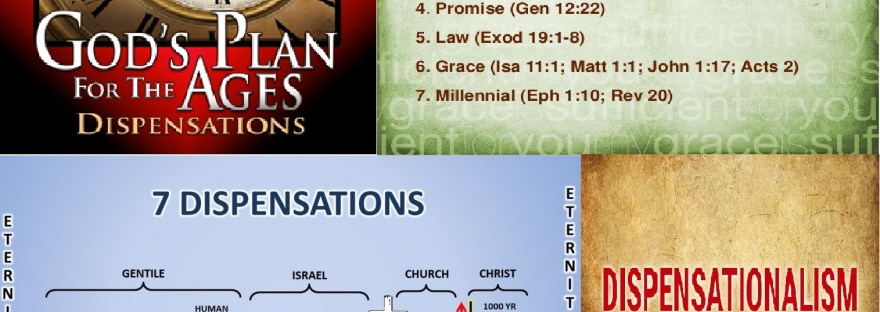
The seven dispensations – What are they?

The seven dispensations are part of a system of biblical interpretation called dispensationalism. Some dispensationalists identify more dispensations, but for the purposes of this article we will discuss the seven common dispensations found in the Bible. Generic dispensationalism divides the history of mankind into seven distinct dispensations: The dispensation of innocence, the dispensation of conscience, the dispensation of human government, the dispensation of promise, the dispensation of Law, the dispensation of grace, and the millennial kingdom of Christ. It is important to note that these seven dispensations are a man-made way of understanding what the Bible has revealed to us about God’s purposes towards men. Dispensationalism is not a biblical concept, nor is it found anywhere in the Bible. It is a theological system of organizing and understanding God’s work, but it is not itself Scripture. Dispensationalism is a religious interpretive system and metanarrative for the Bible. It considers biblical history as divided by God into dispensations, defined periods or ages to which God has allotted distinctive administrative principles. According to dispensationalism, each age of God’s plan is thus administered in a certain way, and humanity is held responsible as a steward during that time. Dispensationalists’ presuppositions start with the inductive reasoning that biblical history has a particular discontinuity in the way God reacts to humanity in the unfolding of their, sometimes supposed, free wills.

Start of the Church Age

Classic dispensationalism began with John Nelson Darby. Darby was succeeded by the theologian C. I. Scofield, the Bible teacher Harry A. Ironside, Lewis Sperry Chafer, William R. Newell, and Miles J. Stanford, each of whom identified Pentecost (Acts 2) with the start of the Church as distinct from Israel; this may be referred to as the “Acts 2” position. Other Acts 2 Pauline dispensationalists include R. B. Shiflet, Roy A. Huebner, and Carol Berubee. In contrast, Grace Movement Dispensationalists believe that the church started later in Acts and emphasize the beginning of the church with the ministry of Paul. Advocates of this “mid-Acts” position identify the start of the church occurring between the salvation of Saul in Acts 9 and the Holy Spirit’s commissioning of Paul in Acts 13. The “Acts 28” position posits that the church began in Acts chapter 28 where the Apostle Paul quotes Isaiah 6:9-10 concerning the blindness of Israel, announcing that the salvation of God is sent to the Gentile world (Acts 28:28).

The word “dispensation” means “a system of order, government, or organization of a nation, community, etc., especially as existing at a particular time.” Looking through the Bible, we can find seven distinct dispensations, or “ways of doing things” that were God-ordered and God-ordained. Each dispensation has a purpose in the overall story. The following is a brief description of each dispensation.

The Dispensation of Innocence

This dispensation covers the time from the creation of man to the fall of man (Genesis 1:28-30 and 2:15-17). All of God’s creatures lived at peace with themselves and with each other, and the world was without sin or death. Man was to procreate, rule the earth and the animals, and take care of the garden. He was given one command to obey: not to eat of the tree of the knowledge of good and evil. Eve and Adam disobeyed this rule, and were expelled from the garden as punishment, ending the dispensation of innocence.

The Dispensation of Conscience

The expulsion from the garden began the dispensation of conscience—a time when man was left to rule himself by his own will and conscience, both of which had been tainted by sin. It was a disaster, and ended in disaster—the worldwide flood (Genesis 3:8—8:22). During this dispensation, man became so wicked that “every intention of the thoughts of his heart was only evil continually” and God regretted making man and was “grieved to his heart” (Genesis 6:5-6). This was also the time when fallen angels married human women and produced giant, evil offspring called Nephilim (Genesis 6:1-4). God chose to end humanity with a flood and begin again with Noah and his family (Genesis 6:11-18).

The Dispensation of Human Government

The dispensation of human government began just after the flood. God made promises and gave commands to Noah and his family. God promised not to curse the earth again, and never to flood it again. He commanded Noah and his sons to repopulate the world and scatter across the earth, and He allowed them to use animals for food. God also established the law of capital punishment (Genesis 8:1-9:7). Noah’s descendants failed to “fill the earth” as was commanded, and instead they worked together to build the tower of Babel (Genesis 11:1-9). God countered this action by confusing their languages, creating different nations and cultures that later spread to different areas. This was the beginning of human government.

The Dispensation of Promise

The dispensation of human government lasted until the call of Abraham. The call of Abraham, the lives of the patriarchs, and the enslavement of the Jewish people to Egypt all fall under the dispensation of promise. This was the time when Abraham’s descendants waited for the promise that was given to Abraham: that God would make Abraham’s descendants a great nation and give them their own land (Genesis 12:1-7). This dispensation ended with the Exodus of the Jews from Egypt. Once they left Egypt they were officially a nation, led by God into the wilderness toward the Promised Land.

The Dispensation of Law

The dispensation of law lasted almost 1,500 years, beginning with the Exodus, and ending with the crucifixion and resurrection of Jesus Christ. The delivery of the Ten Commandments and the Mosaic Law found in Exodus 19—23, outlined the standard of perfection that God required from His people, and included the instructions about temple worship and sacrifices. This was the age of priests, prophets, and kings, both good and evil. The people of Yahweh repeatedly broke His commands, and wandered off after other gods. It is important to note that strict following of commandments was never as important to God as mercy and faithfulness (Hosea 6:6). The law was given to show the people that they needed to depend on God and trust Him to save them, rather than trusting themselves, their own goodness, or other gods for salvation. He has never expected perfection—if He did, He would not have provided the sacrificial system as a way for man to say “yes, I have sinned; here is a symbol of my need for forgiveness and atonement.” The blood of bulls and goats cannot take away sin—they are a symbol, looking forward to the One whose blood could take away sin (Hebrews 9:11-14; Hebrews 10:3-10).

The Dispensation of Grace

The dispensation of grace started at the resurrection of Jesus Christ and continues today. It is the new covenant in Christ’s blood (Luke 22:20). This is also called the “age of grace” or the “church age,” and scholars believe that the entire dispensation—more than 2,000 years—occurs between the 69th and 70th weeks of Daniel’s prophecy in Daniel 9:24. Atonement was provided on the cross, once for all, for any who would believe: Abraham’s children are all those who have faith, including Gentiles (or non-Jews) (Hebrews 10:10, 14; Romans 5:1; Romans 3:29-30; Galatians 3:7, 29). During this dispensation, we also have a Comforter with us, the Holy Spirit of God, who indwells believers (John 14:16-26). Dispensationalists believe that the Church Age will end with the rapture of the Church (1 Thessalonians 4:13-18; Revelation 3:10) and then the tribulation, the seven years when those who dwell on the earth will experience God’s judgment, will begin (Daniel 12:1-4; Matthew 24:21-27). The exact timing of the rapture is a subject of great debate, but dispensationalists believe it will happen at the beginning of the seven years. We do know that some people will be saved during the tribulation (Revelation 7:14-17) and that it will end with the battle of Armageddon, when Jesus Christ will return and defeat Satan and any who would follow him into battle (Revelation 19:11—20:3).

Though atonement was provided on the cross, and unlike the dispensation of the Law, where men suffer the consequences of unatoned and atoned sin almost immediately, we have God exercising patience with man during the dispensation of Grace, 2 Peter 3:8-9; But do not forget this one thing, dear friends: With the Lord a day is like a thousand years, and a thousand years are like a day. The Lord is not slow in keeping his promise, as some understand slowness. Instead he is patient with you, not wanting anyone to perish, but everyone to come to repentance. However, this does not excuse or justify the grieving of the Holy Spirit such as in the case of Ananias and Sapphira in Acts 5:1-10 which resulted in instant judgement.

The Millennial Kingdom of Christ

The Millennial Kingdom begins with the defeat of Satan (Revelation 20:1-3) and ushers in 1,000 years of peace, where Christ will reign on the earth (Revelation 20:4). This is the fulfillment of many prophecies, declaring that Christ will return and be King. After the 1,000 years are ended, Satan will be released. People will again follow him in a battle against God, and they will be defeated again (Revelation 20:7-10). There will be a final judgment of all people, great and small (Revelation 20:11-15), the old earth and heaven will be destroyed by fire, Satan will be thrown into the lake of fire, and this will begin the Eternal Kingdom, the new heaven and the new earth (Revelation 21 and 22). “He will wipe away every tear from their eyes, and death shall be no more, neither shall there be mourning, nor crying, nor pain anymore, for the former things have passed away” (Revelation 21:4).

Man of God

Man of God is a biblical title of respect applied to prophets and beloved religious leaders. The term appears 78 times in 72 verses of the Bible, in application to up to 13 individuals: Moses is the only person called “man of God” in the Torah. Nowadays, most religious leaders, Pastors, Prophets and Evangelists are referred to as Man of God or Servants of God. While the Scriptures states in Acts 17:24-25; “The God who made the world and everything in it is the Lord of heaven and earth and does not live in temples built by human hands. And he is not served by human hands, as if he needed anything. Rather, he himself gives everyone life and breath and everything else.

Since the Scriptures can not be set aside, and the last commission or the Great Commission in Mathew 28:16-20 states; Then the eleven disciples went to Galilee, to the mountain where Jesus had told them to go. When they saw him, they worshiped him; but some doubted. Then Jesus came to them and said, “All authority in heaven and on earth has been given to me. Therefore go and make disciples of all nations, baptizing them in the name of the Father and of the Son and of the Holy Spirit, and teaching them to obey everything I have commanded you. And surely I am with you always, to the very end of the age.” That is Evangelism. Therefore the Scripture text in Acts 17:24-25 indicates that there are no human servants of God. Angels are the Messengers of God. Going to a mountain, or hilltop or church or camp or special location to seek God or a human ‘servant of God’, is the height of folly. God is in you and He is everywhere. God is Spirit, and his worshipers must worship in the Spirit and in truth.” May the Spirit enlighten us, bring light into the darkness that we dwell in. Amen. Jesus Christ is the way and the truth and the life. That life was the light of all mankind. The light shines in the darkness, and the darkness has not overcome it.

How we should pray; according to God the Son

Mathew 6:5-15; “And when you pray, you shall not be like the hypocrites. For they love to pray standing in the synagogues and on the corners of the streets, that they may be seen by men. Assuredly, I say to you, they have their reward. But you, when you pray, go into your room, and when you have shut your door, pray to your Father who is in the secret place; and your Father who sees in secret will reward you openly. And when you pray, do not use vain repetitions as the heathen do. For they think that they will be heard for their many words. “Therefore do not be like them. For your Father knows the things you have need of before you ask Him. In this manner, therefore, pray:

Our Father in heaven,

Hallowed be Your name.

Your kingdom come.

Your will be done

On earth as it is in heaven.

Give us this day our daily bread.

And forgive us our debts,

As we forgive our debtors.

And do not lead us into temptation,

But deliver us from the evil one.

For Yours is the kingdom and the power and the glory forever. Amen.

“For if you forgive men their trespasses, your heavenly Father will also forgive you. But if you do not forgive men their trespasses, neither will your Father forgive your trespasses.

Pure Flawless Clean Perfect

In a world where things, situation, circumstances, and existence is not so clear-cut, black and white, with so many so-called shades of grey, such as assigning colours to lies, e.g. white lie. And people resorting to various activities and actions, in order to survive and where there are different laws, rules and regulations on the same subject matter, or interpretation based on the colour of a person’s skin, social class and or possession of wealth, the Scripture is reassuring in Psalm 19:7-9; The law of the Lord is perfect (flawless), restoring and refreshing the soul; The statutes of the Lord are reliable and trustworthy, making wise the simple. The precepts of the Lord are right, bringing joy to the heart; The commandment of the Lord is pure, enlightening the eyes. The fear of the Lord is clean, enduring forever; The judgments of the Lord are true, they are righteous altogether.[AMP]