Blog

How to Beware of the “Wolf in Sheep’s Clothing”

Think of the current global pandemic and how many of the so-called prophets or men of God prophesied it before it struck. Every time a disaster is about to happen, God usually reveals it through His true prophets. In a TED talk given by Bill Gates around 2018 and early 2019, he predicted a respiratory virus pandemic. While hundreds of “dedicated and acknowledged” men of God predicted zilch (nothing concerning plague) and prosperity and abundance and other positive cliches (words, concepts, ideas and emotive stuff) designed to make their gullible worshipers feel good.

Wolf and sheep. These happen to be two of the most diametrically opposed creatures that you can find. Yet Jesus uses this complete contrast in nature to breach the subject of false prophets. In this article, we’ll take a look at a particular phrase that has been taken out of Matthew 7:15:

“Beware of false prophets, which come to you in sheep’s clothing, but inwardly they are ravenous wolves.”

From this verse is derived the familiar phrase, “wolf in sheep’s clothing.” What does it mean, and what was Jesus saying? As with all of Christ’s words, there is much that we can glean and apply to our lives from this verse, and from the phrase we will cover.

What Is the Book of Matthew About?

The book of Matthew, where we find our verse, named for its author, was written to a specific audience. Matthew is filled with references to Old Testament Scripture, indicating that Matthew’s goal in writing was to reveal Jesus to his Jewish brethren and to prove that He was the promised Messiah.

Matthew himself was a tax collector, who as a group, were despised by the people. This was because they were seen as allies and tools of the Roman government, in collecting sometimes exorbitant taxes from the people. Publicans, as they were known, had the freedom to set their own fees in addition to the taxes being collected, and were known to be unscrupulous in their dealings, hence gaining for themselves a terrible reputation.

Whether or not Matthew himself was as unprincipled as his counterparts we are not told, but when we first encounter Matthew, we find him sitting at a table, doing his job. Matthew’s life would be dramatically altered with a simple, yet direct command from the Savior. We read from Matthew 9:9:

“As Jesus went on from there, he saw a man named Matthew sitting at the tax collector’s booth. ‘Follow me,’ he told him, and Matthew got up and followed him.

In Luke’s telling of this momentous event, he adds that Matthew (also known as Levi) “left all” (Luke 5:28). This tells us the extent of his departure and his level of his commitment as he began his walk with the Lord. Matthew would then in turn invite Jesus to his home for a great feast. Here, Jesus would be surrounded by the only people Matthew knew intimately: other publicans and sinners. The Pharisees, who without a doubt disagreed with nearly everything Jesus did, questioned Jesus’ presence there. But Jesus made a statement that would silence them – at least temporarily.

“And when the Pharisees saw this, they said to his disciples, ‘Why does your teacher eat with tax collectors and sinners?’ But when he heard it, he said, ‘Those who are well have no need of a physician, but those who are sick. Go and learn what this means, ‘I desire mercy, and not sacrifice.’ For I came not to call the righteous, but sinners’” (Matthew 9:11-13).

What Is Happening in Chapter 7?

As we enter into the seventh chapter of Matthew, we are stepping into the middle of one of the greatest, if not the greatest, recorded sermons of Christ. This celebrated discourse is known traditionally as the Sermon on the Mount. In it, Jesus unleashes a collection of teachings that have endured the test of time and continue to be the standard for Christian life and living. In the chapters leading up to this one, Jesus has already covered the beatitudes, the Lord’s Prayer, and the issue of forgiveness.

As Jesus spoke on marriage and divorce, prayer and fasting, forgiveness, and several other topics, the emotions of the people must have been varied. Some were excited, others were captivated, and still others may have been confused and doubting. But what a unique honor it must have been to be under the sound of Jesus’ teaching!  His voice must have been powerful as it resounded through the crowd!

I can see Jesus as He situated Himself on the mountain, as the multitudes began to gather as he readied Himself to minister to the people He came to save. Not everyone would receive Him, or even believe Him; but that didn’t matter, because He loved them.

What Is a False Prophet?

As Jesus continued to speak, he directly confronted and warned the people of a group of individuals that were prominent in his day and continue to be prominent in ours. Let’s restate our verse from Matthew 7:15 here:

“Beware of false prophets, which come to you in sheep’s clothing, but inwardly they are ravenous wolves.”

How can we accurately define what a false prophet is? Simply put, a false prophet is one who professes to speak forth that which God has spoken, but actually does not.

Before we pursue this subject further, let’s first make a statement about prophecy. For many, the immediate thought one has when hearing of or speaking of prophecy is the idea of “foretelling.” This is properly one of the aspects of prophecy; it is predictive. This side of prophecy has the unfortunate tendency to fascinate many. The other aspect of prophecy is that it is simply “forthtelling.” It is the man or woman of God being used to proclaim truth as the Lord has given it to them, though it may not be predictive in nature.

False prophets are those who, for several reasons, have opted to deceive God’s people. Here are three powerful verses which speak decisively of false prophets:

“But there were false prophets also among the people, even as there shall be false teachers among you, who privily shall bring in damnable heresies, even denying the Lord that bought them, and bring upon themselves swift destruction” (2 Peter 2:1).

“Beloved, believe not every spirit, but try the spirits whether they are of God: because many false prophets are gone out into the world” (1 John 4:1).

“For the time will come when they will not endure sound doctrine; but after their own lusts shall they heap to themselves teachers, having itching ears” (2 Timothy 4:3).

These verses not only reveal to us the jaded character of the false prophet, but also show us how dangerous it is to be swayed by such a person.

What Is a Wolf in Sheep’s Clothing?

As an expression alone, a wolf in sheep’s clothing denotes a person who appears harmless and kind, but this attitude only hides their devious and malicious intent. This type of person is easily trusted and is able to gain the favor of those who are unsuspecting. It is hard sometimes to fathom that there are actually people who would purposely do this, but we must not be naive.

From a purely biblical context, we have been given a divine help that warns against those false in their ways, or in their proclamation. That divine help is the power of discernment. Discernment protects us from the false words and purposes of the false prophet.

As we have read previously from 1 John 4:1, we are told to test the spirits to see whether they are of God or not. This has to do with the teachings and proclamations of those who claim to be speaking on behalf of God.

What Does This Verse Mean for Believers Today?

More than ever before, today’s Christian needs to be on guard against wolves in sheep’s clothing and the danger they bring. They cause instability in the child of God who is unprepared to deal with their wares.

Who are the unprepared? It is those who are undiscerning. While every child of God has a measure of discernment, since we all are indwelt by the Spirit, our spiritual senses are sharpened by the amount of time we spend in God’s Word. The Christian who does not read Scripture, or devote ample time to the study of the same, leaves themselves open to false teachings and the like.

The child of God need not be a scholar, surrounding themselves with degrees of every kind, but we do need to remain equipped and ready to stand against heresies and doctrines of demons.

“While evil people and impostors will go on from bad to worse, deceiving and being deceived. But as for you, continue in what you have learned and have firmly believed, knowing from whom you learned it” (2 Timothy 3:13-14).

The seducers spoken of here refer to both false teachers and false prophets. But the encouragement here is that we continue to learn of those things which we are sure of because they have been divinely planted in us.

Stay Vigilant!

As long wolves in sheep’s clothing remain among us, we must keep our swords sharp. I speak of the Word of God which has the power to hold back the flood of false prophecies and teachings of the false prophet. While Satan himself is compared to a roaring lion (1 Peter 5:8), the false teacher is compared to a ravenous wolf.

Because both are predatory in nature, they each seek victims. This is why we must stay vigilant and sober minded. Only then will be able to stem the tide of wolves in sheep’s clothing.

“But thanks be to God, who in Christ always leads us in triumphal procession, and through us spreads the fragrance of the knowledge of him everywhere” (2 Corinthians 2:14).

Our God always causes us to triumph! Amen!
Reference: https://www.biblestudytools.com/bible-study/topical-studies/how-to-beware-of-the-wolf-in-sheeps-clothing.html?utm_source=today%27s+topical+bible+study&utm_campaign=today%27s+topical+bible+study+-+biblestudytools.com&utm_medium=email&utm_content=3243827&bcid=6fd36d2c4984deb491599514588ab2ed&recip=528989851+

TRINITY – God in Three Persons: A Doctrine We Barely Understand

The Trinity can be described as the Christian Godhead as one God in three persons: Father, Son, and Holy Spirit.

According to the gospel account of Luke, towards the end of chapter three, there was the reporting of the baptism of Jesus Christ by John the Baptist, and the assumed genealogy of Jesus Christ. During the baptism account, there was a coordinated physical interaction of the Trinity in the presence of witnesses, the descent of the Holy Spirit in the form of a dove on Jesus Christ and the voice of the Father announcing His pleasure on the proceedings.

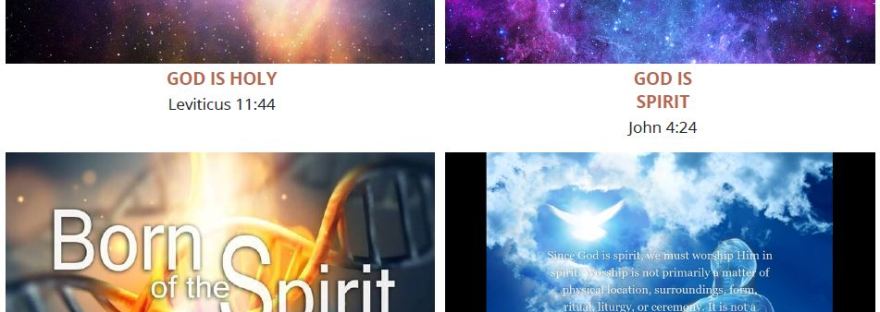
GOD IS HOLY

Leviticus 11:44

GOD IS SPIRIT

John 4:24

JESUS CHRIST IS CONCEIVED FROM THE HOLY SPIRIT

Mathew 1:20-21

All Christians believe the doctrine of the Trinity. If you do not believe this—that is, if you have come to a settled conclusion that the doctrine of the Trinity is not true—you are not a Christian at all. You are in fact a heretic. Those words may sound harsh, but they represent the judgment of the Christian church across the centuries. What is the Trinity? Christians in every land unite in proclaiming that our God eternally exists as Father, Son, and Holy Spirit. Those who deny that truth place themselves outside the pale of Christian orthodoxy. It is a mystery and a paradox. Yet it is true, three reasons for believing in the Trinity:

  • The Bible teaches this doctrine.
  • Christians everywhere have always believed it.
  • No other explanation makes sense.

Someone has said it this way: If you try to explain the Trinity, you will lose your mind. But if you deny it, you will lose your soul. In the Articles of Faith, Article B—The True God from the Calvary Memorial Church Articles of Faith states that:

  • We believe in one living and true God who is the Creator of heaven and earth, who is eternal, almighty, unchangeable, infinitely powerful, wise, just and holy. We believe that the one God eternally exists in three Persons: the Father, the Son, and the Holy Spirit; and that these three are one God, co-equal and co-eternal, having precisely the same nature and attributes, and worthy of precisely the same worship, confidence, and obedience. Matthew 3:16, 17; Matthew 28:19, 20; Mark 12:29; John 1:14; Acts 5:3, 4; II Corinthians 13:14.

One God and One Only, Exists in three Persons, Equal and Eternal, Worthy of equal praise and worship, Distinct yet acting in unity, Constituting the one true God of the Bible. One in Essence, Three in Person.

When we say these things, we mean that the Father is God, the Son is God, and the Holy Spirit is God, but they are not three gods but only one God. The Father is not the Son, the Son is not the Spirit, the Spirit is not the Father, but each is God individually and yet they are together the one true God of the Bible.

Have you ever seen the word “Godhead?” Theologians sometimes use that term when they want to refer to God the Father, God the Son and God the Holy Spirit as three divine Persons in one God. At this point I think we should acknowledge the chief objection to the doctrine of the Trinity, which is that it is absurd. Sometimes the Jehovah’s Witnesses (who pointedly deny the Trinity) ridicule it with this little equation: 1 + 1 + 1 = 3. In their minds Christians worship three Gods, not one. The answer is quite simple. The doctrine of the Trinity is not absurd if that is what the Bible teaches. Furthermore, there is more than one way to play with equations. You could also say it this way: 1 x 1 x 1 = 1!

Eliminating what is incorrect leaves us with what is true. First of all, Christians do not believe in three Gods. That is a heresy called Tritheism. Second, we do not believe that the Father, Son, and the Holy Spirit are three “forms” of God—like, steam, water and ice. That is the heresy called Modalism. Third, we do not believe that the Father, Son, and Holy Spirit are “parts” or “pieces” or God. That would imply that Jesus is 1/3rd God, the Father is 1/3rd God, and the Holy Spirit is 1/3rd God.

Trinity is taught in both the Old and the New Testaments. It is taught by implication in the Old and by direct statement in the New. For instance, the Bible contains numerous clear statements regarding the unity of God: Deuteronomy 6:4 tells us that “the Lord is one.” 1 Corinthians 8:4 adds that “there is no God but one.” 1 Timothy 2:5 explicitly says “there is one God.” All Christians heartily affirm this truth. However, the Bible also contains clear statements regarding diversity within that unity. For instance, in the very first verse of the Bible we are told that “In the beginning God.” The Hebrew word for God is ‘Elohim’, which is actually a plural form of the word El. It is a word that in other contexts is sometimes translated as “gods,” referring to heathen deities. Later in the same chapter we have one of the most striking statements of diversity-in-unity:

  • Then God said, ‘‘Let us make man in our image, in our likeness, and let them rule over the fish of the sea and the birds of the air, over the livestock, over all the earth, and over all the creatures that move along the ground.” So, God created man in his own image, in the image of God he created him; male and female he created them. Genesis 1:26-27

Notice the shift in pronouns. “Let us … in our image … So, God created man in his own image. … he created him.” From us and our, to he. Why the shift? Commentators speak of a literary form called the plural of majesty or the “editorial we.” This much is certainly true. If Genesis 1 does not explicitly teach diversity-in-unity within the Godhead, it certainly leaves room for it to be developed later in the Bible.

Isaiah 48:16 seems to explicitly refer to all three Persons of the Trinity (with my additions in parentheses): “And now the Sovereign LORD (the Father) has sent me (the Son), with his Spirit (the Holy Spirit).” I’m not suggesting that Isaiah fully understood the Trinity or that the Jewish readers would have understood what it meant, but I do think that in the light of the New Testament, we can say that this seems to be a clear statement of the Trinity in the Old Testament.

Consider further this line of evidence. All Three Persons are called God in different places in the Bible.

  • Father — Galatians 1:1
  • Son — John 20:28
  • Spirit — Acts 5:3-4

How could the Son and the Spirit be called God unless they somehow share in God’s essence? But if they share in God’s essence, they are God alongside the Father.

Finally, all three Persons are associated together on an equal basis in numerous passages:

Jesus’ baptism—Matthew 3:13-17 (voice of the Father, Son baptized, Spirit descending like a dove).

Salvation—1 Peter 1:2 (chosen by the Father, sanctified by the Spirit, sprinkled with the blood of Jesus).

Sanctification—2 Corinthians 13:14 (grace of the Lord Jesus, love of God, fellowship of the Holy Spirit).

Christian Baptism—Matthew 28:19 (baptized in one name, yet three Persons—Father, Son, and Holy Spirit).

Prayer—Ephesians 3:14-21 (strengthened by his Spirit, know the love of Christ, filled with the fullness of God).

Christian Growth—2 Thessalonians 2:13 (chosen by God, loved by the Lord, sanctified by the Spirit).

This list of passages might be extended. It simply shows how easily the writers of Scripture passed from one Person of the Trinity to another, doing so in a way that assumes their equality of nature while preserving their distinct personhood. If the doctrine of the Trinity is not true, it would seem to be blasphemy to speak so freely of the Father, the Son, and the Holy Spirit in one and the same breath.

The word “Trinity” is not in the Bible. Neither is the word “Inerrancy”, but we don’t discard it simply because it isn’t found in the Bible. The issue is not the word, but the concept or the idea. We do not believe in the Trinity because of the word, but because of what the Bible teaches. Theologians sometimes speak of the Tri-Unity of God. That is a good word—even though it sounds odd to our ears—because it combines the two ideas of unity and diversity in one word. There is a third word you should know. Sometimes we speak of the “Triune” God. That is also another word that means the same thing as Trinity.

A number of illustrations have been suggested. They all are useful as long as you remember they are only illustrations. For water can exist as solid, liquid, or steam. That’s okay, but usually water only exists in one state at a time. However, there is a physical condition in which water can exist as solid, liquid and steam at the same time—which would be a much better illustration of the Trinity. There are others we could mention. An egg is made up of a shell, the egg white, and the yolk. All three are needed for an egg to be complete. One of the more interesting illustrations note the different roles a person can play. I am a father, a son and a husband at one and the same time. Yet I am only one person. Perhaps a more biblical approach is to consider that a husband and wife are two persons yet in God’s eyes they are “one flesh.” Add children and then you have the family as a miniature (and very imperfect) version of the Trinity.

Tony Evans commented that the pretzel is a good illustration because it consists of one piece of dough with three holes. Take away any one of the holes and the pretzel isn’t really a pretzel anymore. (According to some people, the pretzel was actually invented in Europe several hundred years ago by a monk who wanted to illustrate the Trinity to the children of his village so he took some dough, looped into the familiar three-hour shape, based it, and gave it to the children as an edible object lesson.) Another illustration comes from noted scientist Dr. Henry Morris. He notes that the entire universe is trinitarian by design. The universe consists of three things: matter, space, and time. Take away any one of those three and the universe would cease to exist. But each one of those is itself a trinity:

  • Matter = mass + energy + motion
  • Space = length + height + breadth
  • Time = past + present + future

Thus, the whole universe witnesses to the character of the God who made it (cf. Psalm 19:1). It is important to remember that all illustrations fail eventually. They do not “prove” the Trinity, they simply help us understand the concept.

Many Christians think this doctrine has no practical value. That is, even if it is true, it does not and should not matter to them. However, that simply is not true. Five important ramifications of this truth are:

  • The Trinity helps us answer the question, “What was God doing before he created the universe?”

This is a question little children like to stump their parents with. But skeptics like to ask it as well. You may remember Augustine’s answer: “He was preparing Hell for people who ask questions like that!” But the Trinity teaches us that before the foundation of the world, God was having fellowship within his own being. That is why the Bible tells us that the Father loves the Son (John 17:24). In some sense we can never understand that God the Father, God the Son, and God the Holy Spirit have forever communicated and loved each other. Francis Schaeffer emphasized this point in his books. This, he says, is where the human desire for intimacy and communication comes from. We were made to communicate. That design is part of the image of God within each of us. It also teaches us that God is never “lonely.” He did not create us because he “needed” us. God could have existed forever without us. That he made us at all is a statement of his great love and the wisdom of his plan.

  • The Trinity sets the limits on human speculation about the nature of God.

There is so much we would like to know about God, but our finite minds cannot comprehend it. We are not free to create God in our own image. The Trinity sets the limits for human speculation. God is more than the Trinity, but he is not less than that.

  • The Trinity teaches us that God is beyond all human comprehension.

After all, if we could explain God, he would not be God. I have no doubt that God is much more than “one in essence, three in Person,” but since I cannot even understand those simple phrases, I do not worry at all about what else might be true about God. If you feel baffled by the Trinity, join the crowd. The greatest minds of history have stood in amazement before a God so great that he cannot be contained by our puny explanations.

  • The Trinity exalts the Son and the Spirit.

We all know that God the Father is to be worshiped. But what about Jesus Christ? If he is God, should we not also worship him? The answer of course is yes. But that truth leads us back to the Trinity. He is not merely the Son of God but also God the Son. The same thing may be said about the Holy Spirit. He is not just a “force” but a Divine Person. Not an “influence” or some vague power, but the Third Person of the Trinity. Let me draw one important inference. Since all Three Persons of the Trinity are equally God, we may pray to any member of the Trinity. That, by the way, is the number one question I have been asked about the Holy Spirit since writing Names of the Holy Spirit. Many Christians simply do not feel comfortable praying to the Spirit even though we often sing songs that are essentially prayers to the Spirit, such as “Spirit of God, descend upon my heart” and “Spirit of the living God, fall afresh on me.” Surely if we may sing to the Spirit, we may also pray to him. If he is God, our prayers may be directed to him. I do agree that Christian prayers will customarily be made to the Father (e.g. The Lord’s Prayer). But let us not quibble or imagine that the Father is slighted if we direct our prayers to the Son or to the Spirit, according to the need of the moment. There is no jealousy among the members of the Trinity nor could there ever be.

  • The Trinity helps us understand what really happened at the Cross.

At the climax of Jesus’ suffering, he cried out, “My God, my God, why have you forsaken me?” What do those strange, tortured words mean? We have a hint of the answer in that every other time Jesus prayed, he used the term “Father.” But at that moment, when he bore the full weight of the sins of the world, when all that is evil and wretched was poured out upon him, in some way we cannot begin to fathom, God—who cannot look upon sin—turned his back on his own Son. Sin as it were (though not in ultimate reality) caused a rupture in the Trinity. Instead of “Father,” Jesus cries out, “My God, my God!” It is God speaking to God. The eternal Son cries out to the Father at the moment when the penalty of sin has been laid upon him. If it be asked, how could one man pay for the sins of the entire race, we find the answer in the doctrine of the Trinity. Only an infinite God could bear the sins of the world!


The doctrine of the Trinity has been called the most puzzling doctrine in the Christian faith and the central truth of the Christian faith. Which is it? Inscrutable puzzle or central truth? The answer is both are true. This doctrine unites all true Christians and separates us from those who are not Christian. You may believe and still not be a Christian, but if you deny this doctrine in your heart, you are not a Christian at all. The Trinity is a doctrine that all Christians believe but no one really understands. That much should be clear from this message. If you try to explain the Trinity, you will lose your mind. But if you deny it, you will lose your soul. Someone asked Daniel Webster, who happened to be a fervent Christian, “How can a man of your intellect believe in the Trinity?” “I do not pretend fully to understand the arithmetic of heaven now,” he replied. That is a good phrase—the arithmetic of heaven. The Trinity should cause us to bow in humble adoration before a God who is greater than our minds could ever comprehend.

Let us rejoice that we have a Triune God who has provided for a Trinitarian salvation. When we were lost in sin, our God acted in every Person of his being to save us. The Father gave the Son, the Son offered himself on the Cross, and the Holy Spirit brought us to Jesus. We were so lost that it took every member of the Godhead to save us. In 1774 a man named Ignaz Franz wrote a hymn of praise to the Trinity: Holy God, We Praise Your Name. Verse three may serve as an apt conclusion to this message.

“Holy Father, Holy Son, Holy Spirit, Three we name you;

While in essence only one, undivided God we claim you.

Then, adoring, bend the knee, and confess the mystery.”

Indeed, it is a mystery, and with all the saints we bend the knee in worship before our great God—Father, Son, and Holy Spirit.

Reference: https://www.christianity.com/god/trinity/god-in-three-persons-a-doctrine-we-barely-understand-11634405.html

COVID-19 – Is death a form of punishment?

Punishment can be defined as the infliction or imposition of a penalty as retribution for an offense. “Crime demands just punishment”.

People working in the NHS front-line do so mostly as a result of it being a calling for them, not because it is a career choice motivated by financial rewards or fulfillment born out of societal appreciation. When an individual’s work life is their ministry, reflecting God, adding value to the society, preserving life, then we can say they do good works. Till date, more than one hundred and ten NHS front-line staff (see reference below) have lost their lives to Covid-19. In addition, we have little persons as young as five years of age, as well as older people in their nineties, and everything in between succumbing to corona virus.

This require us to rethink our attitude towards death, especially death as a result of illness, and whether such illness or plague is a form of punishment. Nobody is saying that corona virus is a blessing, as Jesus Christ told us in the gospel of Mathew chapter 5 verse 45; God causes his sun to rise on the evil and the good and sends rain on the righteous and the unrighteous. But according to Job in the book of Job 2:10; Shall we accept good from God, and not trouble?

When an individual dies, what does the dead body knows and or feels? Absolutely nothing, since with the exception of Jesus Christ, no one has clinically died for two or three days and then come back to life, resurrect, to tell us about the situation after death. So, we have to take the Preacher’s word for it in Ecclesiastes 9:5; For the living know that they will die, but the dead know nothing; they have no further reward, and even their name is forgotten. Therefore, whatever means that brings about this state of knowing or feeling nothing, should not be considered as punishment, but merely the means of translating energy or souls from one realm to another realm.

The Scriptures tell us that God is a Spirit, and that we can not in the physical realm see God, and there is a Spiritual realm where God reigns, and that there is judgement after death, and that when an individual has been chosen by God, redeemed by the Blood of Christ, their sins committed in the physical realm are forgiven and they get to spend eternity with Christ, in a state where there is no pain, no suffering, no death, full of peace, joy and happiness, a place of eternal dibs on happiness. This is what Christians hope for (they do not have it in the physical realm, you do not hope for what you already have), and since you can not see God in the physical realm, believing that those He chooses get to spend eternity with Him, pretty much sums up the definition of Faith according to Hebrews 11:1; Now faith is confidence in what we hope for and assurance about what we do not see. Therefore, whatever mechanism brings about “realm translation”, another synonym for death, especially of those individuals chosen by God to do good works (some NHS front-line staff members! I do not know, I am not the one who decides, that is the remit of God), can not be regarded as punishment.

(References: https://www.theguardian.com/world/2020/apr/16/doctors-nurses-porters-volunteers-the-uk-health-workers-who-have-died-from-covid-19)

BE STILL AND KNOW THAT I AM GOD – COVID-19-

The worldwide pervasion of covid-19 evidenced that indeed “The earth is the Lord’s, and everything in it, the world and all who live in it” (Ps 24:1). Have we even sat down to reflect on the reason God, a merciful and powerful father would allow such a deadly disease to cover the whole earth as water covers the sea? In Jeremiah23:27, God said, “I am the Lord, the God of all mankind. Is anything too hard for me?” Then, why is this sting of death, we call coronavirus, still so active and wreathy?

Isaiah 59 tells us that Surely the arm of the Lord is not too short to save the whole world from the deadly onslaught of covid-19, nor his ear too dull to hear our prayer for healing and termination. 2But our iniquities have separated us from our God; our sins have hidden his face from us, so that he will not hear, both the developed and the developing countries. 3For hands that are stained with blood are uncountable, and fingers filled and dripping with guilt are like the sand on the sea shore. Lips that have spoken lies, and still is, are too numerous to number, not mentioning tongues muttering wicked things everywhere, including the church. 4No one calls for mercy; no one pleads his case with the righteousness given by God, even Jesus Christ who was crucified for our transgressions, and raised for our justification; he was wounded for our transgression and bruised for our iniquities, and by his stripes we have been healed, despite that, healing is a mirage, and death is on rampage and unstoppable.

Why would God allow this vampiric virus to gulp down indiscriminately human beings whom he created joyously in his own image? This is a mystery! Could it be because pastors who profess to be servants of the living God have taken his place in the lives of the congregants, thereby encouraging idol worshipping, a sin highly detested by God? Evidently, Church is no longer a place of succor or worship of God, but a place where pastors/general overseers are lauded above the Lord God Almighty. We have all forgotten that God will not share his glory with another, neither will he give his praises to graven images. Besides, the uncalled pastors and the called who have corrupted their callings, lying against the Holy Spirit now  rely on empty arguments that have no scriptural basis nor affinity with God’s purpose to support their ministries and lordship over the flock of God, and speak lies unashamedly; unfortunately, they as well have conceived trouble for the whole earth, and which has now given birth to this evil coronavirus. So,10like the blind every country grope along the wall, feeling its way like men without eyes, looking for cure and how to stop the heavy and swift wave of covid-19, not taking cognizance of what God expects from us at this very trying moment. We all need to recognise the fact stated in Romans: For we have all sinned and come short of the glory/mercy of God. 12For our offenses are many in God’s sight, and our sins testify against us. Our offenses are ever with us, but we are yet to acknowledge our iniquities: 13rebellion and treachery against the Lord, turning our backs on our God, fomenting oppression and revolt, uttering lies our hearts have conceived. 14So healing is driven back, and salvation/life stands at a distance; truth has stumbled in every nation on earth, honesty cannot enter. 15Truth is nowhere to be found, and the Lord looked and was displeased that there was no justice, not even in the church where political and economic bargaining and gambling have become the order of the day.


“Therefore, the Lord, the Lord Almighty” sends “a wasting disease upon” the earth, and “under his pomp/glory a fire” is kindling “like a blazing flame” (Is 10:16), which can only be stayed through true repentance. God himself says, “When I shut up the heavens so that there is no rain, or command locusts to devour the land or send a plague among my people, if my people, who are called by my name, will humble themselves and pray and seek my face and turn from their wicked ways, then will I hear from heaven, and I will forgive them and will heal their land. So, let everyone that has breadth cry out for mercy today. We pray that God will have mercy and forgive us our sins as we really repent and know that He is God all by himself, for “The earth is the Lord’s, and everything in it, the world, and all who live in it (Ps 24:1) evidenced the pervading quality of coronavirus today.

Author: Tflame

Some Christians may not make Heaven – COVID-19 and good works –

It is very poignant that in light of this current COVID-19 pandemic, the end-of-the-world theorist or “Armageddon” and “Raptures’ theorist” are interpreting the pandemic as initiation of the cataclysmic event. But be that the case or not, Jesus Christ had advised His own not to worry about the times and dates that the Heavenly Father sets. However, unless an individual think about how much good works they can or want to achieve in the time period before the event, then that is the ground such individuals rationalizes for themselves for ignoring Jesus Christ’ instruction.

Reasons “Good people go to Hell”

Even our “good works” cannot save us. Salvation is by Grace

We need the righteousness of Jesus Christ, and our surrender to him as Lord and Saviour, to clean our lives of sin and make us fit to live in Heaven.

Romans 3:23; since all have sinned and continually fall short of the glory of God.

In Romans 2, the apostle Paul shares with us the seven factors of judgment that Jesus will use when he opens the Books of Works at the Great White Throne Judgment. From these books Jesus will prove why good people are not fit for Heaven.

Romans 2 does not show folks how to be saved. This passage shows folks why they are lost! These are not the principles of salvation. These are the principles of evaluation.

  1. God will judge everything according to truth because we all are in the habit of comparing ourselves with others.

On Judgment Day God will say to those who died without Jesus Christ as their Saviour, “Let’s judge you for who and what you really are.”

  1. God will evaluate according to His kindness. Romans 2:4 God’s judgment will be in proportion to the amount of kindness that God has poured out to people during their lifetimes.

God expends his kindness to us that he might lead us to repentance.

Christians often wonder why lost people seem to have it so good. The answer is that it’s just God’s kindness to turn them to repentance – the longer they reject his kindness, the more inexcusable they will be when they stand at the Great White Throne Judgment.

  1. God will evaluate according to His accumulated wrath. Romans 2:5. Hardening of arteries can take us to an early grave – but hardening of the heart, spiritually, will take us ultimately to the Lake of Fire.

If the grace and kindness of God have not led us to repentance, then every day, moment by moment, hour by hour, we are storing up drops of the terrible treasure of God’s wrath which will break forth at the Great White Throne.

God is allowing us to live and he is holding back punishment – giving us kindness – so that we might turn to him in repentance.

Our judgment for eternity will be in direct proportion to the amount of kindness that God has given to us to which we ignored as coming from God.

  1. God will evaluate according to deeds. Romans 2:6-10. This is the deal breaker, this is why even Apostle Paul with everything that he did for the spreading of the Gospel, was told in 2 Cor.12:9 “My Grace is sufficient”. Standing before God now is the person who says, “Look, God, judge me according to my deeds. I’ve lived a good life. Take my good works and put them beside my bad ones and certainly the good will outweigh the bad!”

But the problem with the moral man is that he thought that his good deeds will be weighed against his bad deeds or at least be compared against the deeds of others.

That will not be the case. God will take the best works of the moral man or woman and compare them with Jesus’ deeds. Jesus raises the lame, gives sight to the blind, and heals the sick. He takes on the sins of the entire world and by his death and sacrifice brings salvation to those who commit to him as Saviour and Lord.

No person in his or her right mind wants to be judged on works. He or she wants mercy.

  1. God will evaluate without playing favourites. Romans 2:11; God offers salvation to everyone because everyone needs it. God is no respecter of persons. He shows no favouritism. Regarding the issue of sin, no one is better than anyone else from God’s perspective. An analogy goes this way;

Go to the top of the 10-story building, look down, and all the cars will look like toys. Then “Look at the people.” You’ll notice that “They all look small.” You cannot tell the difference “between the five-foot-tall people and the six-foot-tall people”. However down on the sidewalk or street level “you can tell the difference between a tall man and a short man easily”. So, it is in our human judgments. On the human level we see all sorts of variations in wealth, culture, education, character, goodness, and badness.

But, from God’s point of view from the 10th story, everyone looks alike! Without being irreverent I can almost hear God saying to some individuals,

“You dummy. Do you really figure that you have calculated some shifty plan that will let you go up against me and get away with it? You don’t have a ghost of a chance.”

God doesn’t like to judge. He definitely says that judgment is his “strange work” (Isaiah 28:21-22).

Nevertheless, he will judge: “He who spared not his own Son but delivered him up” will certainly not hesitate to judge those who reject his free offer of grace in Jesus Christ (Romans 8:32).

  1. God will evaluate according to how well we’ve lived up to the light we have received. Romans 2:12-15; There are two types of people: Those who have heard the gospel and those who have not. Both are judged according to how they respond to what they know. In other words, they will be judged on the amount of “light” which they have received.

Those who have heard the gospel have seen the “light” and by receiving Christ are living up to the level of the light they have received. But there are many people who hear the gospel and reject it. They have not lived up to the light and therefore stand condemned for God.

Of course, this begs the question regarding the natives in remote parts of the world who will never be exposed to, or hear, the gospel during their lifetimes. This is certainly unfair to send people to hell and have never had the chance, and most likely never will have the chance, to hear the gospel and respond positively to Christ.

Paul teaches us that these folks will be judged according to how well they live up to what they know, and they know much more than we realize. They have an internal conscience which guides them as to what is right and wrong behaviour. They can look at the stars at night and see the universe and know that there must be a God who created all.

In a startling way, Paul seems to be teaching us that salvation is available to those who never heard the gospel if they live up to the light they’ve received.

“To those who by persistence in doing good seek glory, honour and immortality, he will give eternal life. But for those who are self-seeking and who reject the truth and follow evil, there will be wrath and anger” (Romans 2:7-8).

This idea of living up to the light brings up some intriguing thoughts. Do you know anyone who’s lived up to the light they have received? Is it possible that God accepts for salvation those who have lived up to the light received, then, perhaps, it’s best that we not share the gospel because those who hear it may reject it and be lost. They might have a better chance to live up to the light that you have received.

People who have greater “light” have more responsibility to live up to the “light” (Matthew 11:23-24).

The key is – are we living up to what we know? The answer is a resounding “No!” No person performs up to the level of what they know. We all fall short.

  1. God will evaluate according to the inner secrets of the heart. Romans 2:16; At the Great White Throne God will open the closet doors and reveal the secrets of the people who stand there. Jesus spoke of this often (Matthew 10:26-27). Skeletons will come out of closets then. Deeds long buried in the depths of memory will be brought up. Unsolved crimes will find their solutions. These are the secrets of men.

As a Christian I know with absolute assurance that I will never stand before this Judgment Bar. “There is no condemnation to them who are in Christ Jesus” (Romans 8:1).

(Anyway, I’ve already settled my case out of court!)

The way to avoid The Judgment Seat of Christ is to settle your case before it comes to trial.

Christ said, “If you meet your adversary in the roadway, you had better settle with him, lest he drag you into court and you have to pay to the uttermost penny!” (Matthew 5:25-26).

In this passage, the adversary will be God. He will be Judge, Jury, and Prosecuting Attorney.

Christ died on the cross to offer us a chance to accept him now and settle our sin issue before Judgment Day comes. If we die without Christ, our case will come to trial and God has enough evidence to condemn every person to Hell – and he will. There is mercy now – settle out of court. The days of mercy are not without end. When we die, our choice is sealed for eternity.

(Reference: https://www.crosswalk.com/slideshows/7-reasons-good-people-go-to-hell.html?utm_source=&utm_campaign=Integrity%20Moments%20-%20Crosswalk.com&utm_medium=email&utm_content=2924676&bcid=6fd36d2c4984deb491599514588ab2ed&recip=528989851%20)