
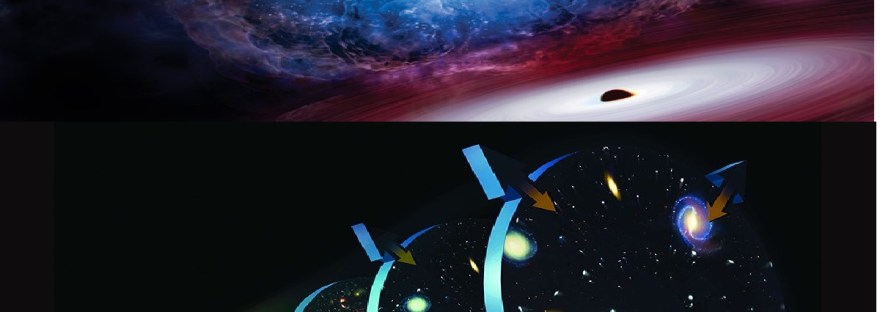
The Big Bang: the birth of the universe
Around 13.7 billion years ago, everything in the entire universe was condensed in an infinitesimally small singularity, a point of infinite denseness and heat. Suddenly, an explosive expansion began, ballooning our universe outwards faster than the speed of light. This was a period of cosmic inflation that lasted mere fractions of a second — about 10^-32 of a second, according to physicist Alan Guth’s 1980 theory that changed the way we think about the Big Bang forever.
When cosmic inflation came to a sudden and still-mysterious end, the more classic descriptions of the Big Bang took hold. A flood of matter and radiation, known as “reheating,” began populating our universe with the stuff we know today: particles, atoms, the stuff that would become stars and galaxies and so on. This all happened within just the first second after the universe began, when the temperature of everything was still insanely hot, at about 10 billion degrees Fahrenheit (5.5 billion Celsius), according to NASA. The cosmos now contained a vast array of fundamental particles such as neutrons, electrons and protons — the raw materials that would become the building blocks for everything that exists today.
This early “soup” would have been impossible to actually see because it couldn’t hold visible light. “The free electrons would have caused light (photons) to scatter the way sunlight scatters from the water droplets in clouds,” NASA stated. Over time, however, these free electrons met up with nuclei and created neutral atoms, or atoms with equal positive and negative electric charges. This allowed light to finally shine through, about 380,000 years after the Big Bang.
Sometimes called the “afterglow” of the Big Bang, this light is more properly known as the cosmic microwave background (CMB). It was first predicted by Ralph Alpher and other scientists in 1948 but was found only by accident almost 20 years later. Because we can’t see it directly, scientists have been trying to figure out how to “see” the Big Bang through other measures. In one case, cosmologists are pressing rewind to reach the first instant after the Big Bang by simulating 4,000 versions of the current universe on a massive supercomputer.
In the beginning, there was an infinitely dense, tiny ball of matter. Then, it all went bang, giving rise to the atoms, molecules, stars and galaxies we see today. Or at least, that’s what we’ve been told by physicists for the past several decades. But new theoretical physics research has recently revealed a possible window into the very early universe, showing that it may not be “very early” after all. Instead, it may be just the latest iteration of a bang-bounce cycle that has been going on for … well, at least once, and possibly forever. Scientists have a really good picture of the very early universe, something we know and love as the Big Bang theory. In this model, a long time ago the universe was far smaller, far hotter and far denser than it is today. In that early inferno 13.8 billion years ago, all the elements that make us what we are were formed in the span of about a dozen minutes.
Even earlier, this thinking goes, at some point our entire universe — all the stars, all the galaxies, all the everything — was the size of a peach and had a temperature of over a quadrillion degree. Amazingly, this fantastical story holds up to all current observations. Astronomers have done everything from observing the leftover electromagnetic radiation from the young universe to measuring the abundance of the lightest elements and found that they all line up with what the Big Bang predicts. As far as we can tell, this is an accurate portrait of our early universe.
But as good as it is, we know that the Big Bang picture is not complete — there’s a puzzle piece missing, and that piece is the earliest moments of the universe itself. That’s a pretty big piece. The problem is that the physics that we use to understand the early universe (a wonderfully complicated mishmash of general relativity and high-energy particle physics) can take us only so far before breaking down. As we try to push deeper and deeper into the first moments of our cosmos, the math gets harder and harder to solve, all the way to the point where it just … quits.
The main sign that we have terrain yet to be explored is the presence of a “singularity,” or a point of infinite density, at the beginning of the Big Bang. Taken at face value, this tells us that at one point, the universe was crammed into an infinitely tiny, infinitely dense point. This is obviously absurd, and what it really tells us is that we need new physics to solve this problem — our current toolkit just isn’t good enough. To save the day, we need some new physics — something that is capable of handling gravity and the other forces, combined, at ultrahigh energies. And that’s exactly what string theory claims to be: a model of physics that is capable of handling gravity and the other forces, combined, at ultrahigh energies. Which means that string theory claims it can explain the earliest moments of the universe.
One of the earliest string theory notions is the “ekpyrotic” universe, which comes from the Greek word for “conflagration,” or fire. In this scenario, what we know as the Big Bang was sparked by something else happening before it — the Big Bang was not a beginning, but one part of a larger process. Extending the ekpyrotic concept has led to a theory, again motivated by string theory, called cyclic cosmology. I suppose that, technically, the idea of the universe continually repeating itself is thousands of years old and predates physics, but string theory gave the idea firm mathematical grounding. The cyclic universe goes about exactly as you might imagine, continually bouncing between big bangs and big crunches, potentially for eternity back in time and for eternity into the future.
The Septuagint Bible and the Masoretic texts
The Greek translation of the Hebrew Bible is called Septuagint because 70 or 72 Jewish scholars reportedly took part in the translation process. The scholars worked in Alexandria during the reign of Ptolemy II Philadelphus (285-247 B.C.), according to the Letter of Aristeas to his brother Philocrates.
The name Septuagint (from the Latin septuaginta, “70”) was derived later from the legend that there were 72 translators, 6 from each of the 12 tribes of Israel, who worked independently to translate the whole and ultimately produced identical versions. Another legend holds that the translators were sent to Alexandria by Eleazar, the chief priest at Jerusalem, at the request of Ptolemy II Philadelphus (285–246 BCE), though its source, the Letter of Aristeas, is unreliable. Despite the tradition that it was perfectly translated, there are large differences in style and usage between the Septuagint’s translation of the Torah and its translations of the later books in the Old Testament. In the 3rd century CE Origen attempted to clear up copyists’ errors that had crept into the text of the Septuagint, which by then varied widely from copy to copy, and a number of other scholars consulted the Hebrew texts in order to make the Septuagint more accurate.
Did Jesus read from the Septuagint? This early collection of scrolls written in Greek is called the Septuagint. When Jesus was born and began entering the temple to sit for the readings this is what He would have encountered, and this is what he would have read when He stood up to read the scrolls.
Did the Dead Sea Scrolls agree with the Septuagint? The biblical manuscripts found among the Dead Sea Scrolls push that date back a whole millennium, to the 2nd century BCE. About 35% of the DSS biblical manuscripts belong to the Masoretic tradition, 5% to the Septuagint family, and 5% to the Samaritan, with the remainder unaligned. The Dead Sea Scrolls are ancient manuscripts that were discovered between 1947 and 1956 in eleven caves near Khirbet Qumran, on the north-western shores of the Dead Sea. They are approximately two thousand years old, dating from the third century BCE to the first century CE.
How often did Jesus quote the Septuagint? In about 90 instances, the Septuagint is quoted literally. In around 80 further instances, the quote is altered in some way. For example, at Matthew 21:42 Jesus says “Did ye never read in the scriptures that the stone which the builders refused is become the head stone of the corner?”, a reference to Psalm 118:22.
The New American Standard Bible is a literal translation from the original texts, well suited to study because of its accurate rendering of the source texts. The Dead Sea Scrolls do not contradict the Bible; in fact, the opposite is the case. Remember: Printing had not been invented in those days. Books therefore had to be laboriously copied by hand, and special precautions had to be taken to prevent errors from creeping in. The earliest manuscript of a New Testament text is a business-card-sized fragment from the Gospel of John, Rylands Library Papyrus P52, which may be as early as the first half of the 2nd century.
Tanakh is an acronym, made from the first Hebrew letter of each of the Masoretic Text’s three traditional divisions: Torah (literally ‘Instruction’ or ‘Law’), Nevi’im (Prophets), and Ketuvim (Writings)—hence TaNaKh. The three-part division reflected in the acronym Tanakh is well attested in the rabbinic literature. Similar to Latin today, Hebrew was the chosen language for religious scholars and the holy scriptures, including the Bible (although some of the Old Testament was written in Aramaic). Jesus likely understood Hebrew, though his everyday life would have been conducted in Aramaic.
Septuagint scholars are about as grateful as any for the discovery of the Scrolls. The biblical texts from the Judean Desert now confirm what those familiar with the Septuagint already suspected: the divergences in some biblical books give a window into the Bible’s early formation history. The text of the Septuagint is contained in a few early, but not necessarily reliable, manuscripts. The best known of these are the Codex Vaticanus (B) and the Codex Sinaiticus (S), both dating from the 4th century ce, and the Codex Alexandrinus (A) from the 5th century.
The Dead Sea Scrolls contain nothing about Jesus or the early Christians, but indirectly they help to understand the Jewish world in which Jesus lived and why his message drew followers and opponents. One significance of the Dead Sea scrolls is that they demonstrate how accurately the Bible was transmitted over time by the Jewish scribes (there is better than a 95% agreement between the Hebrew words of the Great Isaiah Scroll and the Hebrew Masoretic Text, from which our Old Testament was translated). Ketef Hinnom scrolls – Probably the oldest surviving texts currently known from the Hebrew Bible – priestly blessing dated to 600 BC. Text from the Book of Numbers in the Old Testament. Described as “one of most significant discoveries ever made” for biblical studies.
Its Hebrew name is the same as its first word, Bereshit (“In the beginning”). Genesis is an account of the creation of the world, the early history of humanity, and of Israel’s ancestors and the origins of the Jewish people. The books of the Bible found in the Dead Sea Scrolls; The various scroll fragments record parts of the books of Genesis, Exodus, Leviticus, Deuteronomy, Samuel, Ruth, Kings, Micah, Nehemiah, Jeremiah, Joel, Joshua, Judges, Proverbs, Numbers, Psalms, Ezekiel and Jonah. The Adamic language, according to Jewish tradition (as recorded in the midrashim) and some Christians, is the language spoken by Adam (and possibly Eve) in the Garden of Eden.
The book of Genesis and the book of Job, chapter 38 gave a description about the origin of life, and the universe. A comparison of the Scriptural account and the astronomical/physics account, yields for the latter inconsistencies, missing mathematical models, zero evidence and an astronomic stretch of imagination, and mathematical odds of one in quadrillion-quadrillions of randomness, unsupervised sequence without intelligence. Whereas observation of the universe or nature indicates intelligent design and masterplan consistent with Scriptural account. Therefore, the choice not to believe the Scriptures points to foolhardiness, ignorance of the highest order, that is synonymous to blindness.


