

The Bible verses Isaiah 40:6–8, which state that “All men are like grass, and all their glory is like the flowers of the field. The grass withers and the flowers fall, but the word of our God stands forever”. This passage emphasizes the transience of human life and accomplishments in contrast to the enduring nature of God’s word.
The Pale Blue Dot
Carl Sagan played a leading role in the U.S. space program. The prominent planetary scientist was a consultant and adviser to NASA beginning in the 1950s. He briefed the Apollo astronauts before their flights to the Moon.
In his role as a visiting scientist at JPL, Sagan helped design and manage the Mariner 2 mission to Venus; the Mariner 9, Viking 1, and Viking 2 trips to Mars; the Voyager 1 and Voyager 2 missions to the outer solar system, and the Galileo mission to Jupiter.
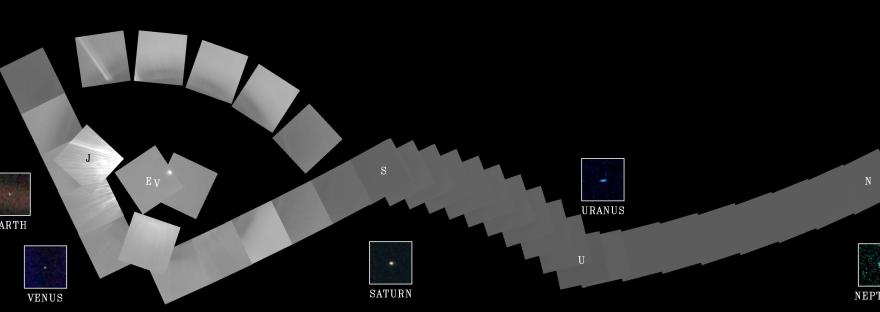
Sagan also was a member of the Voyager Imaging Team. He had the original idea in 1981 to use the cameras on one of the two Voyager spacecraft to image Earth. He realized that because the spacecraft were so far away the images might not show much. This was precisely why Sagan and other members of the Voyager team felt the images were needed — they wanted humanity to see Earth’s vulnerability, and that our home world is just a tiny, fragile speck in the cosmic ocean.
On Feb. 13, 1990, Voyager 1 warmed up its cameras for three hours. Then the spacecraft’s science platform was pointed at Neptune and the observations began.
After Neptune, it took images of Uranus, Saturn, Mars, the Sun, and then Jupiter, Earth, and Venus. The Earth images were taken at 04:48 GMT on Feb. 14, 1990, just 34 minutes before Voyager 1 powered off its cameras forever.
It took until May 1, 1990 — and four separate communications passes with NASA’s Deep Space Network — for all the image data to finally arrive back on Earth. Voyager 1 had captured images of six of the seven planets targeted as well as the Sun.
In his subsequent book “Pale Blue Dot: A Vision of the Human Future in Space,” Sagan wrote of the image: “That’s here. That’s home. That’s us. On it everyone you love, everyone you know, everyone you ever heard of, every human being who ever was, lived out their lives… on a mote of dust suspended in a sunbeam.”
“There is perhaps no better demonstration of the folly of human conceits than this distant image of our tiny world,” he said. “To me, it underscores our responsibility to deal more kindly with one another, and to preserve and cherish the pale blue dot, the only home we’ve ever known.”
Voyager 1 was launched Sept. 5, 1977, just days after its twin — Voyager 2 — on Aug. 20. Because it was on a faster route to the mission’s first encounter, at Jupiter, Voyager 1 overtook Voyager 2 on Dec. 15, 1977. (This was the reason for the order of their naming.)
Voyager 1 flew past Jupiter on March 5, 1979, and Saturn on Nov. 12, 1980.
After snapping the Pale Blue Dot and other “family photos,” at 05:22 GMT, Feb. 14, 1990, Voyager 1 powered off its cameras forever. Mission planners wanted to save its energy for the long journey ahead.
In August 2012, Voyager 1 entered interstellar space. It’s now the most distant human-made object ever.
The phrase “what is man that you are mindful of him” comes from Psalm 8:4, expressing a sense of awe at God’s care for humanity despite His immense power and the vastness of creation. The psalm contrasts God’s glory with mankind’s perceived frailty, asking why the Creator would pay attention to people, who are made “a little lower than the angels” but are also “crowned with glory and honour”.
- Contemplating the vastness of creation: The psalmist, David, looks at the night sky and questions why God, the creator of the heavens, moon, and stars, would care so much about human beings.
- God’s creation of man: The psalm acknowledges that God made humans in His image and gave them authority over the earth, a source of both glory and honour.
- The central question: The phrase is a reflection on the seemingly impossible paradox of God’s attention to humanity. Why would the magnificent and all-powerful Creator be mindful of a fragile and short-lived human being?
- The answer found in the rest of the psalm: The rest of Psalm 8 answers this by detailing the specific ways God cares for and elevates humanity, including giving them dominion over creation, and the New Testament interpretation that this was ultimately fulfilled in Jesus Chris
Reference
http://www.science.nasa.gov/mission/voyager/voyager-1s-pate-blue-dot


