
Genesis chapter 3 verse 21; The Lord God made garments of skin for Adam and his wife and clothed them. What is the garment of skin and why did God make it? Is it the skin of lambs or goat? Is this text to be taken literarily or metaphorically? What is the nature of a man? Can the nature of a man be transmitted or inherited by its offspring? Do men possess a soul and or a spirit? Did Adam and Eve spiritually died (metaphorically) with the fall in the garden of Eden?
Is the soul and or the spirit, a physical entity? What is Hell? Does Hell mean separation from God? Does Hell mean lack of communion with God? John chapter 4 verse 24; God is spirit, and his worshippers must worship in the Spirit and in truth.”
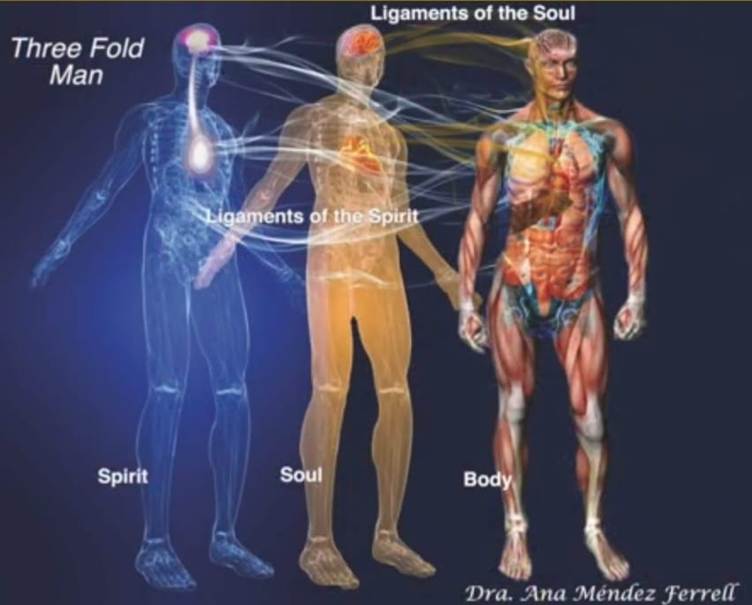
1. The Body (Physical)
- Function: The material vehicle that interacts with the physical world.
- Connection: Uses the five physical senses (sight, hearing, smell, taste, touch) to experience the environment.
- Concept: Often referred to in scripture as the “vessel” or “earth suit” that houses the soul and spirit.
2. The Soul (Immaterial – Psychological)
- Function: The command centre of human personality, self-awareness, and intellect.
- Connection: Composed of the mind (reasoning and imagination), will (decision-making), and emotions (feelings and desires).
- Concept: It is the bridge between the physical body and the unseen spiritual realm.
3. The Spirit (Immaterial – Spiritual)
- Function: The innermost, deepest part of a human that relates directly to the spiritual realm and to God.
- Connection: Operates through spiritual faculties like conscience (knowing right from wrong), intuition (knowing without reasoning), and communion (worship and prayer).
- Concept: In many traditions, it is considered dormant or dead to God until a spiritual awakening occurs, but becomes the dwelling place for the Holy Spirit for believers.
- Interaction and Harmony
- These three parts form a unified whole. The spirit contacts God, the soul governs your personality and mental state, and the body expresses these inward realities to the physical world. Imbalance in one area—such as neglecting physical health or experiencing emotional turmoil—often negatively impacts the other components.
Here’s a clear breakdown of what Jesus said in the Gospel accounts regarding the soul and spirit of man:
The Soul (psychē in Greek)
Jesus spoke about the soul quite frequently. Key references include:
- Matthew 10:28 — He warned not to fear those who kill the body but cannot kill the soul, but rather to fear God who can destroy both soul and body.
- Matthew 16:26 — “What does it profit a man if he gains the whole world but forfeits his soul?” This is one of his most famous sayings.
- Mark 8:36–37 — A parallel passage to the above, emphasising the soul’s supreme value.
- Matthew 11:29 — “You will find rest for your souls.” Here Jesus uses soul to refer to the deep inner life of a person.
- Luke 12:19–20 — In the Parable of the Rich Fool, God addresses the man: “You fool! This very night your soul will be required of you.” Jesus uses psychē to mean the life/soul that belongs to God.
- John 10:11, 15, 17 — Jesus repeatedly says he lays down his psychē (soul/life) for the sheep, showing the soul as the seat of sacrificial self-giving.
- John 12:27 — “Now my soul (psychē) is troubled.” Jesus speaks of his own soul in anguish before the crucifixion.
The Spirit (pneuma in Greek)
Jesus spoke less frequently about the spirit of man specifically, but there are notable instances:
- Matthew 5:3 — “Blessed are the poor in spirit” — referring to humility and dependence on God in one’s inner spirit.
- Matthew 26:41 — “The spirit is willing, but the flesh is weak.” Here Jesus acknowledges the human spirit as capable of godly desire, yet still limited.
- Luke 23:46 — On the cross, Jesus cried, “Father, into your hands I commit my spirit” (pneuma) — using the word for his own departing spirit at death.
- John 3:5–6 — In his conversation with Nicodemus, Jesus distinguishes between being born of the flesh and born of the Spirit, touching on the spirit’s role in spiritual rebirth.
- John 4:23–24 — Jesus tells the Samaritan woman that true worshippers will worship the Father “in spirit and in truth,” pointing to the human spirit as the organ of true worship.
- John 11:33; 13:21 — Jesus is described as being “troubled in spirit” (pneuma), showing the spirit as the seat of deep emotion.
Summary
| Term | Greek | Jesus’ Emphasis |
| Soul | psychē | The eternal inner life; its value surpasses all earthly things; can be lost or saved |
| Spirit | pneuma | The God-ward faculty; the organ of worship, prayer, and spiritual rebirth |
Jesus spoke about both, but referenced the soul more often in ethical and eschatological contexts (what you risk, what you must save), while spirit appeared more in contexts of worship, prayer, and new birth. The two concepts are closely related but NOT IDENTICAL in his teaching.
The major character attributes of man that are not coded for biologically in the genes: This is a profound and wide-ranging question that can be approached from theological, philosophical, and anthropological perspectives. Here’s a comprehensive breakdown:
The Major Character Attributes of Man
1. Trichotomy vs. Dichotomy — The Makeup of Man
Many theologians and philosophers understand man as composed of distinct but interrelated dimensions:
Trichotomous view (three parts):
- Body — the physical, material aspect
- Soul (psychē) — the seat of personality, emotion, will, and individual identity
- Spirit (pneuma) — the God-ward faculty; the part that communes with God
Dichotomous view (two parts):
- Body — the material/physical nature
- Soul/Spirit — treated as one immaterial inner nature
Both views are widely held among theologians, but the distinction matters when understanding how man relates to God, to others, and to himself.
2. The Intellectual Attribute — The Mind
Man is a rational, thinking being. This sets him apart from all other creatures:
- Capable of reason, logic, and abstract thought
- Able to reflect on himself (self-awareness)
- Capable of language, philosophy, science, and theology
- Able to know God — not just instinctively, but consciously and personally
- Possesses conscience — an inner moral faculty that evaluates right and wrong
This is why in Scripture, man is called to love God with all his mind (Matthew 22:37).
3. The Moral Attribute — Conscience and Free Will
Man is a moral agent:
- Endowed with free will — the capacity to choose between good and evil
- Possesses a conscience that bears witness to moral law (Romans 2:15)
- Capable of guilt, shame, repentance, and moral growth
- Accountable for his actions — unlike animals, man can be held morally responsible
This moral dimension is central to every major religious and philosophical tradition.
4. The Emotional Attribute — The Heart
Man is a feeling, passionate being:
- Experiences love, joy, grief, anger, fear, hope, and despair
- The heart in biblical terms is the centre of emotion, desire, and motivation
- Capable of deep compassion and also deep hatred
- Emotions drive much of human behaviour and relationship
5. The Volitional Attribute — The Will
Man possesses willpower and intentionality:
- Ability to set goals and pursue them
- Capacity for self-discipline and self-denial
- Can choose loyalty, commitment, and perseverance
- The will is what makes man responsible for his choices
6. The Social Attribute — Relational Nature
Man is fundamentally a social being:
- Created for community and relationship — “It is not good for man to be alone” (Genesis 2:18)
- Needs love, belonging, and meaningful connection
- Organises into families, tribes, societies, and nations
- Capable of friendship, loyalty, sacrifice, and covenant
7. The Spiritual Attribute — God-Consciousness
Man is uniquely a spiritual being:
- Has an innate awareness of God or a higher power (what theologians call the sensus divinitatis)
- Experiences a longing for transcendence — for meaning beyond the material world
- Capable of worship, prayer, and faith
- Has a deep inner awareness that death is not the end
As Augustine famously wrote: “Our heart is restless until it rests in Thee.”
8. The Creative Attribute — Image of God (Imago Dei)
In the Judeo-Christian tradition, man is made in the image of God (Genesis 1:26–27):
- Capable of creativity — art, music, architecture, language, invention
- Has a sense of beauty and aesthetic appreciation
- Able to subdue and cultivate the earth (stewardship)
- This image is what gives man inherent dignity and worth
9. The Fallen Attribute — The Sinful Nature
No honest account of man’s character can ignore his tendency toward evil:
- Prone to selfishness, pride, and deception
- Capable of great cruelty and injustice
- Experiences inner conflict between good desires and destructive ones (Romans 7:15–24)
- In theological terms, man is fallen — his original nature corrupted by sin
This explains the paradox of man: capable of extraordinary nobility and tremendous wickedness at the same time.
10. The Immortal Attribute — Eternal Destiny
Man alone among earthly creatures has eternal significance:
- The soul/spirit survives physical death
- Man faces judgement and eternal consequence
- Capable of eternal fellowship with God — or eternal separation
- This gives every human life ultimate, irreducible worth
Summary Table
| Attribute | Faculty | Key Expression |
| Intellectual | Mind | Reason, knowledge, conscience |
| Moral | Will + Conscience | Right/wrong, accountability |
| Emotional | Heart | Love, grief, joy, desire |
| Volitional | Will | Choice, purpose, discipline |
| Social | Relationships | Community, love, covenant |
| Spiritual | Spirit | Worship, prayer, God-awareness |
| Creative | Imagination | Art, invention, stewardship |
| Fallen | Sin nature | Pride, selfishness, brokenness |
| Immortal | Soul | Eternal destiny |
Man is therefore the most complex, dignified, and conflicted of all earthly creatures — made for God, capable of great good, yet deeply broken, and in need of redemption. This tension runs through all of human history, literature, philosophy, and religion.


