Sense of Humour

The quality of an individual to find certain things funny. The trait of appreciating (and being able to express) the humorous.

The trial of Jesus Christ by the Jewish religious establishment, known as the Sanhedrin, involved accusations of blasphemy and violations of Jewish law. Jesus was found guilty after he affirmed his identity as the Messiah, leading to a verdict that called for his execution, although the Sanhedrin lacked the authority to carry out the death penalty, which was ultimately executed by the Roman governor, Pontius Pilate.

Doctrinal principles attributed to Apostle Paul were used to sow weed among the seeds of the word of God, partly due to early Christian ‘Fathers’ trying to solicit favour from the establishment ‘Roman Empire’ at that time. An example credited to Apostle Paul’s writings is Romans 13:1-2 states that everyone should submit to the governing authorities because all authority comes from God, and resisting authority is resisting what God has established. This emphasizes the importance of respecting those in positions of power. The error here is the inability of universal application of such doctrines. JD Vance’s argument in the recent row between Donald Trump and the Pope relies on this text.

However, then by the same token, the most evil government in recent history (Adolf Hitler, that resulted in more than 26 million dead during the second World War, including the use of 2 ‘Atomic bombs to kill more than two hundred thousand Japanese people) has to enjoy the same latitude, that God put Hitler in power between 1933 to 1945.

Irony can be a form of humour, as it often involves an unexpected outcome or a contrast between what is said and what is meant, which can be amusing. However, irony and humour are distinct concepts; humour is broader and encompasses anything designed to be funny, while irony specifically involves subverting expectations.

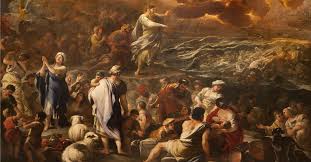
The use of irony by God in the Bible; God often uses irony in the Bible to challenge human expectations and reveal deeper truths, such as when Pharaoh’s attempts to oppress the Israelites ultimately led to their liberation through Moses, who was raised in Pharaoh’s own household. This literary device highlights God’s sovereignty and the unexpected ways He works in human history.

Irony and sarcasm are literary devices used throughout the Bible to convey deeper truths, challenge assumptions, and provoke reflection. These rhetorical tools are employed by various biblical authors to highlight the folly of human wisdom, the futility of idolatry, and the sovereignty of God. G. K. Beale A New Testament scholar shows how God has used irony throughout history in order to put his own wisdom and glory on display, using what is weak and foolish to accomplish his purposes.

Irony is not only encountered in every-day life, we also find it in Scripture. “In common parlance, irony is the statement of one thing with the intention of suggesting something else. Ironic incongruity underlines both the teachings of Jesus and his fate.

JD Vance warned Pope Leo to “be careful” when opining on matters of theology (the head of the Catholic church, which dates back to 330 AD or 1700 years ago, while the United States as a nation goes back to 250 years, and JD Vance is just a Catholic for less than 6 years), following a series of high-profile clashes between the leader of the Catholic Church and President Donald Trump over the past few days.

During a Turning Point USA event in Georgia on Tuesday, the vice president also acknowledged that some voters don’t “love” the Middle East conflict, defended Erika Kirk against “disgusting” attacks and sparred with a heckler who accused the administration of committing genocide.

Leo, the first U.S.-born pontiff, responded by saying he has “no fear of the Trump administration.” Earlier in the month, he wrote on X, “Anyone who is a disciple of Christ, the Prince of Peace, is never on the side of those who once wielded the sword and today drop bombs.”

Vance said he actually likes it when the pope comments on matters of policy because it invites debate. He said he has disagreed with Leo on a number of occasions, including most recently on the Middle east war.

“How can you say that God was never on the side of those who wield the sword?” Vance questioned. “Was God on the side of the Americans who liberated France from the Nazis? Was God on the side of the Americans who liberated Holocaust camps?”

He said he believes the answer is yes, while highlighting the concept of “just war theory.”

Vance, a former atheist who converted to Catholicism in 2019, then questioned Leo’s doctrinal chops. Leo spent nearly 50 years working in the church, including as a priest, a missionary and a cardinal, before being elected pontiff last year.

“In the same way it’s important for the vice president of the United States to be careful when I talk about matters of public policy, I think it’s very, very important for the pope to be careful when he talks about matters of theology,” he said.

The irony here is so thick you can cut it with a knife; when you compare the trial of Jesus Christ by the Sanhedrin, and the spat between Pope Leo and Donald Trump/JD Vance. God is great (Allah Akbar).

Does, Did God in OT kill people?

A nine-year old family member of mine, asked the question, and the answer they got from me was ‘No’. They went further, and stated, ‘what about the Egyptians that were perished in the Red Sea?’ And the response they got from me was, ‘God does not kill people, man kills man’.

Using the OT document, an intellectual analysis of the document goes as follows:

Fundamentally, when someone lends you a substance (life essence/soul) at a certain point in time, and subsequently at a given point in time determined by the Lender, collects it back. With a major factor or consideration, that you, the borrower had no say in when the substance was lent to you, and therefore, no say in when it would be collected back from you.

Furthermore, Jesus Christ the ‘Son of God’ validated Himself, by stating that He came to fulfill what was written in the OT. Therefore, the invalidation/repudiation of the OT, is an invalidation of Christianity.

Let us take a dive into the OT for verification of the foundational statement above.

In Genesis 15, God instructs Abraham to seal a covenant by splitting a heifer, goat, and ram in half, arranging them opposite each other, while leaving a dove and pigeon whole. This blood covenant ritual symbolized a binding agreement where, ultimately, a smoking fire pot and flaming torch representing God passed between the pieces. Verses 12-16 states; When the sun was setting, a deep sleep overcame Abram; and a horror (terror, shuddering fear, nightmare) of great darkness overcame him. God said to Abram, “Know for sure that your descendants will be strangers [living temporarily] in a land (Egypt) that is not theirs, where they will be enslaved and oppressed for four hundred years. But on that nation whom your descendants will serve I will bring judgment, and afterward they will come out [of that land] with great possessions. As for you, you shall [die and] go to your fathers in peace; you shall be buried at a good old age. Then in the fourth generation your descendants shall return here [to Canaan, the land of promise], for the wickedness and guilt of the Amorites is not yet complete (finished).”

Psalm 51 verses 5-6; Surely I was sinful at birth, sinful from the time my mother conceived me. Yet you desired faithfulness even in the womb; you taught me wisdom in that secret place.

Isaiah 45 verses 6-7; That people may know from the rising to the setting of the sun [the world over] That there is no one except Me. I am the Lord, and there is no other, The One forming light and creating darkness, Causing peace and creating disaster; I am the Lord who does all these things.

Genesis 1 verses 1-5; In the beginning God (Elohim) created [by forming from nothing] the heavens and the earth. The earth was formless and void or a waste and emptiness, and darkness was upon the face of the deep [primeval ocean that covered the unformed earth]. The Spirit of God was moving (hovering, brooding) over the face of the waters. And God said,  “Let there be light”; and there was light.God saw that the light was good (pleasing, useful) and He affirmed and sustained it; and God separated the light [distinguishing it] from the darkness. And God called the light day, and the darkness He called night. And there was evening and there was morning, one day.

An apt example that God lends a person, life essence/soul at a predetermined time and collects it back, also at a predetermined time, can be found in 1 Kings 22, King Ahab of Israel died in battle at Ramoth-Gilead after being struck by a “random” arrow that pierced his armour. Despite disguising himself to evade prophecy, he was mortally wounded, bled into his chariot, and died that evening, fulfilling Elijah’s prophecy that dogs would lick his blood. Take note of 1 Kings 22: verses 19-22; Micaiah continued, “Therefore hear the word of the Lord: I saw the Lord sitting on his throne with all the multitudes of heaven standing around him on his right and on his left. And the Lord said, ‘Who will entice Ahab into attacking Ramoth Gilead and GOING TO HIS DEATH THERE?’ “One suggested this, and another that. Finally, a spirit came forward, stood before the Lord and said, ‘I will entice him.’ “‘By what means?’ the Lord asked. “‘I will go out and be a deceiving spirit in the mouths of all his prophets,’ he said. “‘You will succeed in enticing him,’ said the Lord. ‘Go and do it.’

Life is hard, but God is good, creation has no say in what the Creator does, the qualification that God is good or evil is baseless, because He created good and evil, therefore He transcends good and evil, only the works of His Hands are good or evil, to those who experience it. God is the One who woke up the ICE agents in Minnesota and the victims they shot and killed on the days the victims were shot and killed. Does that mean that the God who is the same yesterday, today and tomorrow, is the One who killed the victims of the ICE agents in Minnesota? Do your own research, and answer the question of the nine-year old boy: Did the God of the OT killed the Egyptians that perish in the Red Sea? And did the God of today killed the victims of the shootings by ICE agents in Minnesota?

Love unquantifiability thereof, universality and standardisation of reward and punishment.

Matthew 22:37 means to love God with your entire being—heart (emotions/will), soul (life/essence), and mind (intellect)—representing a total, undivided commitment and devotion to Him, stemming from the ancient Jewish Shema (Deuteronomy 6:5) and forming the foundation for all other commandments, including loving your neighbour. It’s about prioritizing God above all else and integrating every part of yourself into a relationship of worship and obedience. Does a mother love one child more than another? The moment an individual ‘A’ loves individual ‘B’ more than individual ‘C’, that kind of love is not true love in the sight of God.

The Bible emphasizes treating others equally through love, respect, and fairness, often highlighting that God shows no favouritism. Key verses include the “Golden Rule” (Matthew 7:12), calling to love neighbours as oneself (Matthew 22:39), and the prohibition of partiality based on social status (James 2:1-4)

Isaiah 40:10; the Sovereign LORD comes with power, ruling with a mighty arm to bring rewards for the faithful and recompense (justice/retribution) for his people.

Standardisation of reward and punishment

The Parable of the Workers in the Vineyard (Matthew 20:1–16) tells of a landowner paying workers hired at different times (6 am to 5 pm) the same daily wage ( 1 denarius). Early workers grumble at the equal pay, but the owner asserts his right to be generous. It teaches God’s grace is unconditional, not based on merit. 

Mathew 5: 21-45;

“You have heard that it was said to the men of old, ‘You shall not murder,’ and ‘Whoever murders shall be guilty before the court.’ But I say to you that everyone who continues to be angry with his brother or harbours malice against him shall be guilty before the court; and whoever speaks [contemptuously and insultingly] to his brother, ‘Raca (You empty-headed idiot)!’ shall be guilty before the supreme court (Sanhedrin); and whoever says, ‘You fool!’ shall be in danger of the fiery hell.

The truth in the word of God that reward and punishment are standardised, and that love is unquantifiable, indicate that the end game/goal does not determine the actions/behavioural pattern, rather, since character/behavioural pattern are not physically/genetically determined, which indicates that character/behavioural pattern resides in the soul (life/essence), which does not change throughout the life of an individual. Therefore, the soul determines the endgame/goal. In addition, the lifetime of an individual is spent reinforcing and manifesting what is in the life/essence (soul). What is absent cannot be reinforced or manifested.

The Tiny Blue Dot

The Bible verses Isaiah 40:6–8, which state that “All men are like grass, and all their glory is like the flowers of the field. The grass withers and the flowers fall, but the word of our God stands forever”. This passage emphasizes the transience of human life and accomplishments in contrast to the enduring nature of God’s word. 

The Pale Blue Dot

Carl Sagan played a leading role in the U.S. space program. The prominent planetary scientist was a consultant and adviser to NASA beginning in the 1950s. He briefed the Apollo astronauts before their flights to the Moon.

In his role as a visiting scientist at JPL, Sagan helped design and manage the Mariner 2 mission to Venus; the Mariner 9, Viking 1, and Viking 2 trips to Mars; the Voyager 1 and Voyager 2 missions to the outer solar system, and the Galileo mission to Jupiter.

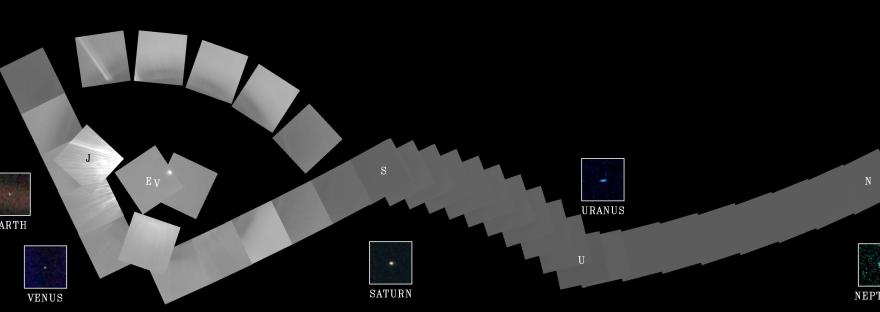
Sagan also was a member of the Voyager Imaging Team. He had the original idea in 1981 to use the cameras on one of the two Voyager spacecraft to image Earth. He realized that because the spacecraft were so far away the images might not show much. This was precisely why Sagan and other members of the Voyager team felt the images were needed — they wanted humanity to see Earth’s vulnerability, and that our home world is just a tiny, fragile speck in the cosmic ocean.

On Feb. 13, 1990, Voyager 1 warmed up its cameras for three hours. Then the spacecraft’s science platform was pointed at Neptune and the observations began.

After Neptune, it took images of Uranus, Saturn, Mars, the Sun, and then Jupiter, Earth, and Venus. The Earth images were taken at 04:48 GMT on Feb. 14, 1990, just 34 minutes before Voyager 1 powered off its cameras forever.

It took until May 1, 1990 — and four separate communications passes with NASA’s Deep Space Network — for all the image data to finally arrive back on Earth. Voyager 1 had captured images of six of the seven planets targeted as well as the Sun.

In his subsequent book “Pale Blue Dot: A Vision of the Human Future in Space,” Sagan wrote of the image: “That’s here. That’s home. That’s us. On it everyone you love, everyone you know, everyone you ever heard of, every human being who ever was, lived out their lives… on a mote of dust suspended in a sunbeam.”

“There is perhaps no better demonstration of the folly of human conceits than this distant image of our tiny world,” he said. “To me, it underscores our responsibility to deal more kindly with one another, and to preserve and cherish the pale blue dot, the only home we’ve ever known.”

Voyager 1 was launched Sept. 5, 1977, just days after its twin — Voyager 2 — on Aug. 20. Because it was on a faster route to the mission’s first encounter, at Jupiter, Voyager 1 overtook Voyager 2 on Dec. 15, 1977. (This was the reason for the order of their naming.)

Voyager 1 flew past Jupiter on March 5, 1979, and Saturn on Nov. 12, 1980.

After snapping the Pale Blue Dot and other “family photos,” at 05:22 GMT, Feb. 14, 1990, Voyager 1 powered off its cameras forever. Mission planners wanted to save its energy for the long journey ahead.

In August 2012, Voyager 1 entered interstellar space. It’s now the most distant human-made object ever.

The phrase “what is man that you are mindful of him” comes from Psalm 8:4, expressing a sense of awe at God’s care for humanity despite His immense power and the vastness of creation. The psalm contrasts God’s glory with mankind’s perceived frailty, asking why the Creator would pay attention to people, who are made “a little lower than the angels” but are also “crowned with glory and honour”. 

  • Contemplating the vastness of creation: The psalmist, David, looks at the night sky and questions why God, the creator of the heavens, moon, and stars, would care so much about human beings.
  • God’s creation of man: The psalm acknowledges that God made humans in His image and gave them authority over the earth, a source of both glory and honour.
  • The central question: The phrase is a reflection on the seemingly impossible paradox of God’s attention to humanity. Why would the magnificent and all-powerful Creator be mindful of a fragile and short-lived human being?
  • The answer found in the rest of the psalm: The rest of Psalm 8 answers this by detailing the specific ways God cares for and elevates humanity, including giving them dominion over creation, and the New Testament interpretation that this was ultimately fulfilled in Jesus Chris

Reference

http://www.science.nasa.gov/mission/voyager/voyager-1s-pate-blue-dot

In the Name of

In a monarchy, whenever the statement: In the Name of the Monarch is uttered; this implies: the institution of the Monarch, not the literal name, Elizabeth or Charles. The same thing goes in a Democracy; when this same statement is made, it signifies, the institution (Constitution) of democracy, and not the name of the current holder of the position of the head of the institution.

However, if an individual takes a marriage oath, or the oath of office (such as in the United States of America), or gives evidence in a court of Law, such an individual is not a “Christian”, because that individual has contradicted his or her Lord and Saviour, Jesus Christ, who explicitly said in the Sermon on the Mount: see Mathew 5:34-37; But I say to you, take no oath at all, neither by heaven, for it is the throne of God, nor by the earth, for it is the footstool of His feet, nor by Jerusalem, for it is the city of the great King. Nor shall you take an oath by your head, for you cannot make a single hair white or black. But make sure your statement is, ‘Yes, yes’ or ‘No, no’; anything beyond these is of evil origin.

This makes you wonder about the so called Christian Evangelical sects supporting Donald Trump for Presidency of the United States of America for 2024, they are not CHRISTIANS, they only appropriate the label “Christians” in name only, but not in nature. The same goes for people who swear an oath at Church weddings, or gives evidence in a court of law, by swearing on the Bible, or certain US Supreme court Justices. If they can not or will not, do or follow the precepts of their Lord and Saviour, no prayer said in the Name of Jesus Christ will be heard by their Lord, because they speak from their head and not from their heart.