The ‘Anatomy’ of Man; Body, Soul and spirit

Genesis chapter 3 verse 21; The Lord God made garments of skin for Adam and his wife and clothed them. What is the garment of skin and why did God make it? Is it the  skin of lambs or goat? Is this text to be taken literarily or metaphorically? What is the nature of a man? Can the nature of a man be transmitted or inherited by its offspring? Do men possess a soul and or a spirit? Did Adam and Eve spiritually died (metaphorically) with the fall in the garden of Eden?

Is the soul and or the spirit, a physical entity? What is Hell? Does Hell mean separation from God? Does Hell mean lack of communion with God? John chapter 4 verse 24; God is spirit, and his worshippers must worship in the Spirit and in truth.”

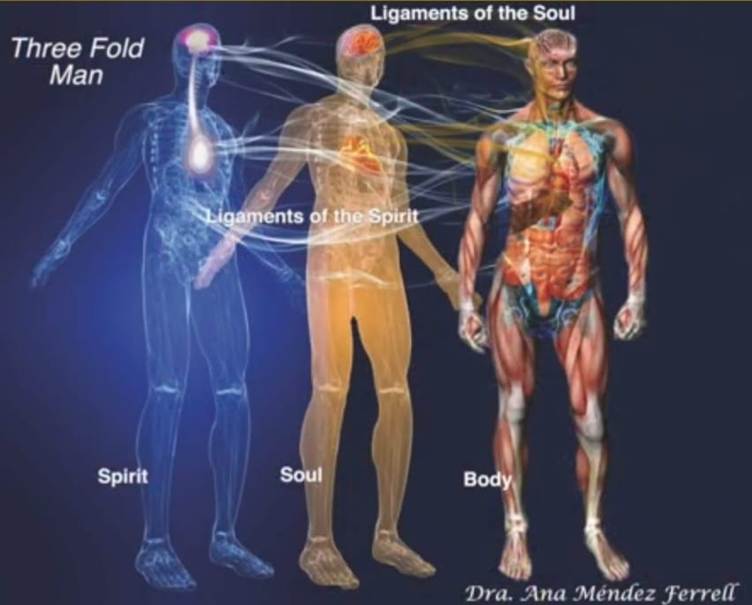
1. The Body (Physical)

  • Function: The material vehicle that interacts with the physical world.
  • Connection: Uses the five physical senses (sight, hearing, smell, taste, touch) to experience the environment.
  • Concept: Often referred to in scripture as the “vessel” or “earth suit” that houses the soul and spirit.

2. The Soul (Immaterial – Psychological)

  • Function: The command centre of human personality, self-awareness, and intellect.
  • Connection: Composed of the mind (reasoning and imagination), will (decision-making), and emotions (feelings and desires).
  • Concept: It is the bridge between the physical body and the unseen spiritual realm.

3. The Spirit (Immaterial – Spiritual)

  • Function: The innermost, deepest part of a human that relates directly to the spiritual realm and to God.
  • Connection: Operates through spiritual faculties like conscience (knowing right from wrong), intuition (knowing without reasoning), and communion (worship and prayer).
  • Concept: In many traditions, it is considered dormant or dead to God until a spiritual awakening occurs, but becomes the dwelling place for the Holy Spirit for believers.
  • Interaction and Harmony
  • These three parts form a unified whole. The spirit contacts God, the soul governs your personality and mental state, and the body expresses these inward realities to the physical world. Imbalance in one area—such as neglecting physical health or experiencing emotional turmoil—often negatively impacts the other components.
Here’s a clear breakdown of what Jesus said in the Gospel accounts regarding the soul and spirit of man:


The Soul (psychē in Greek)

Jesus spoke about the soul quite frequently. Key references include:

  • Matthew 10:28 — He warned not to fear those who kill the body but cannot kill the soul, but rather to fear God who can destroy both soul and body.
  • Matthew 16:26 — “What does it profit a man if he gains the whole world but forfeits his soul?” This is one of his most famous sayings.
  • Mark 8:36–37 — A parallel passage to the above, emphasising the soul’s supreme value.
  • Matthew 11:29 — “You will find rest for your souls.” Here Jesus uses soul to refer to the deep inner life of a person.
  • Luke 12:19–20 — In the Parable of the Rich Fool, God addresses the man: “You fool! This very night your soul will be required of you.” Jesus uses psychē to mean the life/soul that belongs to God.
  • John 10:11, 15, 17 — Jesus repeatedly says he lays down his psychē (soul/life) for the sheep, showing the soul as the seat of sacrificial self-giving.
  • John 12:27 — “Now my soul (psychē) is troubled.” Jesus speaks of his own soul in anguish before the crucifixion.

The Spirit (pneuma in Greek)

Jesus spoke less frequently about the spirit of man specifically, but there are notable instances:

  • Matthew 5:3 — “Blessed are the poor in spirit” — referring to humility and dependence on God in one’s inner spirit.
  • Matthew 26:41 — “The spirit is willing, but the flesh is weak.” Here Jesus acknowledges the human spirit as capable of godly desire, yet still limited.
  • Luke 23:46 — On the cross, Jesus cried, “Father, into your hands I commit my spirit” (pneuma) — using the word for his own departing spirit at death.
  • John 3:5–6 — In his conversation with Nicodemus, Jesus distinguishes between being born of the flesh and born of the Spirit, touching on the spirit’s role in spiritual rebirth.
  • John 4:23–24 — Jesus tells the Samaritan woman that true worshippers will worship the Father “in spirit and in truth,” pointing to the human spirit as the organ of true worship.
  • John 11:33; 13:21 — Jesus is described as being “troubled in spirit” (pneuma), showing the spirit as the seat of deep emotion.

Summary

TermGreekJesus’ Emphasis
SoulpsychēThe eternal inner life; its value surpasses all earthly things; can be lost or saved
SpiritpneumaThe God-ward faculty; the organ of worship, prayer, and spiritual rebirth

Jesus spoke about both, but referenced the soul more often in ethical and eschatological contexts (what you risk, what you must save), while spirit appeared more in contexts of worship, prayer, and new birth. The two concepts are closely related but NOT IDENTICAL in his teaching.

The major character attributes of man that are not coded for biologically in the genes: This is a profound and wide-ranging question that can be approached from theological, philosophical, and anthropological perspectives. Here’s a comprehensive breakdown:


The Major Character Attributes of Man


1. Trichotomy vs. Dichotomy — The Makeup of Man

Many theologians and philosophers understand man as composed of distinct but interrelated dimensions:

Trichotomous view (three parts):

  • Body — the physical, material aspect
  • Soul (psychē) — the seat of personality, emotion, will, and individual identity
  • Spirit (pneuma) — the God-ward faculty; the part that communes with God

Dichotomous view (two parts):

  • Body — the material/physical nature
  • Soul/Spirit — treated as one immaterial inner nature

Both views are widely held among theologians, but the distinction matters when understanding how man relates to God, to others, and to himself.


2. The Intellectual Attribute — The Mind

Man is a rational, thinking being. This sets him apart from all other creatures:

  • Capable of reason, logic, and abstract thought
  • Able to reflect on himself (self-awareness)
  • Capable of language, philosophy, science, and theology
  • Able to know God — not just instinctively, but consciously and personally
  • Possesses conscience — an inner moral faculty that evaluates right and wrong

This is why in Scripture, man is called to love God with all his mind (Matthew 22:37).


3. The Moral Attribute — Conscience and Free Will

Man is a moral agent:

  • Endowed with free will — the capacity to choose between good and evil
  • Possesses a conscience that bears witness to moral law (Romans 2:15)
  • Capable of guilt, shame, repentance, and moral growth
  • Accountable for his actions — unlike animals, man can be held morally responsible

This moral dimension is central to every major religious and philosophical tradition.


4. The Emotional Attribute — The Heart

Man is a feeling, passionate being:

  • Experiences love, joy, grief, anger, fear, hope, and despair
  • The heart in biblical terms is the centre of emotion, desire, and motivation
  • Capable of deep compassion and also deep hatred
  • Emotions drive much of human behaviour and relationship

5. The Volitional Attribute — The Will

Man possesses willpower and intentionality:

  • Ability to set goals and pursue them
  • Capacity for self-discipline and self-denial
  • Can choose loyalty, commitment, and perseverance
  • The will is what makes man responsible for his choices

6. The Social Attribute — Relational Nature

Man is fundamentally a social being:

  • Created for community and relationship — “It is not good for man to be alone” (Genesis 2:18)
  • Needs love, belonging, and meaningful connection
  • Organises into families, tribes, societies, and nations
  • Capable of friendship, loyalty, sacrifice, and covenant

7. The Spiritual Attribute — God-Consciousness

Man is uniquely a spiritual being:

  • Has an innate awareness of God or a higher power (what theologians call the sensus divinitatis)
  • Experiences a longing for transcendence — for meaning beyond the material world
  • Capable of worship, prayer, and faith
  • Has a deep inner awareness that death is not the end

As Augustine famously wrote: “Our heart is restless until it rests in Thee.”


8. The Creative Attribute — Image of God (Imago Dei)

In the Judeo-Christian tradition, man is made in the image of God (Genesis 1:26–27):

  • Capable of creativity — art, music, architecture, language, invention
  • Has a sense of beauty and aesthetic appreciation
  • Able to subdue and cultivate the earth (stewardship)
  • This image is what gives man inherent dignity and worth

9. The Fallen Attribute — The Sinful Nature

No honest account of man’s character can ignore his tendency toward evil:

  • Prone to selfishness, pride, and deception
  • Capable of great cruelty and injustice
  • Experiences inner conflict between good desires and destructive ones (Romans 7:15–24)
  • In theological terms, man is fallen — his original nature corrupted by sin

This explains the paradox of man: capable of extraordinary nobility and tremendous wickedness at the same time.


10. The Immortal Attribute — Eternal Destiny

Man alone among earthly creatures has eternal significance:

  • The soul/spirit survives physical death
  • Man faces judgement and eternal consequence
  • Capable of eternal fellowship with God — or eternal separation
  • This gives every human life ultimate, irreducible worth

Summary Table

AttributeFacultyKey Expression
IntellectualMindReason, knowledge, conscience
MoralWill + ConscienceRight/wrong, accountability
EmotionalHeartLove, grief, joy, desire
VolitionalWillChoice, purpose, discipline
SocialRelationshipsCommunity, love, covenant
SpiritualSpiritWorship, prayer, God-awareness
CreativeImaginationArt, invention, stewardship
FallenSin naturePride, selfishness, brokenness
ImmortalSoulEternal destiny

Man is therefore the most complex, dignified, and conflicted of all earthly creatures — made for God, capable of great good, yet deeply broken, and in need of redemption. This tension runs through all of human history, literature, philosophy, and religion.
What is Time, Fundamentally

Genesis 1 verses 14-19; And God said, “Let there be lights in the vault of the sky to separate the day from the night, and let them serve as signs to mark sacred times, and days and years, and let them be lights in the vault of the sky to give light on the earth.” And it was so. God made two great lights—the greater light to govern the day and the lesser light to govern the night. He also made the stars. God set them in the vault of the sky to give light on the earth, to govern the day and the night, and to separate light from darkness. And God saw that it was good. And there was evening, and there was morning—the fourth day.

What is time from the perspective of living organisms compared to that of cosmic bodies?

This is a beautifully deep question that sits at the intersection of biology, physics, and philosophy.

What is Time, Fundamentally?

Physically, time is a dimension of the universe — part of the spacetime fabric described by Einstein’s relativity. But experienced time and cosmic time are very different things.


Time from the Perspective of Living Organisms

Time is biological and relative

Living organisms don’t experience time as a fixed constant — they experience it through:

  • Metabolism — faster metabolism generally correlates with a faster subjective experience of time. A hummingbird’s heart beats ~1,200 times per minute; it likely perceives the world in much finer temporal slices than a tortoise
  • Circadian rhythms — almost all life on Earth is locked to roughly a 24-hour biological clock, tied to the planet’s rotation
  • Neural processing speed — the faster an organism processes sensory information, the more “frames per second” of reality it experiences. Small fast animals like flies perceive time more slowly relative to us (they see us moving in slow motion)

Time is purpose-driven for life

For living organisms, time is experienced as:

  • Survival pressure — immediate, urgent, fleeting
  • Generational — life measures time in lifespans, seasons, and reproductive cycles
  • Cellular — at the cellular level, time is measured in chemical reactions, protein folding, and DNA replication — milliseconds to hours
  • Evolutionary — at the species level, meaningful change happens over thousands to millions of years

Life’s relationship with time is asymmetric

Living organisms have a profound awareness of time’s arrow — birth, growth, decay, death. Entropy is felt personally. Every living thing is essentially a temporary configuration of matter fighting against disorder.


Time from the Perspective of Cosmic Bodies

Time is almost incomprehensibly vast

  • The Sun is 4.6 billion years old and will live another ~5 billion — a single stellar lifetime dwarfs all of human civilisation millions of times over
  • A neutron star can complete a full rotation in milliseconds, experiencing enormous amounts of rotational “time” per second
  • Black holes warp time itself — at the event horizon, time slows to a standstill relative to a distant observer
  • Galaxies evolve over billions of years; their “events” — collisions, star formation, spiral arm shifts — are invisible on any human timescale

Cosmic bodies don’t experience time

This is perhaps the most striking contrast. A star doesn’t feel its 10-billion-year life. A galaxy doesn’t anticipate its eventual collision with a neighbour. Cosmic time simply passes and accumulates through physics — gravity, nuclear fusion, thermodynamics — without any internal experience.


The Great Contrast

Living OrganismsCosmic Bodies
ScaleMicroseconds to millenniaMillions to billions of years
ExperienceSubjective, felt, urgentNone — purely physical
MeasurementHeartbeats, seasons, generationsLight-years, orbital periods
Relationship to entropyActive resistancePassive progression
Time’s arrowDeeply feltIndifferent

A Philosophical Reflection

There is something remarkable in the contrast: the universe is ancient and vast, yet indifferent to time, while a mayfly lives only one day but experiences that day with full biological urgency and presence.

In a sense, consciousness may be the universe’s only mechanism for actually experiencing time — and living organisms, however brief, are the only things in the cosmos for whom time truly means anything.

As the physicist Carlo Rovelli puts it, time as we feel it — flowing, urgent, personal — may be less a feature of the universe and more a feature of us.

The time scale and timespan of living organisms differs from that of cosmic bodies. How old is the oldest verified living organism?

The oldest verified living organism depends on how you define “individual organism” — the answer changes quite dramatically.

Single Organism (Clonal / Rooted)

Pando — a clonal colony of quaking aspen trees in Utah, USA — is often cited as one of the oldest and most massive living organisms, estimated at around 80,000 years old, though some estimates go higher. It’s technically a single organism connected by one root system.

Oldest Individual Non-human Animal

Jonathan the Seychelles giant tortoise is the oldest known living animal, born around 1832, making him approximately 193 years old as of 2026. He lives on the island of St. Helena.

Oldest Individual Tree

Methuselah, a Great Basin bristlecone pine in California, USA, is approximately 4,855 years old — the oldest known individual (non-clonal) tree.

Oldest Known Living Microorganism

Bacteria revived from ancient salt crystals and permafrost have been claimed to be hundreds of thousands to millions of years old, though these claims are harder to verify and debated scientifically.

Oldest in the Ocean

Ocean quahog clams (Arctica islandica) are among the longest-lived animals — one nicknamed “Ming” was confirmed at 507 years old when it was (unfortunately) killed during the aging process in 2006.

Key takeaway

Life’s longevity record depends heavily on definition — a single rooted tree, a clonal colony, an animal, or a microbe all yield very different answers. But life on Earth has clearly mastered the art of persistence.

The Sun is about 4.6 billion years old, formed from a collapsing cloud of gas and dust in a spiral arm of the Milky Way. It’s currently about halfway through its main-sequence lifetime — it’s expected to continue burning hydrogen for another ~5 billion years before expanding into a red giant.

Earth is also about 4.54 billion years old, forming roughly 50–100 million years after the Sun from the same swirling disk of gas and dust (the solar nebula).

We know this primarily through radiometric dating of the oldest rocks and minerals on Earth (zircon crystals dated to ~4.4 billion years), as well as dating of meteorites from the same era.

The earliest known systematic human anatomical dissections were performed in Alexandria, Egypt, around 300–250 BCE.

The key figures were Herophilus of Chalcedon and Erasistratus of Chios, both working at the famous Library/Museum of Alexandria under the patronage of the Ptolemaic rulers. They are credited with being the first to perform dissections of human cadavers in a systematic, scientific way — and according to some ancient sources (like Celsus), they may have even performed vivisections on condemned criminals, though this remains debated.

Before Alexandria, anatomical knowledge came mainly from:

  • Animal dissections (e.g., Aristotle dissected many animals but not humans)
  • Wound observation in warfare and surgery
  • Hippocratic writings (~400 BCE), which were based on external observation rather than dissection

After the Alexandrian period, human dissection largely fell out of practice in the ancient world due to cultural and religious taboos, and wasn’t systematically revived in Europe until the 13th–14th centuries, with figures like Mondino de Luzzi in Bologna.

During a philosophical discussion with a friend, it was suggested that the modern generation are more intelligent than the older ones. Are the adolescents of the modern generation capable of more brain functioning capacity compared to previous generations?

This is a fascinating and nuanced question. The short answer is: it’s complicated — and depends on what you mean by “brain functioning capacity.”

The Flynn Effect

The most well-documented finding is the Flynn Effect — IQ scores rose steadily across the 20th century in many countries, roughly 3 points per decade. This suggests improvements in certain cognitive abilities like abstract reasoning and pattern recognition, likely due to better nutrition, education, healthcare, and more cognitively stimulating environments.

Where modern adolescents may have an edge

  • Visual-spatial processing — navigating digital interfaces, reading complex visuals, and multitasking across screens appears stronger
  • Information access and synthesis — faster at finding and filtering large amounts of information
  • Tech-native problem solving — intuitive with tools previous generations had to consciously learn

Where there are concerns

  • Attention span and deep focus — studies suggest sustained concentration may be declining, linked to smartphone and social media use
  • Memory — reliance on external devices (“Google effect”) may reduce the need to internally store information
  • The Flynn Effect may be reversing — some Scandinavian and other studies from the 1990s onward suggest IQ gains have plateaued or slightly declined in some developed nations
  • Mental health — rates of anxiety, depression, and stress are notably higher in Gen Z, which affects cognitive performance

The bigger picture

The brain’s raw biological capacity hasn’t changed — human brains are essentially the same hardware as thousands of years ago. What changes across generations is how that capacity is trained, used, and expressed, shaped by environment, education, technology, nutrition, and culture.

So modern adolescents aren’t necessarily more capable in an absolute sense, but they are differently capable — optimised for the cognitive demands of the world they grew up in. The elephant in the room is; do you subscribe to the school of thought of an evolutionist or that of an intelligent designer/creationist? Follow the evidence.

Truth, Knowledge, Understanding and Wisdom

Truth is conformity to reality or fact, meaning it represents what is actually the case, contrasting with falsehood or misrepresentation. It is often associated with honesty and is a property of statements or beliefs that accurately describe the world.

John 14: 15-24; “If you love me, keep my commands.And I will ask the Father, and he will give you another advocate to help you and be with you forever— the Spirit of truth. The world cannot accept him, because it neither sees him nor knows him. But you know him, for he lives with you and will be in you.I will not leave you as orphans; I will come to you.Before long, the world will not see me anymore, but you will see me. Because I live, you also will live. On that day you will realize that I am in my Father, and you are in me, and I am in you. Whoever has my commands and keeps them is the one who loves me. The one who loves me will be loved by my Father, and I too will love them and show myself to them.” Then Judas (not Judas Iscariot) said, “But, Lord, why do you intend to show yourself to us and not to the world?” Jesus replied, “Anyone who loves me will obey my teaching. My Father will love them, and we will come to them and make our home with them. Anyone who does not love me will not obey my teaching. These words you hear are not my own; they belong to the Father who sent me.

John 14:6-7; Jesus answered, “I am the way and the truth and the life. No one comes to the Father except through me. If you really know me, you will knowmy Father as well. From now on, you do know him and have seen him.”

What you believe, you don’t know, what you know, you don’t believe.

Belief is often based on what we do not know, while knowledge is grounded in certainty. This concept suggests that true belief requires uncertainty, as you cannot believe in something you already know.

Understanding Belief and Knowledge

The Nature of Belief

Belief is fundamentally tied to uncertainty. When you believe in something, it implies that you do not have complete knowledge or certainty about it. For example, you might believe in concepts or entities that you cannot fully verify or understand, such as mythical figures or abstract ideas. This is because belief fills the gaps where knowledge is lacking.

The Nature of Knowledge

Knowledge, on the other hand, is based on certainty and understanding. When you know something, you have evidence or experience that confirms its truth. For instance, you know your family members because you have direct experiences with them. This certainty means that you do not need to believe in their existence; you simply know it to be true.

Key Differences

AspectBeliefKnowledge
DefinitionAcceptance of something as true without full evidenceUnderstanding based on certainty and evidence
Relation to UncertaintyRequires uncertainty; you believe what you do not fully knowGrounded in certainty; you know what you understand
ExamplesBelieving in a deity or a mythKnowing your name or your age

In essence, belief and knowledge are distinct yet interconnected concepts. Belief thrives in the realm of the unknown, while knowledge is anchored in certainty. Understanding this difference can help clarify how we approach various ideas and truths in our lives.

Definition of Wisdom

Wisdom is indeed defined as the judicious application of knowledge. It encompasses several key aspects:

Key Aspects of Wisdom

  • Judicious Application: Wisdom involves using knowledge effectively to make sound decisions and judgments.
  • Influenced by Experience: It is shaped by personal experiences, allowing individuals to apply their knowledge in practical situations.
  • Ethical Considerations: Wisdom incorporates ethical understanding, guiding individuals to consider the moral implications of their decisions.
  • Deep Understanding: It requires a profound comprehension of complex life situations, enabling individuals to navigate challenges thoughtfully.

Comparison with Knowledge

AttributeKnowledgeWisdom
DefinitionAccumulation of facts and informationJudicious application of knowledge
NatureQuantitative and objectiveQualitative and subjective
AcquisitionThrough study and observationThrough reflection and life experience
FocusAnswers “what” and “how”Answers “why” and “should”

In summary, wisdom is more than just knowledge; it is the ability to apply that knowledge in a way that is ethical, insightful, and beneficial to oneself and others.

Proverbs 9:10 states, “The fear of the Lord is the beginning of wisdom, and knowledge of the Holy One is understanding.”

ConceptDescription
WisdomThe ability to make sound decisions and choices based on knowledge.
KnowledgeAwareness or understanding of facts, truths, or principles.
UnderstandingThe ability to grasp the meaning or significance of knowledge.

This verse emphasizes that a proper reverence for God is foundational to gaining wisdom, while true understanding comes from knowing God.

In biblical teachings, knowledge is the accumulation of facts and information, understanding is the ability to discern and apply that knowledge, and wisdom is the practical application of both knowledge and understanding in decision-making. These three concepts build on each other, with wisdom emerging from the combination of knowledge and understanding over time.

The fear of the Lord is significant in gaining wisdom because it serves as the foundation for true knowledge and understanding. It involves a deep respect and reverence for God, which leads to obedience and a transformed perspective on life.

For the LORD gives wisdom; from his mouth come knowledge and understanding.

Wisdom will save you also from the adulterous woman, from the wayward woman with her seductive words, who has left the partner of her youth and ignored the covenant she made before God. Surely her house leads down to death and her paths to the spirits of the dead. None who go to her return or attain the paths of life.

The location of wisdom is primarily discussed in Job 28. This chapter presents a profound exploration of wisdom, emphasizing that it cannot be discovered through human effort or material wealth.

Key Themes in Job 28

  • Human Effort: The chapter begins by illustrating the lengths to which humans go to find precious metals, highlighting that despite their ingenuity, wisdom remains elusive.
  • Inaccessibility: It states that wisdom cannot be found in the land of the living, nor can it be purchased with riches. This underscores the idea that wisdom transcends human understanding and material possessions.
  • Divine Source: Ultimately, Job 28 concludes that true wisdom is a gift from God. It emphasizes that “the fear of the Lord, that is wisdom; and to depart from evil is understanding” (Job 28:28). This indicates that wisdom is intrinsically linked to a relationship with God and moral integrity.

Summary of Job 28 Structure

SectionContent Description
Verses 1-14Describes human efforts to mine for precious metals.
Verses 15-19States that wisdom cannot be bought or valued.
Verses 20-28Concludes that wisdom is found only in God and through reverence for Him.

This chapter serves as a critical reflection on the nature of wisdom, contrasting human knowledge with divine understanding.

The difference between dissemination of data or information and receival of knowledge and Truth.

Dissemination means the act of spreading information, ideas, or knowledge widely to many people. In Genesis chapter 3, the account of the fall of man: Now the serpent was more crafty than any of the wild animals the Lord God had made. He said to the woman, “Did God really say, ‘You must not eat from any tree in the garden’?” The woman said to the serpent, “We may eat fruit from the trees in the garden, but God did say, ‘You must not eat fruit from the tree that is in the middle of the garden, and you must not touch it, or you will die.’”“You will not certainly die,” the serpent said to the woman.“For God knows that when you eat from it your eyes will be opened, and you will be like God, knowing good and evil.”

When you read this account to the end, objectively, the main question for the serpent, is; what was its motive? To prove that the Creator/God is lying. Secondly, who spoke the Real Truth? God or the serpent? The Man did die after eating the forbidden fruit, with the passage of time. Did the serpent speak the truth or did it disseminate information with an ulterior motive? (Injudicious application of ‘knowledge’)Injudicious means showing poor judgment or being unwise, especially in personal relationships or social situations. It refers to actions or comments that lack discretion or sensibility.

Stars, Constellations and Galaxies mentioned in the Bible

Fun fact, the Sun does not depend on planet earth, while planet earth depends on the Sun. Without the Sun, no planet earth, while without planet earth, the Sun continues to tow 7 planets and countless space rocks in its orbit. Planet earth relies on the Sun, which is our Star, in the Milky Way galaxy. Cosmologist states that water is essential for life, however, there is water on the moon, but no life.

There is a song, sung by people from Southwestern Nigeria, with parts of its lyrics as follow “The King that we do not see, but whose handiwork we see”, whenever you ask the people to list some of the handiwork of the King; they talk about miracles such as, parting of the Red Sea, and Jesus Christ walking on water. There is a disconnect between the concept of God and the reality of the physical universe of which Man and all living organisms are a part thereof. Which means to most religious people, God is abstract, and not real, like their friends and family. They cannot see or perceive God physically.

Genesis 1:14-18;

And God said, “Let there be lights in the vault of the sky to separate the day from the night, and let them serve as signs to mark sacred times, and days and years, and let them be lights in the vault of the sky to give light on the earth.” And it was so. God made two great lights—the greater light to govern the day and the lesser light to govern the night. He also made the stars. God set them in the vault of the sky to give light on the earth,to govern the day and the night, and to separate light from darkness. And God saw that it was good.

Psalm 19: 1-6;

The heavens declare the glory of God; the skies proclaim the work of his hands. Day after day they pour forth speech; night after night they reveal knowledge.They have no speech, they use no words; no sound is heard from them.Yet their voicegoes out into all the earth, their words to the ends of the world. In the heavens God has pitched a tent for the sun. It is like a bridegroom coming out of his chamber, like a champion rejoicing to run his course. It rises at one end of the heavens and makes its circuit to the other; nothing is deprived of its warmth. (The black hole at the centre of the Milky Way is called Sagittarius A*, which is a supermassive black hole with an estimated mass of about 4.3 million times that of the Sun. It is located approximately 26,000 light-years from Earth in the constellation Sagittarius.)

Job 38: 7;

While the morning stars sang together and all the angelsshouted for joy?

Job 38:31-33;

 “Can you bind the chainsof the Pleiades? Can you loosen Orion’s belt? Can you bring forth the constellations in their seasons or lead out the Bearwith its cubs?Do you know the laws of the heavens? Can you set up God’sdominion over the earth?

Job 9: 7-9;

He speaks to the sun and it does not shine; he seals off the light of the stars. He alone stretches out the heavens and treads on the waves of the sea. He is the Maker of the Bearand Orion, the Pleiades and the constellations of the south.

The book of Job is the oldest book in the Bible. It is not surprising, therefore, that it contains a number of references to creation and the Flood, for these great events were still relatively fresh in the thinking of Job and his contemporaries. The first of these creation references in Job is the text above, and it is remarkable that it centres especially on the stars and their constellations. Still another constellation is mentioned in Job 26:13: “By his spirit he hath garnished the heavens; his hand hath formed the crooked serpent.”

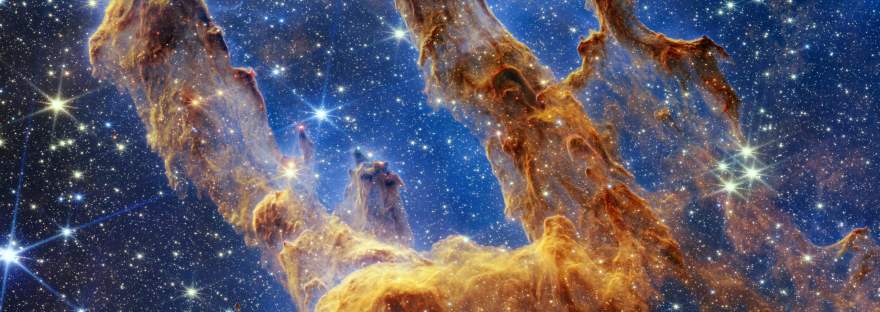
Job 26: 5-14; “The dead are in deep anguish, those beneath the waters and all that live in them.The realm of the dead is naked before God; Destructionlies uncovered.He spreads out the northern skies over empty space; he suspends the earth over nothing. He wraps up the waters in his clouds, yet the clouds do not burst under their weight. He covers the face of the full moon, spreading his clouds over it. He marks out the horizon on the face of the waters for a boundary between light and darkness.The pillars of the heavens quake (The star-forming region known as the Pillars of Creation is located in the Eagle Nebula, approximately 6,500 to 7,000 light-years from Earth. This region is famous for its stunning columns of interstellar gas and dust that are actively creating new stars.), aghast at his rebuke.By his power he churned up the sea; by his wisdom he cut Rahab to pieces.By his breath the skies became fair; his hand pierced the gliding serpent. And these are but the OUTER FRINGE of his works; how faint the whisper we hear of him! Who then can understand the thunder of his power?”

Finally: “Canst thou bind the sweet influences of Pleiades, or loose the bands of Orion? Canst thou bring forth Mazzaroth in his season? or canst thou guide Arcturus with his sons? Knowest thou the ordinances of heaven? canst thou set the dominion thereof in the earth?” (Job 38: 31-33). The term “Mazzaroth” actually means the 12 constellations of the Zodiac.

Thus, God not only created the stars but arranged them in star groupings that could be used for “signs, and for seasons” (Genesis 1:14;). Since God does nothing without a holy purpose, we can be sure that these sidereal signs were not to be used as astrological signs. God’s Word, in fact, forbids the practice of astrology (Isaiah 47: 12-14; “Keep on, then, with your magic spells and with your many sorceries, which you have laboured at since childhood. Perhaps you will succeed, perhaps you will cause terror. All the counsel you have received has only worn you out! Let your astrologers come forward, those stargazers who make predictions month by month, let them save you from what is coming upon you. Surely they are like stubble; the fire will burn them up. They cannot even save themselves from the power of the flame. These are not coals for warmth; this is not a fire to sit by.). The constellations must all in some way have testified of the coming Savior.

Location of Constellations

Pleiades

  • Constellation: Taurus
  • Description: The Pleiades, also known as the Seven Sisters, is an open star cluster located approximately 444 light-years from Earth. It is one of the most recognizable star clusters in the night sky.

Orion

  • Constellation: Orion
  • Description: Orion is a prominent constellation known for its three-star belt. It is visible in the night sky and is often associated with various myths and stories across cultures.

Bear

  • Constellations: Ursa Major and Ursa Minor
  • Description:
    • Ursa Major (Great Bear): Contains the well-known asterism called the Big Dipper.
    • Ursa Minor (Little Bear): Includes Polaris, the North Star, which is located near the north celestial pole.

Crooked Serpent

  • Constellation: Draco
  • Description: Draco winds around the north celestial pole and is known for its distinctive shape resembling a serpent. It is located between the constellations Ursa Major and Ursa Minor.
ConstellationLocationNotable Features
PleiadesTaurusOpen star cluster, visible to the naked eye
OrionOrionThree-star belt, prominent in the night sky
Ursa MajorNorthern HemisphereBig Dipper, Great Bear
Ursa MinorNorthern HemisphereContains Polaris, the North Star
DracoNorthern HemisphereWinds around the north celestial pole

The Parable of the Wheat and Tares

The Parable of the Wheat and Tares, found in Matthew 13:24-30, tells the story of a farmer who sows good wheat in his field, but an enemy sows weeds (tares) among the wheat while everyone sleeps (See ‘Sense of Humour’: Doctrinal principles attributed to Apostle Paul were used to sow weed among the seeds of the word of God; https://adonai4oo.wordpress.com/blog/ ). The farmer instructs his servants to let both grow together until the harvest, when the weeds will be separated and burned, symbolizing the final judgment between the righteous and the wicked.

Overview of the Parable

The Parable of the Wheat and the Tares, found in Matthew 13:24-30, illustrates the coexistence of good and evil in the world. In this story, a man sows good seed in his field, but while he sleeps, an enemy sows tares (weeds) among the wheat. When the wheat grows, the tares also appear.

Key Elements of the Parable

Characters and Symbols

Character/SymbolRepresentation
The ManRepresents Jesus (the Son of Man)
Good Seed (Wheat)Represents the children of the Kingdom
Tares (Weeds)Represents the children of the evil one (Satan)
The FieldRepresents the world
The HarvestRepresents the end of the age
The ReapersRepresent angels who will separate the good from the bad

Main Message

  • The parable teaches that good and evil will grow together until the end of time.
  • At the harvest, the good will be gathered into God’s kingdom, while the evil will be separated and destroyed.

Interpretation

In Matthew 13:36-43, Jesus explains the parable to His disciples. He emphasizes that the presence of both good and bad is a reality in the world. The final judgment will reveal the true nature of individuals, separating the righteous from the wicked.

Lessons Learned

  • Patience and Tolerance: Believers are encouraged to coexist with those who may not share their faith, as ultimate judgment belongs to God.
  • Awareness of Evil: The parable serves as a reminder that evil exists alongside good, and believers should remain vigilant.

This parable highlights the importance of understanding the spiritual dynamics at play in the world and reassures believers of God’s ultimate justice.