Blog

Energy – Force – Power

God created the heavens and the earth, and everything seen and unseen. In the process of creation, right after the first phase, God created time, to govern and act as a reference frame for all creation in nature. As a result of Time, being cyclical and simultaneously linear, in addition to being irrevocably unidirectional, this translates into all physical matter with a starting point having a decay or death or transformation point in time. So much so, that when God Himself stepped into time (to do the work of Salvation), He was subjected to that irrevocability, which we know His death and resurrection (transformation back to His Spirit form).

The law of conservation of energy states that energy can neither be created nor destroyed – only converted from one form of energy to another. This means that a system always has the same amount of energy, unless it’s added from the outside.

Energy, in physics, the capacity for doing work. It may exist in potential, kinetic, thermal, electrical, chemical, nuclear, or other various forms.

In Physics, force is defined as: The push or pull on an object with mass causes it to change its velocity. Force is an external agent capable of changing a body’s state of rest or motion. It has a magnitude and a direction. A force is exerted on one object by another. The idea of a force is not limited to living things or non-living things. All objects (living and non-living) can apply a force on or to another object; also, all objects (living and non-living) can be affected by forces.

In physics, power is the amount of energy transferred or converted per unit time. Power, in science and engineering, time rate of doing work or delivering energy, expressible as the amount of work done W, or energy transferred, divided by the time interval t—or W/t.

There may be some compacting—holding down of energy—in the heart centre, to avoid energetic interaction with people” and that “At the beginning stages of death, the energy field starts to separate. The lower three bodies (layers of the energy field) break up and dissolve.

Jesus Christ is the Power of God, the wisdom of God, and most important of all, the Love of God, for man, to work Salvation.

Pesach Passover Ascension Pentecost

Passover, Hebrew Pesaḥ or Pesach, in Judaism, holiday commemorating the Hebrews’ liberation from slavery in Egypt and the “passing over” of the forces of destruction, or the sparing of the firstborn of the Israelites, when the Lord “smote the land of Egypt” on the eve of the Exodus. Passover begins with the 15th and ends with the 21st (or, outside of Israel and among Reform Jews, the 22nd) day of the month of Nisan (March or April). On these seven (or eight) days, all leaven, whether in bread or other mixture, is prohibited, and only unleavened bread, called matzo, may be eaten. The matzo symbolizes both the Hebrews’ suffering while in bondage and the haste with which they left Egypt in the course of the Exodus. Passover is also sometimes called the Festival of Unleavened Bread. The word Pesach or Passover can also refer to the Korban Pesach, the paschal lamb that was offered when the Temple in Jerusalem stood; to the Passover Seder, the ritual meal on Passover night; or to the Feast of Unleavened Bread. One of the biblically ordained Three Pilgrimage Festivals, Passover is traditionally celebrated in the Land of Israel for seven days.

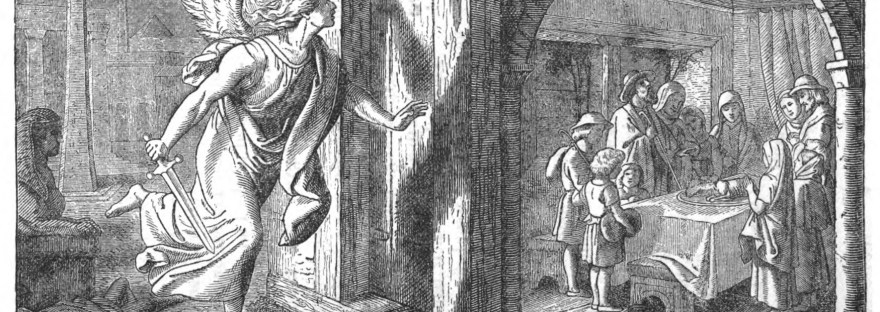
According to the Book of Exodus, God commands Moses to tell the Israelites to mark a lamb’s blood above their doors in order that the Angel of Death will pass over them (i.e., that they will not be touched by the tenth plague, death of the firstborn). After the death of the firstborn Pharaoh, the Israelites were ordered to leave, taking whatever, they want, and Moses was asked to bless him in the name of the Lord. The passage goes on to state that the Passover sacrifice recalls the time when God “passed over the houses of the Israelites in Egypt”. This story is recounted at the Passover meal in the form of the Haggadah, in fulfilment of the command “And thou shalt tell (Higgadata) thy son in that day, saying: It is because of that which the LORD did for me when I came forth out of Egypt. The term Pesach (Hebrew: פֶּסַח, Pesaḥ) may also refer to the lamb or goat which was designated as the Passover sacrifice (called the Korban Pesach in Hebrew). Four days before the Exodus, the Hebrews were commanded to set aside a lamb, and inspect it daily for blemishes. During the day on the 14th of Nisan, they were to slaughter the animal and use its blood to mark their lintels and door posts. Before midnight on the 15th of Nisan they were to consume the lamb. The biblical requirements of slaying the Paschal lamb in the individual homes of the Hebrews and smearing the blood of the lamb on their doorways were celebrated in Egypt. However, once Israel was in the wilderness and the tabernacle was in operation, a change was made in those two original requirements. Passover lambs were to be sacrificed at the door of the tabernacle and no longer in the homes of the Jews. No longer, therefore, could blood be smeared on doorways.

The Passover begins on the 15th day of the month of Nisan, which typically falls in March or April of the Gregorian calendar. The 15th day begins in the evening, after the 14th day, and the seder meal is eaten that evening. Passover is a spring festival, so the 15th day of Nisan typically begins on the night of a full moon after the northern vernal equinox. However, due to leap months falling after the vernal equinox, Passover sometimes starts on the second full moon after vernal equinox, as in 2016. To ensure that Passover did not start before spring, the tradition in ancient Israel held that the lunar new year, the first day of Nisan, would not start until the barley was ripe, being the test for the onset of spring. If the barley was not ripe, or various other phenomena indicated that spring was not yet imminent, an intercalary month (Adar II) would be added. However, since at least the 4th century, the intercalation has been fixed mathematically according to the Metonic cycle.

In Christianity, the celebration of Easter (not to be confused with the pre-Christian Saxon festival from which it derives its English name) and its date in the calendar finds its roots in the Jewish feast of Passover, when, according to Christian interpretation, Jesus was crucified as the Passover Lamb. The coincidence of Jesus’ crucifixion with the Jewish Passover led some early Christians to make a false etymological association between Hebrew Pesach and Greek pascho (“suffer”).

The focus of this piece has to do with the central event of Pesach. In the Hebrew Bible, the destroying angel (Hebrew: מַלְאָך הַמַשְׁחִית, malʾāḵ hamašḥīṯ), also known as mashḥit (מַשְׁחִית mašḥīṯ, ‘destroyer’; plural: מַשְׁחִיתִים, mašḥīṯīm, ‘spoilers, ravagers’), is an entity sent out by YHWH on several occasions to kill the enemies of the Hebrews. These angels (mal’akh) are also variously referred to as memitim (מְמִיתִים, ‘executioners, slayers’), or Angel of the Lord. The latter is found in Job 33:22, as well as in Proverbs 16:14 in the plural, “messengers of death”. Mashchith was also used as an alternate name for one of the seven compartments of Gehenna. In 2 Samuel 24:15-16, the destroying angel kills the inhabitants of Jerusalem. In I Chronicles 21:15, the same “Angel of the Lord” is seen by David to stand “between the earth and the heaven, with a drawn sword in his hand stretched out against Hebrews’s enemies”. Later, in II Kings 19:35, the angel kills 185,000 Assyrian soldiers. In the Book of Enoch, angels of punishment and destruction belong to a group of angels called satans with Satan as their leader. First, they tempt, then accuse and finally punish and torment, both wicked humans and fallen angels. In Judaism, such angels might be seen as created by one’s sins. As long as a person lives, God allows him to repent. However, after death, the angels of destruction are allowed to execute the sentence proclaimed in the heavenly court. There are two possible scenarios regarding the use of sacrificial lamb’s blood during Pesach: first scenario; as Global Positional System markers for the Mashhit, who would have otherwise been lost, whose task is difficult enough even when at the right address, still has to identify the first born in a family. Second scenario; symbolic and metaphoric dry run or test run with regards to the redemption of mankind from sin (death is the wages of sin), through the sacrifice of an unblemished lamb (Lamb of God: Jesus Christ, the First Born, Son of Man, Emmanuel), that occurred some millennia later on the same anniversary as that occurred in Egypt. Neither scenario is mutually exclusive or inclusive of the other. When the reader considers the God that created the Universe with stars and celestial objects with fixed positional locations to the smallest nanometre, it is inconceivable that this God that knows everything and sees everything, would have non-human messengers that requires bloody markings to identify their kill-zones. In any case, the Ascension day is forty days after the Passover (the first Passover Sabbath), that is 26th of May 2022, while Pentecost day is fifty days after Passover, that is 5th of June 2022. Passover, Ascension day, and Pentecost day anniversaries are all derived from the Jewish Calendar and its Pesach.

Does God have Feelings and Emotions?

The above question is predicated on a series of assumptions and belief systems. Among which; that God is a Being that exists, and that this Being has a physical body capable of experiencing emotions and feelings. Feelings can be defined as an emotional state or reaction. The sense by which a person knows whether things are hard or soft, hot, or cold, heavy, or light · A sensation of temperature or pressure. Feeling is a general term for a subjective point of view as well as for specific sensations.

In normal language usage, the noun “feeling” is often used as being the same as emotion. However, in psychology, feeling is used as a technical term which means a generalized bodily consciousness of a physiological sensation. A feeling is a particular sensation or an emotional perception or attitude. Feeling is defined as the sense of touch or something experienced through touch or emotion. Feeling, in psychology, the perception of events within the body, closely related to emotion. An awareness by your body of something in it or on it sensation; an emotional state or reaction. Feeling was originally used to describe the physical sensation of touch through either experience or perception.

There are four kinds of basic emotions: happiness, sadness, fear, and anger, which are differentially associated with three core affects: reward (happiness), punishment (sadness), and stress (fear and anger). Emotion can be defined as, a complex experience of consciousness, bodily sensation, and behaviour that reflects the personal significance of a thing, an event, or a state of affairs. “Emotions,” wrote Aristotle (384–322 BCE), “are all those feelings that so change men as to affect their judgements, and that are also attended by pain or pleasure. Such are anger, pity, fear, and the like, with their opposites.” Emotion is indeed a heterogeneous category that encompasses a wide variety of important psychological phenomena.

Some emotions are very specific, insofar as they concern a particular person, object, or situation. Others, such as distress, joy, or depression, are very general. Some emotions are very brief and barely conscious, such as a sudden flush of embarrassment or a burst of anger. Others, such as long-lasting love or simmering resentment, are protracted, lasting hours, months, or even years (in which case they can become a durable feature of an individual’s personality). An emotion may have pronounced physical accompaniments, such as a facial expression, or it may be invisible to observers. An emotion may involve conscious experience and reflection, as when one “wallows” in it, or it may pass virtually unnoticed and unacknowledged by the subject. An emotion may be profound, in the sense that it is essential to one’s physical survival or mental health, or it may be trivial or dysfunctional. An emotion may be socially appropriate or inappropriate. It may even be socially obligatory—e.g., feeling remorse after committing a crime or feeling grief at a funeral.

Delving into Scriptures, that is if the reader believes in the veracity of Biblical accounts; in Genesis 6:5-6; The Lord saw how great the wickedness of the human race had become on the earth, and that every inclination of the thoughts of the human heart was only evil all the time. The Lord regretted that he had made human beings on the earth, and his heart was deeply troubled. In addition to the previous text, in 1 Samuel 15:10-11; Then the word of the Lord came to Samuel: “I regret that I have made Saul king, because he has turned away from me and has not carried out my instructions.” The following texts from the Scriptures were all about God’s anger: Deuteronomy 9:8; Exodus 15:7; Exodus 32:10-11; Numbers 11:1-2; Job 4:9; Isaiah 13:5; Jeremiah 32:29; Lamentations 2:2; Numbers 32:13; 2 Kings 13:3; Isaiah 51:20; Ezekiel 7:8; Habakkuk 3:12; Mathew 21:12-13; Isaiah 13:9; Daniel 8:19; Mathew 3:7; Romans 2:5; Jeremiah 7:29; Deuteronomy 31:17; 2 Kings 17:18; 2 Kings 23:25-27; Psalm 78:59; Psalm 89:38; Lamentations 2:6-7.

Earlier, feeling was described as an awareness by your body of something in it or on it, sensation; an emotional state or reaction. The Scriptures in three places told us that God wept, shed tears; John 11:35; Luke 19:41; and Hebrews 5:7-9. This article poses questions that the reader has to answer, among which are; the veracity of the Scriptures, the existence of God, the possession by God of a physical body capable of experiencing emotions and feelings. Life is not lived with words, but with actions and therefore experiences. Behaviour, attitude, environment, and character, all of which plays a role in life, of everyone including God, if you believe that He exists.

Forgiveness, sins, transgressions, trespasses, and debts

Trespass can be defined as (1) enter someone’s land or property without permission. It can also be defined as (2) commit an offence against (a person or a set of rules). Sin can be defined as an immoral act considered to be a transgression against divine law. Transgression can be defined as an act that goes against a law, rule, or code of conduct; an offence. Debt can be defined as a sum of money that is owed or due, or the state of owing money, or a feeling of gratitude for a service or favour.

How does God and man deal with forgiveness of sins, transgression, trespasses, and debts? According to Mark 2:7; “Why does this fellow talk like that? He’s blaspheming! Who can forgive sins but God alone?” Another reference text in Luke 5:21; The Pharisees and the teachers of the law began thinking to themselves, “Who is this fellow who speaks blasphemy? Who can forgive sins but God alone?” In addition to these texts, in Mark 2:10-11; But I want you to know that the Son of Man has authority on earth to forgive sins.” So, he said to the man, “I tell you, get up, take your mat and go home.” Since only God can forgive sins, can people forgive others of sins?

Before Emmanuel, it is only God who forgives sins. Only Jesus Christ. However, when God was amongst us, He then spoke that man should forgive man, when they trespass against each other. The prayer that our Lord Jesus Christ taught us contain the line “Mathew 6:12; ‘And forgive us our debts, as we have forgiven our debtors” The Scriptures also stated in Deuteronomy 15:3; You may require payment from a foreigner, but you must cancel any debt your fellow Israelite owes you. With Emmanuel, we all became members of one family of all nations. The question of how many times people should forgive others, of sins was posed in Mathew 18:21; Then Peter came to Jesus and asked, “Lord, how many times shall I forgive my brother or sister who sins against me? Up to seven times?” And the answer was given in Mathew 18:35; “This is how my heavenly Father will treat each of you unless you forgive your brother or sister from your heart.” Which is every time.

The leading note of Psalm 51 states “For the director of music. A psalm of David. When the prophet Nathan came to him after David had committed adultery with Bathsheba.” In addition, David was also guilty of second-degree murder. As a result of which Uriah, the late husband of Bathsheba, was no longer alive to forgive David and Bathsheba. Which led to David in Psalm 51 verse 4 to cry out to God “Against you, you only, have I sinned and done what is evil in your sight; so, you are right in your verdict and justified when you judge. At the end of the day, when a person commits a crime, or an offense, or a transgression against another person, whenever the case gets to the courts, it is no longer a case of person A versus person B, but a case of the Law making and giving institution, State or Kingdom versus the accused. Ultimately, when we sin, it is against God. And Jesus Christ is a forgiving God, when we acknowledge our sins and are penitent, remorseful, and contrite. Forgive others, so you may be forgiven.

God, sicknesses, diseases, and sin

Sin is not a disease, but a state of mind, in the nature (heart)of the person. While God embraces and heals the sick, He can not stand a sinner in His presence, because God is Holy, He will not beheld sin, and rather turns His Face away from sin, which is confirmed in Isaiah 59:2; But your iniquities have separated you from your God; your sins have hidden his face from you, so that he will not hear. However, in Mark 1:40-42; A man with leprosy came to him and begged him on his knees, “If you are willing, you can make me clean.” Jesus was indignant. He reached out his hand and touched the man. “I am willing,” he said. “Be clean!” Immediately the leprosy left him, and he was cleansed.

God prophesied some seven hundred years before He walked among us, in Isaiah 61:1; The Spirit of the Sovereign Lord is on me, because the Lord has anointed me to proclaim good news to the poor. He has sent me to bind up the broken hearted, to proclaim freedom for the captives and release from darkness for the prisoners. Subsequently when He walked among us, that is exactly what He did, including touching, embracing, and healing the sick.

Since sin is in the nature of a person, absolution also deals with that nature. It involves first of all, true remorse, which is preceded by recognition of the sins, or sinful nature. Followed by contrition, and mind change, involving the will, of not wanting to continue with the previous sinful state of mind. This is demonstrated in the record in Luke 7: 36-50. In this passage, take note of three sentences from Jesus Christ; (1) Therefore, I tell you, her many sins have been forgiven—as her great love has shown. But whoever has been forgiven little loves little.” (2) Then Jesus said to her, “Your sins are forgiven.” (3) Jesus said to the woman, “Your faith has saved you; go in peace.”

Love triumphs over law. Since all have sinned, however according to the Holy Spirit speaking in Psalm 130 verse 4; But with you there is forgiveness, so that we can, with reverence, serve you. God forgives us, so that He can behold us, so that we can come into His presence to gaze at the beauty of His Holiness.