John 14:6-7; Jesus answered, “I am the way and the truth and the life. No one comes to the Father except through me. If you really know me, you will know my Father as well. From now on, you do know him and have seen him.” John 4:24; God is spirit, and his worshipers must worship in the Spirit and in truth.”
Below are excerpts from an article published by BBC.com
Chemistry Nobel awarded for solving mystery of life’s asymmetry
Heiner Linke, chair of the Nobel Committee for Chemistry, explained: “Henri Kagan and Kenso Soai have provided a solution to a chemical mystery that is over a century old: how homochirality – the selective production of the correct version of a molecule – can emerge spontaneously.
Kenso Soai from Tokyo University of Science took the next step in 1995. He published a scientific paper in the journal Nature, external describing the first ever chemical reaction that had the potential to be homochiral – producing only the desired version of an organic molecule.
In 2003, he finally succeeded in controlling a reaction in which only one of the two possible mirror images was formed.
“Other than life itself,” the Nobel Committee said in a statement, “no one had previously achieved this feat”.
Prof Angus Davison, from the University of Nottingham, studies the biology of chirality and said that the Nobel-winning chemistry could help reveal how and why life favours “one-handedness”.
“In ways that we don’t yet quite understand, the chirality of the basic building blocks of life ends up making bodies that are themselves also chiral,” he told BBC News.
This was the foundation, he explained, of our hearts being on left hand side of our bodies and snail shells that coil to the right.
Peter Somfai, a member of the Nobel Committee for Chemistry, said the research awarded this year’s prize has become part of “our basic understanding of how chemistry functions”.
He said showing how a mirror image is created is “probably the most fundamental question in life – because somehow that happened four billion years ago when life was created. And now we have, for the first time, mimicked that in the lab”.
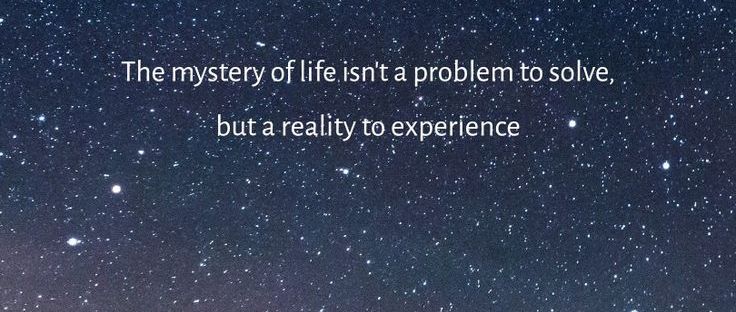
The quote “The mystery of life isn’t a problem to solve, but a reality to experience” originates from Frank Herbert’s classic science fiction novel Dune.
Context and Meaning
Source: In the novel, Paul Atreides recounts that the Bene Gesserit Reverend Mother Mohiam shared this idea with him.
The First Law of Mentat: Paul replies to it by quoting, “A process cannot be understood by stopping it. Understanding must move with the flow of the process, must join it and flow with it.”
Core Philosophy: The text emphasizes that life is a dynamic flow. You cannot fully comprehend existence by trying to halt, dissect, or rigidly control it. Instead, true understanding comes from being present and moving along with life’s natural progression.
Human beings are physical entities, and all the particles, atoms, molecules, and chemical constituents that make up biological organisms are present in the Cosmos, the observable physical universe. If human beings have souls, then the soul of a human being is not a physical entity.
This brings us to the issue of Life; this is a mystery that science has not been able to unravel. Science may unravel the issue of chirality (see excerpts from the Nobel prize for Chemistry, above), but the science has not been able to create life in the laboratory from nothing. Maybe that is because creation of life (from nothing) is not a physiochemical occurrence. This brings us back to the starting text of this article from the words of Jesus Christ, a character from the Bible. Who claims to be ‘Life’, furthermore, He stated that ‘God is Spirit’ (a non-physical entity). So why are human beings who are physical entities searching for an ‘Entity’ that is non-physical. The use of physiochemical methods to search for a ‘non-physical entity’ seems to be a fruitless endeavour. Anyway, they can always hope, though technically, ‘hope’ is not a concept recognized by science. Scientifically, Life remains a mystery.
God created the physical universe and Time: Genesis 1 verses 1-3; In the beginning God created the heavens and the earth. Now the earth was formless and empty, darkness was over the surface of the deep, and the Spirit of God was hovering over the waters. And God said, “Let there be light,” and there was light. Genesis 1 verses 14-15; And God said, “Let there be lights in the vault of the sky to separate the day from the night, and let them serve as signs to mark sacred times, and days and years, and let them be lights in the vault of the sky to give light on the earth.” And it was so.
The speed limit of the universe refers to the speed of light in a vacuum (), which is approximately 299,792,458 meters per second (roughly 186,282 miles per second).
It is not merely the speed at which light travels, but a fundamental property of spacetime that sets the maximum speed at which any matter, energy, or information can move through space.
1. Mass Increases with Speed
According to Albert Einstein’s theory of Special Relativity, as an object with mass accelerates and moves faster, its relativistic mass-energy increases. To continue accelerating, it requires progressively more energy. As an object approaches , the energy required to accelerate it further approaches infinity, making it impossible for anything with mass to reach or exceed the speed of light.
2. Massless Particles
Particles that have no invariant rest mass—such as photons (particles of light) and gluons—do not need to accelerate; they naturally travel at from the moment they are created.
3. Causality and the Speed of Information
The speed limit is crucial for preserving causality—the principle that a cause must always precede its effect:
The speed of light is essentially the speed of causality itself.
If information or matter could travel faster than , it would be possible in certain reference frames to observe an effect before its cause occurred (effectively traveling backward in time), creating severe physical paradoxes.
4. Cosmic “Lag”
Because the speed of light is finite, looking out into space is equivalent to looking back in time:
Light from the Sun takes roughly 8 minutes and 20 seconds to reach Earth.
Light from distant stars and galaxies takes thousands or billions of years, showing them as they existed in the past.
In modern physics, gravity and quantum behaviour are described by two distinct, highly successful theoretical frameworks that explain how the universe works at different scales:
1. The Scientific Explanation for Gravity: General Relativity
At a macroeconomic/cosmological scale, gravity is described by Albert Einstein’s Theory of General Relativity (1915).
Space-Time Curvature: Rather than viewing gravity as an invisible force pulling two masses together (as Isaac Newton originally conceptualized), General Relativity explains gravity as a structural deformation of spacetime—a four-dimensional continuum combining the three dimensions of space with time.
Mass Informs Spacetime: Massive objects (like stars, planets, and black holes) curve and distort the spacetime around them.
Motion Follows Geometry: Objects in motion, including light rays and smaller celestial bodies, travel along the straightest possible paths in this curved spacetime (called geodesics). What we feel as the “pull” of gravity is simply our motion along these geometric curves. For instance, the Earth orbits the Sun because it is moving through a spacetime well carved out by the Sun’s mass.
Time Dilation: Because mass curves time along with space, time moves slower in stronger gravitational fields relative to weaker ones (gravitational time dilation).
2. The Scientific Explanation for Quantum Behaviour: Quantum Mechanics
At atomic and subatomic scales, the Universe behaves according to Quantum Mechanics. Rather than predictable, continuous motion, microscopic particles display counterintuitive properties governed by probability:
Wave-Particle Duality: Matter and light exhibit both particle-like and wave-like properties. Electrons, photons, and other particles do not exist at precise, single points until they are measured; instead, they exist as a wavefunction () that describes the probability of finding the particle in various states or positions (governed by the Schrödinger equation).
Quantization of Energy: Physical quantities like energy, angular momentum, and spin cannot vary continuously. Instead, they exist in discrete packets or units called quanta. An electron in an atom, for instance, jumps between specific energy levels rather than sliding smoothly between them.
The Uncertainty Principle: Formulated by Werner Heisenberg, this fundamental limit states that certain pairs of physical properties (like a particle’s precise position and momentum) cannot both be known simultaneously with infinite precision. Observing one property inherently increases the uncertainty of the other.
Superposition: Before a measurement occurs, a quantum system can exist in a linear combination of multiple physical states simultaneously. The system “collapses” into a single definite state only upon interaction with an external observer or environment (quantum measurement).
Quantum Entanglement: When particles interact in specific ways, their quantum states become intertwined. Measuring the state of one particle instantly determines the state of its entangled partner, regardless of the distance separating them—a phenomenon Einstein famously called “spooky action at a distance.”
The Unresolved Frontier: Unifying Gravity and Quantum Physics
While General Relativity excels at explaining massive, cosmic-scale objects and Quantum Mechanics perfectly predicts subatomic phenomena, they are fundamentally incompatible mathematically:
Deterministic vs. Probabilistic: General Relativity relies on a deterministic, smooth, and continuous spacetime geometry. Quantum mechanics operates on discrete, probabilistic, and fundamentally uncertain fluctuations.
The “Singularity” Problem: At extreme locations where both massive weight and tiny scales overlap—such as the centre of a black hole or the moment of the Big Bang—General Relativity yields infinite density and breaks down.
To reconcile these two theories, theoretical physicists are actively working on a unified theory of Quantum Gravity. Leading candidate frameworks include:
String Theory: Proposes that fundamental particles are not zero-dimensional points, but tiny, vibrating one-dimensional strings operating in 10 or 11 dimensions.
Loop Quantum Gravity (LQG): Suggests that spacetime itself is not a smooth continuum, but is instead broken down into discrete, microscopic loops or “pixels” of space at the Planck scale ( meters).
In theoretical physics, a graviton is the hypothetical elementary particle that mediates the force of gravity in the framework of quantum field theory.
If gravity can be described quantum mechanically, just like the other three fundamental forces of nature, the graviton would be its quantum force-carrier (or gauge boson).
Key Properties of the Graviton
Physicists have deduced what properties a graviton must possess based on the known behaviour of gravity:
Spin-2: Unlike the photon (spin-1) or the Higgs boson (spin-0), the graviton must have an intrinsic angular momentum (spin) of 2. This unique tensor nature is required to reproduce the attractive, geometry-bending nature of gravity described by Einstein’s General Relativity.
Massless: Gravity has an infinite range (it acts across cosmic distances), which mathematically requires the particle mediating it to have zero rest mass.
Electrically Neutral: Gravitons carry no electric charge.
Speed of Light (): Because it is massless, a graviton would travel through a vacuum at the exact speed of light.
The Analogy to Other Fundamental Forces
To understand how gravitons fit into physics, it helps to compare gravity to the other fundamental forces in the Standard Model of Particle Physics:
Force
Mediator / Particle
Observed?
Electromagnetism
Photon
Yes
Strong Nuclear Force
Gluon
Yes
Weak Nuclear Force
W & Z Bosons
Yes
Gravity
Graviton
Theoretical (Unobserved)
Just as electromagnetic radiation (light) is made up of individual packets called photons, gravitational waves—ripples in spacetime detected by observatories like LIGO—would theoretically be made up of a stream of individual gravitons.
Why Haven’t We Detected Gravitons?
Detecting an individual graviton is one of the most difficult challenges in modern physics:
Extreme Weakness of Gravity: On the scale of individual subatomic particles, gravity is fantastically weak compared to electromagnetism (roughly times weaker).
Tiny Cross-Section: Because a graviton interacts so weakly with matter, an experiment capable of detecting a single graviton would require a detector with astronomical mass (e.g., a detector the size of Jupiter placed in orbit around a neutron star) and would still take thousands of years to register a single interaction.
Status in Modern Physics
The graviton remains purely hypothetical. While standard General Relativity treats gravity as a smooth, continuous curvature of space rather than a stream of particles, candidate theories of quantum gravity—such as String Theory—naturally predict the existence of spin-2 massless particles, making gravitons a central feature of quantum physics research.
Whether time exists as a physical entity depends heavily on how physics defines an “entity.”
If by “physical entity” you mean a substance or fluid made of particles (like water) or an independent object you can touch, isolate, or collect in a jar, no: time is not a physical entity. You cannot have a container of time, nor is there a “time particle” (unlike gravity, which theoretically has the graviton, or light, which has the photon).
However, if by “physical entity” you mean an objective feature of physical reality—something that exists independently of human thought and can be measured, warped, and calculated—then modern physics overwhelmingly treats time as real, but as a dimension or relationship rather than an object.
1. Spacetime: A Geometric Dimension, Not a Substance
In Albert Einstein’s General Relativity, space and time are merged into a continuous, four-dimensional fabric called spacetime.
Time is a dimension of measurement (like length, width, and height).
Just as a meter stick measures distance between physical points, a clock measures the interval along a trajectory through spacetime.
Spacetime can stretch, warp, and curve around mass and energy. Strong gravitational fields and high speeds literally slow the rate at which time passes (gravitational and kinematic time dilation).
While the “fabric” of spacetime feels like an object in Einstein’s mathematics, time itself is a coordinate direction within that geometry, not a tangible substance filling the void.
2. The “Block Universe” (Eternalism)
General Relativity supports a view known as the Block Universe. In this interpretation, the past, present, and future all exist simultaneously in a static 4D block of spacetime.
Under this framework, the “passage” or “flow” of time is a subjective experience of observers moving along their worldlines, rather than a physical movement of time itself.
The “present moment” isn’t a physical wave traveling through the cosmos; it is simply a coordinate point, much like “here” is a point in space.
3. The Arrow of Time: An Emergent Property of Entropy
If physical laws at the microscopic scale are symmetric (they work the same forward or backward in time), why do we experience time as flowing strictly forward?
Physics explains the Arrow of Time not as a physical entity pushing us forward, but as an emergent property of thermodynamics:
The Second Law of Thermodynamics dictates that the overall disorder (entropy) of an isolated system always increases.
Eggs crack and drop; they never un-crack and jump back into your hand.
The forward direction of time is essentially the direction in which the universe goes from a state of low entropy (the Big Bang) to higher entropy. Time’s “flow” is a measure of changing physical states and relationships, rather than a physical stream.
4. Quantum Mechanics: Does Time Dissolve at the Base Level?
In standard Quantum Mechanics, time is an external background parameter—a global tick-tock against which quantum states evolve. However, when physicists try to combine quantum mechanics with general relativity to form a theory of Quantum Gravity, time seems to disappear entirely.
The Wheeler–DeWitt Equation: In equations attempting to describe the quantum state of the entire universe, the time variable vanishes.
Relational Time: Physicists like Carlo Rovelli argue that at the fundamental Planck scale ( meters), time does not exist as a fundamental feature of the universe. Instead, physical systems simply evolve relative to one another (e.g., system A changes relative to system B), and what we call “time” is an illusion or macro-level emergent phenomenon, similar to how “temperature” isn’t a property of an individual atom, but emerges when you group billions of them together.
Summary
Time is not a physical object or particle. Instead, physics views time as:
A dimensional coordinate of spacetime used to locate events and calculate intervals.
A measure of change and entropic evolution in physical systems.
Potentially an emergent phenomenon that arises from deeper quantum relationships where time itself does not exist.
The combination of quantum mechanics with general relativity will give us God/Creator, who is by the way non-physical [John 4 verse 24; God is spirit, and his worshipers must worship in the Spirit and in truth.], with time disappearing completely, though science is not there yet, maybe in the future. Which is a contradiction inherent in the concept that postulates time disappearing completely, with the past, present, and future all existing simultaneously.
This is the crossroad of physical cosmology, biology, big bang, evolution and faith. The reader is advised to keep an open mind, do a comparative analysis of the facts, and subsequently form their own opinion. Isaiah 45: 6-8; That they may know from the rising of the sun to its setting That there is none besides Me. I am the Lord, and there is no other;I form the light and create darkness, I make peace and create calamity; I, the Lord, do all these things.’ “Rain down, you heavens, from above, And let the skies pour down righteousness; Let the earth open, let them bring forth salvation, And let righteousness spring up together. I, the Lord, have created it.
All living organisms have pulses; algae, viruses, bacteria, plants, and animals. Their life span differs, the truly amazing truth is that cosmic bodies; the planet earth, and other planetary bodies, the stars (such as our star, the Sun), black holes that are usually at the centre of each galaxy, our native galaxy, the Milky way has a black hole known as Sagittarius A, at its centre, all also have pulses. Our Sun has an eleven year cycle (pulse), our planet has a 200000 years to one million years pulse (do the research on the breakaway of the Eastern section of the African continent: East Africa rift valley). Though the frequency of volcanic eruption in various parts of the planet indicate birth pains (formation of new material) on a shorter time span frequency. It’s counter intuitive to our comprehension that cosmic bodies have pulses just like us.
Major characteristics of living organisms: All living organisms share a set of key characteristics that distinguish them from non-living matter. Biologists generally define life through the following major traits:
1. Cellular Organisation
All living things are composed of one or more cells. The cell is the fundamental unit of life.
Unicellular organisms (like bacteria) consist of a single cell.
Multicellular organisms (like humans and trees) are composed of complex networks of specialised cells.
2. Metabolism
Living organisms undergo continuous chemical reactions to sustain life. This total of all chemical reactions is called metabolism, which includes:
Anabolism: Building up complex molecules (e.g., photosynthesis in plants).
Catabolism: Breaking down molecules to release energy (e.g., cellular respiration).
3. Homeostasis
Organisms must maintain a stable, constant internal environment despite changes in their external surroundings. Examples include regulating body temperature, water balance, and pH levels.
4. Growth and Development
All living things grow (increase in size or cell number) and develop (mature through a defined life cycle governed by their genetic material).
5. Reproduction
Living organisms have the ability to produce offspring to ensure the continuation of their species. This can happen in two ways:
Asexual reproduction: A single organism produces an exact genetic copy of itself.
Sexual reproduction: Two parents contribute genetic material to produce unique offspring.
6. Response to Stimuli
Organisms can detect and react to changes in their environment (stimuli). These responses can be behavioural (like a plant bending toward light) or physiological (like a person sweating when hot).
7. Adaptation through Evolution
Over generations, populations of living organisms adapt to their environments. Changes in DNA allow species to evolve via natural selection, ensuring survival in changing world conditions.
Characteristics of living entities exhibited by cosmic bodies. Cosmic bodies (stars, planets, galaxies) don’t actually meet the biological definition of “living,” but they can superficially display a few characteristics we associate with life. Here’s a breakdown of where the comparison holds up and where it breaks down:
Characteristics of Life (Biological Standard)
Living things generally show: growth, reproduction, metabolism, response to stimuli, homeostasis, organisation (cells), and evolution/adaptation.
Where Cosmic Bodies “Mimic” Life-like Traits
1. Growth
Stars accumulate mass from surrounding gas and dust clouds, growing over millions of years.
Planets form and grow through accretion of smaller bodies (planetesimals).
Black holes “grow” by consuming matter and merging with other black holes.
2. Birth and Death (Life Cycles)
Stars are “born” in nebulae, go through a main sequence “life,” and “die” as white dwarfs, neutron stars, or supernovae.
This life-cycle terminology (protostar → main sequence → red giant → death) closely parallels biological life stages, which is why it’s used colloquially.
3. Energy Consumption/Metabolism (loose analogy)
Stars convert hydrogen to helium via fusion, releasing energy — vaguely resembling metabolic energy conversion, though it’s a nuclear process, not a chemical/biological one.
4. Reproduction (very loose analogy)
Supernovae scatter heavy elements that seed the formation of new stars and planetary systems — sometimes called “stellar reproduction,” though it’s not self-directed or genetically informed.
5. Response to Environment
Planetary and stellar systems respond to gravitational influences (e.g., tidal locking, orbital resonance), but this is passive physics, not a biological “response to stimuli.”
6. Structure/Organization
Cosmic bodies have internal layered structure (core, mantle, crust for planets; core, radiative zone, convective zone for stars) — analogous to organised biological systems, but not cellular.
Key Missing Criteria
Cosmic bodies lack:
Self-replication with genetic information
Homeostasis (active self-regulation)
Evolution by natural selection
Response to stimuli in a purposeful/adaptive sense
Metabolism in the biochemical sense
Bottom Line
The similarities are largely metaphorical and process-based (growth, cycles, transformation) rather than functional in the biological sense. Scientists use “life cycle” language for stars and galaxies as a useful analogy for teaching and visualisation — not because these bodies are literally alive.
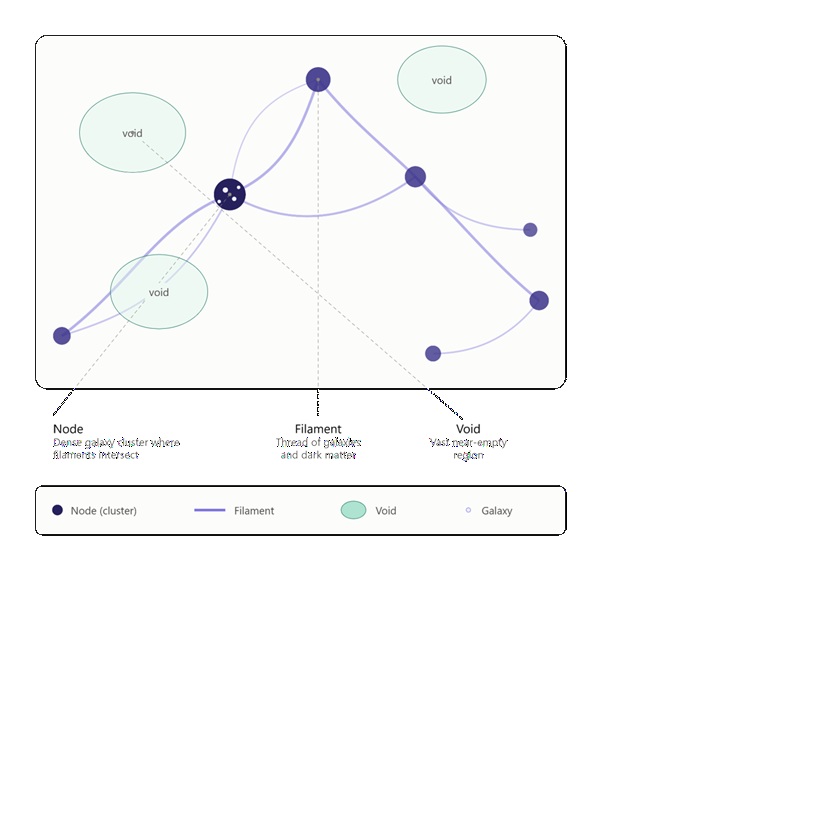
The cosmic web is the large-scale structure of the universe — the way matter (both visible and dark matter) is arranged across space on the grandest scales, forming a pattern that resembles a three-dimensional spiderweb or a sponge-like network.
Structure of the Cosmic Web
It has four main components:
1. Filaments
Long, thread-like structures made of galaxies, gas, and dark matter.
These are the “strands” of the web, often hundreds of millions of light-years long.
Galaxies tend to flow along these filaments, pulled by gravity.
2. Nodes (Clusters)
Dense regions where filaments intersect.
These host massive galaxy clusters — some of the largest gravitationally bound structures in the universe.
3. Walls (Sheets)
Flattened, sheet-like structures of galaxies, less dense than filaments but denser than voids.
An example is the “Great Wall,” a massive sheet-like arrangement of galaxies.
4. Voids
Enormous, roughly spherical regions that are nearly empty of galaxies and matter.
Voids can span tens to hundreds of millions of light-years and make up most of the universe’s volume.
How It Formed
The cosmic web originated from tiny density fluctuations in the early universe (visible in the Cosmic Microwave Background). Over billions of years:
Regions with slightly more matter attracted more matter via gravity.
Dark matter, which vastly outweighs normal matter, formed the initial gravitational scaffolding.
Normal (baryonic) matter — gas and eventually galaxies — fell into this scaffolding, tracing out the filaments, nodes, and walls we observe today.
Why It Matters
It reveals the role of dark matter (reference Isaiah 45: 6-8), since the web’s structure is shaped predominantly by dark matter’s gravity, even though we can’t see it directly.
It helps cosmologists test models of the universe’s evolution (e.g., using simulations like the Millennium Simulation or Illustris).
Studying the cosmic web helps explain how galaxies form, migrate, and cluster over cosmic time.
That’s the basic layout: filaments (the purple threads) carry galaxies along them like beads on a string, converging at nodes — the densest points, where massive galaxy clusters form. Between the filaments and walls are the voids, vast nearly-empty bubbles that make up most of the universe’s volume.
A useful way to picture it: imagine soap bubbles packed together. The thin films and edges where bubbles meet are the filaments and walls (matter concentrates there), while the hollow interior of each bubble is a void. The whole pattern is invisible in normal light on this scale — what actually holds the shape together is dark matter’s gravity, with visible galaxies just tracing the underlying scaffold.
Expansion of the universe refers to the observation that the space between galaxies (on large scales) is continuously stretching over time — galaxies aren’t just moving through space, but the fabric of space itself is growing.
Key Points
1. It’s not an explosion into empty space
A common misconception is that the universe expanded like a bomb going off, with galaxies flying outward from a central point into pre-existing empty space.
In reality, space itself is stretching everywhere, uniformly. There is no center and no edge — every point moves away from every other point.
2. The raisin bread analogy
Picture raisin bread dough rising in an oven. Each raisin (galaxy) doesn’t move through the dough — but as the dough expands, every raisin gets farther from every other raisin.
The farther apart two raisins start, the faster they separate as the loaf expands — this mirrors what we observe with galaxies.
3. Discovered through redshift
In the 1920s, Edwin Hubble observed that light from distant galaxies is shifted toward longer (redder) wavelengths — called redshift.
This happens because space stretches while light travels through it, stretching the light’s wavelength too.
Crucially, more distant galaxies show greater redshift, meaning they’re receding faster — this relationship is Hubble’s Law.
4. Hubble’s Law
Recession velocity = H₀ × distance (where H₀ is the Hubble constant, roughly 70 km/s per megaparsec).
This means space is expanding at a consistent rate everywhere — it’s not that galaxies are “running away” from a specific spot.
5. Accelerating expansion
Observations in the late 1990s (using distant supernovae) revealed the expansion isn’t slowing down due to gravity, as expected — it’s actually speeding up.
This acceleration is attributed to dark energy, a mysterious force that makes up roughly 68% of the universe’s total energy content, though its nature is still not well understood.
6. What isn’t expanding
Locally bound systems — galaxies, solar systems, planets, even you — don’t expand, because gravity (and other forces) hold them together tightly enough to resist the stretching of space.
Expansion only becomes significant on very large scales, between galaxies and galaxy clusters that aren’t gravitationally bound to each other.
Bottom Line
Expansion means the space between cosmic structures is growing over time, carrying galaxies apart from one another — not because they’re moving through a fixed space, but because the space itself is stretching, and this stretching is accelerating due to dark energy. Psalm 19: 1-6; The heavens declare the glory of God; And the firmament shows His handiwork. Day unto day utters speech, And night unto night reveals knowledge. There is no speech nor language Where their voice is not heard. Their line has gone out through all the earth, And their words to the end of the world. In them He has set a tabernacle for the sun,Which is like a bridegroom coming out of his chamber, And rejoices like a strong man to run its race. Its rising is from one end of heaven, And its circuit to the other end; And there is nothing hidden from its heat. What do we have here, faith in God who says, He created light and darkness, physical cosmology that says there is matter and anti-matter, light/stars, galaxies and dark energy, cosmic web, is there a parallel to be seen, well the rest is up to the reader to form their opinion on this piece.

 ), which is approximately 299,792,458 meters per second (roughly 186,282 miles per second).
 , the energy required to accelerate it further approaches infinity, making it impossible for anything with mass to reach or exceed the speed of light.
 from the moment they are created.
 , it would be possible in certain reference frames to observe an effect before its cause occurred (effectively traveling backward in time), creating severe physical paradoxes.
 ) that describes the probability of finding the particle in various states or positions (governed by the Schrödinger equation).
 meters).
 ): Because it is massless, a graviton would travel through a vacuum at the exact speed of light.
 times weaker).
 vanishes.
 meters), time does not exist as a fundamental feature of the universe. Instead, physical systems simply evolve relative to one another (e.g., system A changes relative to system B), and what we call “time” is an illusion or macro-level emergent phenomenon, similar to how “temperature” isn’t a property of an individual atom, but emerges when you group billions of them together.