
The Parable of the Rich Man and Lazarus, found in Luke 16:19–31.
The story, briefly:
A rich man lives in luxury while a poor beggar named Lazarus lies at his gate, covered in sores, longing for scraps from his table. Both die. Lazarus is carried by angels to “Abraham’s side” (often rendered “Abraham’s bosom” in older translations), while the rich man ends up in torment in Hades.
The chasm shows up when the rich man, in agony, begs Abraham to send Lazarus to dip his finger in water and cool his tongue. Abraham refuses, explaining that Lazarus had suffering in life and the rich man had comfort, and now their situations are reversed. Then comes the key verse, Luke 16:26, where Abraham says a great chasm has been fixed between them, so that no one can cross from one side to the other in either direction.
The rich man then asks Abraham to send Lazarus back to warn his five brothers so they don’t end up in the same place. Abraham replies that they have Moses and the Prophets to listen to — and if they won’t listen to those, they won’t be convinced even if someone rises from the dead (a line often read as a foreshadowing of the resistance Jesus’s own resurrection would meet).
A few notes on how this parable is read:
- Some scholars treat it as a straightforward parable using imagery familiar to Jesus’s audience, not a detailed cartography of the afterlife.
- Others read it more literally, as a real depiction of the intermediate state of the dead.
- The term “Abraham’s bosom” became, in later Jewish and Christian tradition, associated with a place of comfort for the righteous dead.
The phrase infinite monkey cage came from Professor Brian Cox. The title of Professor Brian Cox’s BBC Radio 4 show and podcast, The Infinite Monkey Cage (co-hosted with comedian Robin Ince), directly plays on a famous mathematical concept known as the Infinite Monkey Theorem.
1. The Core Concept (The Infinite Monkey Theorem)
The theorem states that a monkey pressing keys at random on a typewriter keyboard for an infinite amount of time will almost surely eventually produce a given text, such as the complete works of William Shakespeare.
- Probability & Infinity: The idea is that given infinite time or infinite attempts, even an extremely improbable event becomes a certainty.
2. How Cox and the Show Apply the Phrase
Professor Brian Cox and his team adapted this concept to frame their show’s philosophy and format:
- The “Cage” / Setup: Rather than literal monkeys typing, the show places a mix of physicists, scientists, experts, and comedians in a room together.
- The “Infinite” Experiment: By throwing diverse minds together—some asking high-level academic questions and others asking simple or nonsensical ones—the show explores whether, through endless discussion and curiosity, profound scientific understanding will naturally emerge out of the chatter.
- Humour Meets Science: Cox often points out that while comedians and scientists seem like opposite ends of the spectrum, placing them in the same room creates an “anarchic” atmosphere that breaks down complex science into accessible, humorous, and insightful ideas.
In short, Cox’s premise behind The Infinite Monkey Cage is a light-hearted nod to probability: if you gather curious, quirky minds and let them talk about the universe long enough, you’ll inevitably hit on deep scientific truths—and have fun doing it.
However, when the infinite monkey theorem is applied to man travelling in space and time, then we realize that man is trapped on this star called the Sun. Take the case of the current man-made space crafts at the farthest distance from the earth, Voyager 1 and Voyager 2.
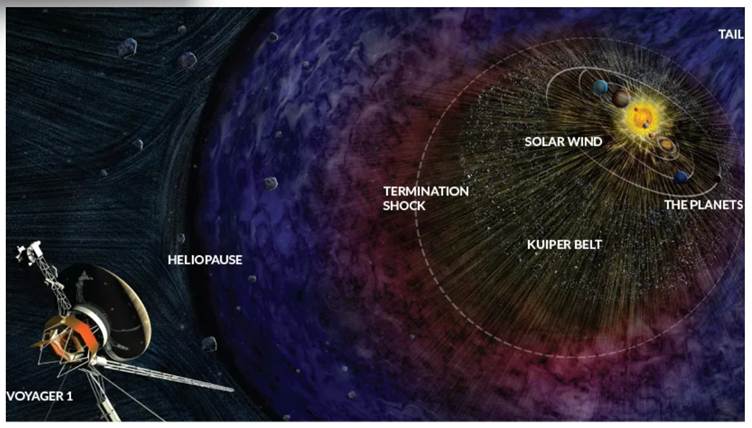
They are continuously hurtling through space and Earth is constantly orbiting the Sun, their exact distances fluctuate second by second.
As of August 2026, their approximate distances from Earth are:
Voyager 1
- Distance from Earth: ~25.59 billion km (~15.90 billion miles)
- Astronomical Units (AU): ~171.05 AU (1 AU is the average distance from Earth to the Sun)
- One-Way Signal Time: It takes light/radio signals about 23 hours and 42 minutes to travel one way between Voyager 1 and Earth.
Fun fact: Voyager 1 is fast approaching a historic milestone—in November 2026, it will become the first human-made object to be a full light-day (about 25.9 billion km) away from Earth.
Voyager 2
- Distance from Earth: ~21.39 billion km (~13.29 billion miles)
- Astronomical Units (AU): ~142.96 AU
- One-Way Signal Time: It takes about 19 hours and 49 minutes for signals to travel one way between Voyager 2 and Earth.
Both probes are travelling through interstellar space (having crossed the heliopause years ago) and are maintained by NASA’s Deep Space Network. Neither Voyager is actually aimed at Proxima Centauri, the nearest star to us — their trajectories were set by planetary flybys decades ago, not by a destination star. But here’s what the numbers look like if you just ask “at their current speed, how long to cover the distance to the nearest star?”
The distance
Proxima Centauri, the nearest star to the Sun, is about 4.24 light-years away — roughly 268,000 AU. Both Voyagers are only around 140–170 AU from the Sun right now, which is a rounding error against that distance, so it barely matters where exactly they are today.
Their speeds
- Voyager 1: ~17 km/s (~3.6 AU/year) — the faster of the two, currently the most distant human-made object at about 166 AU from the Sun.
- Voyager 2: ~15.4 km/s (~3.25 AU/year) — currently around 139 AU out.
Travel time to Proxima Centauri
- Voyager 1: ≈ 268,000 AU ÷ 3.6 AU/yr ≈ 74,000–75,000 years
- Voyager 2: ≈ 268,000 AU ÷ 3.25 AU/yr ≈ 82,000–83,000 years
A couple of caveats worth keeping in mind:
- They’re not headed there. Voyager 1 is drifting roughly toward the constellation Ophiuchus/Camelopardalis direction; Voyager 2 toward Sagittarius/Pavo. Neither path passes anywhere near Proxima Centauri.
- The “40,000 years” figure you may have seen refers to a different fact: Voyager 1 will pass within about 1.6 light-years of the star Gliese 445 in roughly 40,000 years — not because it’s heading there on purpose, but because that star happens to be moving toward the general area Voyager 1 is drifting through. Gliese 445 isn’t the nearest star to us today, but it will be closer to Voyager 1’s future path than Proxima Centauri is.
- Both spacecraft will run out of power for their instruments and transmitters by around the early-to-mid 2030s, so they’ll be silent, coasting relics for the vast majority of that 74,000–83,000-year journey.
Indeed, the physical man on the planet earth orbiting around the star called the Sun, is trapped in space and time, an infinite monkey cage, that deviates fundamentally from the Infinite Monkey mathematical theorem of a monkey typing the text ‘the complete works of William Shakespeare’, since neither a specific monkey nor a specific man exists ad infinitum. In addition to which, our star, the Sun at the edge of its heliosphere/heliopause is surrounded by the Oort Cloud, Interstellar space filled with gas, mostly hydrogen and helium, dust, radiation, and nebulae. The Oort Cloud is made of trillions of icy space rocks and debris left over from when our solar system formed 4.6 billion years ago. These frozen chunks are mostly made of water ice, methane ice, and ammonia ice, along with small amounts of rocky dust.

