Psalm 51 verse 6; Yet you desired faithfulness even in the womb; you taught me wisdom in that secret place.
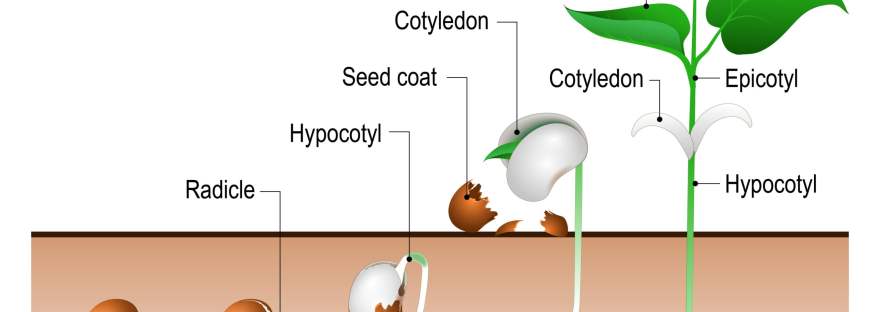
In a seed planted in the soil, who taught the radicle, the first organ to emerge from the seed to grow downwards, geotropism in search of water and mineral nutrients, and who taught the hypocotyl to grow upwards in search of light for photosynthesis? The process of a seed germinating into a seedling involves a sequence of physiological and structural changes, moving from dormancy to active plant growth:
- Imbibition (Water Absorption): The dormant seed absorbs water rapidly through its seed coat. This hydration causes the seed to swell, breaking the outer coat open, and activates metabolic enzymes within the seed.
- Enzyme Activation and Respiration: Absorbed water triggers the release of plant hormones (primarily gibberellins). These hormones signal the seed to produce enzymes (like amylase) that break down stored food reserves—such as starches, proteins, and lipids—into simple sugars and energy to power cell division.
- Radicle Emergence (Root Formation): The radicle (embryonic root) is the first structure to break through the seed coat. It grows downward into the soil (geotropism) to anchor the plant and begin absorbing water and mineral nutrients.
- Hypocotyl/Plumule Emergence (Shoot Growth): The hypocotyl (embryonic stem) grows upward toward light. As it pushes through the soil, it forms a protective hook shape (in many dicots) to shelter the delicate embryonic leaves (plumule) from damage.
- Establishment of the Seedling: Once above ground, the shoot straightens. The primary leaves expand, turn green, and begin photosynthesis. As the plant starts producing its own energy rather than relying on stored seed reserves, the seed fully transitions into an independent seedling.
The term substrate refers to an underlying substance, surface, or layer on which something rests, grows, or acts. Its specific definition depends on the domain:
- Biochemistry: The specific reactant molecule upon which an enzyme acts to produce a chemical reaction.
- Biology and Ecology: the surface, soil, or material on or in which an organism (such as a plant, fungus, or animal) lives, anchors itself, or grows.
- Materials Science and Engineering: A base material (like a silicon wafer, glass, or circuit board) on which additional layers, circuits, or coatings are deposited or attached.
- Chemistry: The chemical species or base compound observed in a reaction that reacts with a reagent.
Knowledge is typically defined in philosophy and epistemology as justified true belief. To qualify as knowledge under this classic definition, a statement or idea must fulfill three key criteria:
- Belief: A person must hold the idea or claim to be true.
- Truth: The claim must correspond to objective reality or fact.
- Justification: The person must have adequate evidence, sound reasoning, or reliable grounds for believing it, rather than just guessing correctly.
Beyond this formal philosophical definition, knowledge is broadly categorized into a few distinct types:
- Propositional Knowledge (Know-that): Declarative facts, concepts, and information (e.g., knowing that water boils at 100°C).
- Procedural Knowledge (Know-how): Practical skills and technical abilities (e.g., knowing how to ride a bicycle or code software).
- Knowledge by Acquaintance: Direct perceptual experience or personal familiarity with a person, place, or sensation (e.g., knowing the taste of an apple or knowing a city well).
Understanding is a psychological and cognitive process that goes beyond merely knowing or holding information. While knowledge is the awareness or possession of facts (“knowing that“), understanding is the ability to perceive how those facts connect, why they work, and how to apply them (“knowing why and how“).
Key dimensions of understanding include:
- Comprehension of Relationships: Recognizing underlying patterns, cause-and-effect mechanisms, and structural connections between individual pieces of information.
- Sense-Making and Context: Placing new concepts into a coherent mental framework or mental model, allowing you to interpret meaning rather than just memorize syntax or definitions.
- Transfer and Application: The capacity to take abstract concepts learned in one scenario and successfully apply, adapt, or troubleshoot them in entirely new or unfamiliar situations.
- Perspective-Taking: In social or psychological contexts (e.g., empathy), understanding involves grasping another person’s point of view, emotions, or motivations.
Wisdom is the ability to contemplate, evaluate, and act using a combination of knowledge, experience, deep understanding, common sense, and sound judgment.
While knowledge is knowing facts (“that”) and understanding is comprehending connections and causes (“why”), wisdom is knowing how to apply both appropriately in real-world, often complex or ambiguous situations (“what ought to be done”).
Key components of wisdom include:
- Judgement and Discernment: The capacity to weigh values, navigate ethical dilemmas, foresee long-term consequences, and make sound decisions despite uncertainty.
- Self-Reflection and Humility: Awareness of one’s own biases, emotional triggers, and intellectual limitations—acknowledging what you do not know.
- Perspective and Synthesis: The ability to look beyond immediate circumstances, view problems from multiple viewpoints, and balance competing interests or trade-offs.
- Action and Praxis: Unlike purely theoretical understanding, wisdom is inherently practical; it manifests in how one responds to life’s challenges and guides others.
There you have it, according to the Psalmist, the Lord teaches us, living organisms, human beings, animals, and plants, wisdom in the womb (be it the soil or substrate on which plants grow, or the womb in the case of mammals), actions and activities by the foetus/seed that ensures its survival into the next phase and environment of living life.