The Parable of the Rich Man and Lazarus, found in Luke 16:19–31.
The story, briefly: A rich man lives in luxury while a poor beggar named Lazarus lies at his gate, covered in sores, longing for scraps from his table. Both die. Lazarus is carried by angels to “Abraham’s side” (often rendered “Abraham’s bosom” in older translations), while the rich man ends up in torment in Hades.
The chasm shows up when the rich man, in agony, begs Abraham to send Lazarus to dip his finger in water and cool his tongue. Abraham refuses, explaining that Lazarus had suffering in life and the rich man had comfort, and now their situations are reversed. Then comes the key verse, Luke 16:26, where Abraham says a great chasm has been fixed between them, so that no one can cross from one side to the other in either direction.
The rich man then asks Abraham to send Lazarus back to warn his five brothers so they don’t end up in the same place. Abraham replies that they have Moses and the Prophets to listen to — and if they won’t listen to those, they won’t be convinced even if someone rises from the dead (a line often read as a foreshadowing of the resistance Jesus’s own resurrection would meet).
A few notes on how this parable is read:
Some scholars treat it as a straightforward parable using imagery familiar to Jesus’s audience, not a detailed cartography of the afterlife.
Others read it more literally, as a real depiction of the intermediate state of the dead.
The term “Abraham’s bosom” became, in later Jewish and Christian tradition, associated with a place of comfort for the righteous dead.
The phrase infinite monkey cage came from Professor Brian Cox. The title of Professor Brian Cox’s BBC Radio 4 show and podcast, The Infinite Monkey Cage (co-hosted with comedian Robin Ince), directly plays on a famous mathematical concept known as the Infinite Monkey Theorem.
1. The Core Concept (The Infinite Monkey Theorem)
The theorem states that a monkey pressing keys at random on a typewriter keyboard for an infinite amount of time will almost surely eventually produce a given text, such as the complete works of William Shakespeare.
Probability & Infinity: The idea is that given infinite time or infinite attempts, even an extremely improbable event becomes a certainty.
2. How Cox and the Show Apply the Phrase
Professor Brian Cox and his team adapted this concept to frame their show’s philosophy and format:
The “Cage” / Setup: Rather than literal monkeys typing, the show places a mix of physicists, scientists, experts, and comedians in a room together.
The “Infinite” Experiment: By throwing diverse minds together—some asking high-level academic questions and others asking simple or nonsensical ones—the show explores whether, through endless discussion and curiosity, profound scientific understanding will naturally emerge out of the chatter.
Humour Meets Science: Cox often points out that while comedians and scientists seem like opposite ends of the spectrum, placing them in the same room creates an “anarchic” atmosphere that breaks down complex science into accessible, humorous, and insightful ideas.
In short, Cox’s premise behind The Infinite Monkey Cage is a light-hearted nod to probability: if you gather curious, quirky minds and let them talk about the universe long enough, you’ll inevitably hit on deep scientific truths—and have fun doing it.
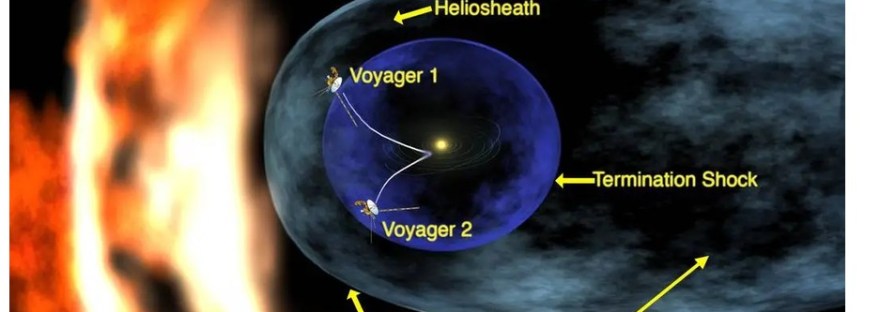
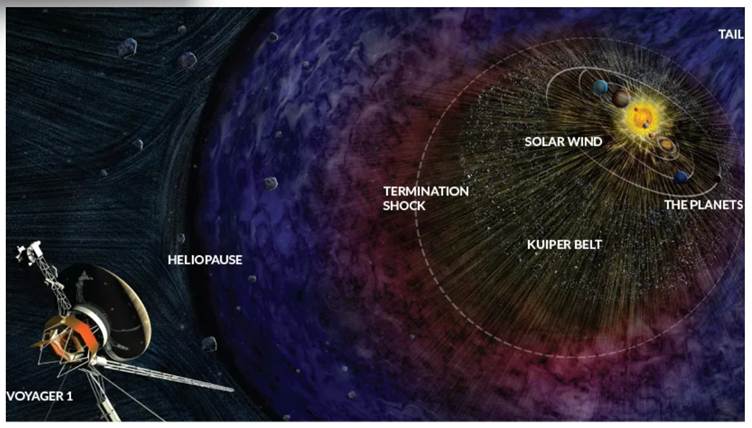
However, when the infinite monkey theorem is applied to man travelling in space and time, then we realize that man is trapped on this star called the Sun. Take the case of the current man-made space crafts at the farthest distance from the earth, Voyager 1 and Voyager 2.
They are continuously hurtling through space and Earth is constantly orbiting the Sun, their exact distances fluctuate second by second.
As of August 2026, their approximate distances from Earth are:
Voyager 1
Distance from Earth: ~25.59 billion km (~15.90 billion miles)
Astronomical Units (AU): ~171.05 AU (1 AU is the average distance from Earth to the Sun)
One-Way Signal Time: It takes light/radio signals about 23 hours and 42 minutes to travel one way between Voyager 1 and Earth.
Fun fact: Voyager 1 is fast approaching a historic milestone—in November 2026, it will become the first human-made object to be a full light-day (about 25.9 billion km) away from Earth.
Voyager 2
Distance from Earth: ~21.39 billion km (~13.29 billion miles)
Astronomical Units (AU): ~142.96 AU
One-Way Signal Time: It takes about 19 hours and 49 minutes for signals to travel one way between Voyager 2 and Earth.
Both probes are travelling through interstellar space (having crossed the heliopause years ago) and are maintained by NASA’s Deep Space Network. Neither Voyager is actually aimed at Proxima Centauri, the nearest star to us — their trajectories were set by planetary flybys decades ago, not by a destination star. But here’s what the numbers look like if you just ask “at their current speed, how long to cover the distance to the nearest star?”
The distance Proxima Centauri, the nearest star to the Sun, is about 4.24 light-years away — roughly 268,000 AU. Both Voyagers are only around 140–170 AU from the Sun right now, which is a rounding error against that distance, so it barely matters where exactly they are today.
Their speeds
Voyager 1: ~17 km/s (~3.6 AU/year) — the faster of the two, currently the most distant human-made object at about 166 AU from the Sun.
Voyager 2: ~15.4 km/s (~3.25 AU/year) — currently around 139 AU out.
Travel time to Proxima Centauri
Voyager 1: ≈ 268,000 AU ÷ 3.6 AU/yr ≈ 74,000–75,000 years
Voyager 2: ≈ 268,000 AU ÷ 3.25 AU/yr ≈ 82,000–83,000 years
A couple of caveats worth keeping in mind:
They’re not headed there. Voyager 1 is drifting roughly toward the constellation Ophiuchus/Camelopardalis direction; Voyager 2 toward Sagittarius/Pavo. Neither path passes anywhere near Proxima Centauri.
The “40,000 years” figure you may have seen refers to a different fact: Voyager 1 will pass within about 1.6 light-years of the star Gliese 445 in roughly 40,000 years — not because it’s heading there on purpose, but because that star happens to be moving toward the general area Voyager 1 is drifting through. Gliese 445 isn’t the nearest star to us today, but it will be closer to Voyager 1’s future path than Proxima Centauri is.
Both spacecraft will run out of power for their instruments and transmitters by around the early-to-mid 2030s, so they’ll be silent, coasting relics for the vast majority of that 74,000–83,000-year journey.
Indeed, the physical man on the planet earth orbiting around the star called the Sun, is trapped in space and time, an infinite monkey cage, that deviates fundamentally from the Infinite Monkey mathematical theorem of a monkey typing the text ‘the complete works of William Shakespeare’, since neither a specific monkey nor a specific man exists ad infinitum. In addition to which, our star, the Sun at the edge of its heliosphere/heliopause is surrounded by the Oort Cloud, Interstellar space filled with gas, mostly hydrogen and helium, dust, radiation, and nebulae. The Oort Cloud is made of trillions of icy space rocks and debris left over from when our solar system formed 4.6 billion years ago. These frozen chunks are mostly made of water ice, methane ice, and ammonia ice, along with small amounts of rocky dust.
This is the crossroad of physical cosmology, biology, big bang, evolution and faith. The reader is advised to keep an open mind, do a comparative analysis of the facts, and subsequently form their own opinion. Isaiah 45: 6-8; That they may know from the rising of the sun to its setting That there is none besides Me. I am the Lord, and there is no other;I form the light and create darkness, I make peace and create calamity; I, the Lord, do all these things.’ “Rain down, you heavens, from above, And let the skies pour down righteousness; Let the earth open, let them bring forth salvation, And let righteousness spring up together. I, the Lord, have created it.
All living organisms have pulses; algae, viruses, bacteria, plants, and animals. Their life span differs, the truly amazing truth is that cosmic bodies; the planet earth, and other planetary bodies, the stars (such as our star, the Sun), black holes that are usually at the centre of each galaxy, our native galaxy, the Milky way has a black hole known as Sagittarius A, at its centre, all also have pulses. Our Sun has an eleven year cycle (pulse), our planet has a 200000 years to one million years pulse (do the research on the breakaway of the Eastern section of the African continent: East Africa rift valley). Though the frequency of volcanic eruption in various parts of the planet indicate birth pains (formation of new material) on a shorter time span frequency. It’s counter intuitive to our comprehension that cosmic bodies have pulses just like us.
Major characteristics of living organisms: All living organisms share a set of key characteristics that distinguish them from non-living matter. Biologists generally define life through the following major traits:
1. Cellular Organisation
All living things are composed of one or more cells. The cell is the fundamental unit of life.
Unicellular organisms (like bacteria) consist of a single cell.
Multicellular organisms (like humans and trees) are composed of complex networks of specialised cells.
2. Metabolism
Living organisms undergo continuous chemical reactions to sustain life. This total of all chemical reactions is called metabolism, which includes:
Anabolism: Building up complex molecules (e.g., photosynthesis in plants).
Catabolism: Breaking down molecules to release energy (e.g., cellular respiration).
3. Homeostasis
Organisms must maintain a stable, constant internal environment despite changes in their external surroundings. Examples include regulating body temperature, water balance, and pH levels.
4. Growth and Development
All living things grow (increase in size or cell number) and develop (mature through a defined life cycle governed by their genetic material).
5. Reproduction
Living organisms have the ability to produce offspring to ensure the continuation of their species. This can happen in two ways:
Asexual reproduction: A single organism produces an exact genetic copy of itself.
Sexual reproduction: Two parents contribute genetic material to produce unique offspring.
6. Response to Stimuli
Organisms can detect and react to changes in their environment (stimuli). These responses can be behavioural (like a plant bending toward light) or physiological (like a person sweating when hot).
7. Adaptation through Evolution
Over generations, populations of living organisms adapt to their environments. Changes in DNA allow species to evolve via natural selection, ensuring survival in changing world conditions.
Characteristics of living entities exhibited by cosmic bodies. Cosmic bodies (stars, planets, galaxies) don’t actually meet the biological definition of “living,” but they can superficially display a few characteristics we associate with life. Here’s a breakdown of where the comparison holds up and where it breaks down:
Characteristics of Life (Biological Standard)
Living things generally show: growth, reproduction, metabolism, response to stimuli, homeostasis, organisation (cells), and evolution/adaptation.
Where Cosmic Bodies “Mimic” Life-like Traits
1. Growth
Stars accumulate mass from surrounding gas and dust clouds, growing over millions of years.
Planets form and grow through accretion of smaller bodies (planetesimals).
Black holes “grow” by consuming matter and merging with other black holes.
2. Birth and Death (Life Cycles)
Stars are “born” in nebulae, go through a main sequence “life,” and “die” as white dwarfs, neutron stars, or supernovae.
This life-cycle terminology (protostar → main sequence → red giant → death) closely parallels biological life stages, which is why it’s used colloquially.
3. Energy Consumption/Metabolism (loose analogy)
Stars convert hydrogen to helium via fusion, releasing energy — vaguely resembling metabolic energy conversion, though it’s a nuclear process, not a chemical/biological one.
4. Reproduction (very loose analogy)
Supernovae scatter heavy elements that seed the formation of new stars and planetary systems — sometimes called “stellar reproduction,” though it’s not self-directed or genetically informed.
5. Response to Environment
Planetary and stellar systems respond to gravitational influences (e.g., tidal locking, orbital resonance), but this is passive physics, not a biological “response to stimuli.”
6. Structure/Organization
Cosmic bodies have internal layered structure (core, mantle, crust for planets; core, radiative zone, convective zone for stars) — analogous to organised biological systems, but not cellular.
Key Missing Criteria
Cosmic bodies lack:
Self-replication with genetic information
Homeostasis (active self-regulation)
Evolution by natural selection
Response to stimuli in a purposeful/adaptive sense
Metabolism in the biochemical sense
Bottom Line
The similarities are largely metaphorical and process-based (growth, cycles, transformation) rather than functional in the biological sense. Scientists use “life cycle” language for stars and galaxies as a useful analogy for teaching and visualisation — not because these bodies are literally alive.
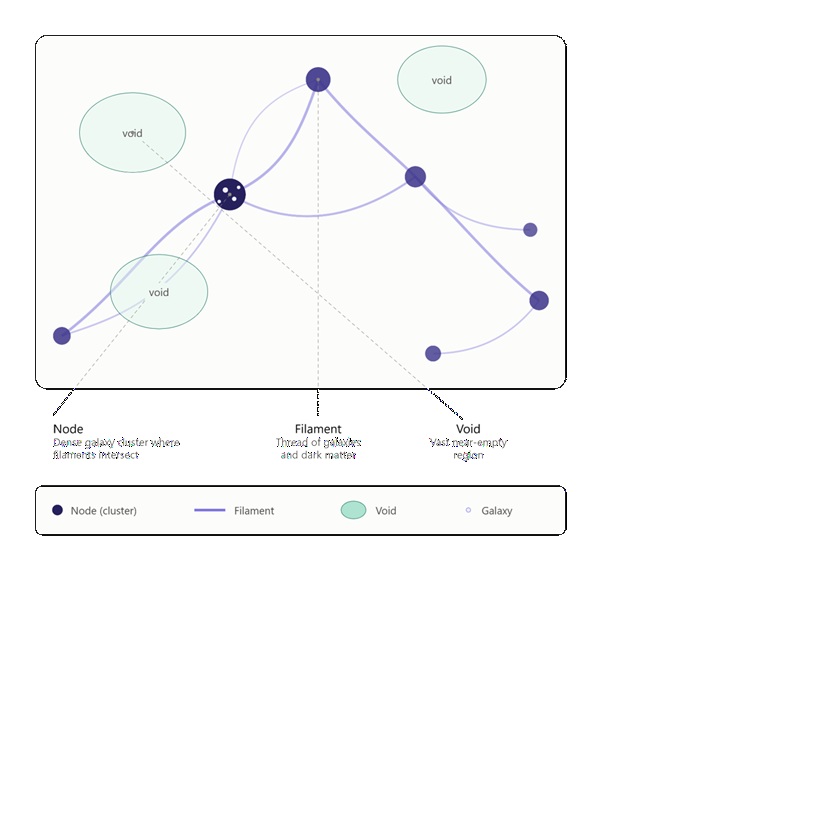
The cosmic web is the large-scale structure of the universe — the way matter (both visible and dark matter) is arranged across space on the grandest scales, forming a pattern that resembles a three-dimensional spiderweb or a sponge-like network.
Structure of the Cosmic Web
It has four main components:
1. Filaments
Long, thread-like structures made of galaxies, gas, and dark matter.
These are the “strands” of the web, often hundreds of millions of light-years long.
Galaxies tend to flow along these filaments, pulled by gravity.
2. Nodes (Clusters)
Dense regions where filaments intersect.
These host massive galaxy clusters — some of the largest gravitationally bound structures in the universe.
3. Walls (Sheets)
Flattened, sheet-like structures of galaxies, less dense than filaments but denser than voids.
An example is the “Great Wall,” a massive sheet-like arrangement of galaxies.
4. Voids
Enormous, roughly spherical regions that are nearly empty of galaxies and matter.
Voids can span tens to hundreds of millions of light-years and make up most of the universe’s volume.
How It Formed
The cosmic web originated from tiny density fluctuations in the early universe (visible in the Cosmic Microwave Background). Over billions of years:
Regions with slightly more matter attracted more matter via gravity.
Dark matter, which vastly outweighs normal matter, formed the initial gravitational scaffolding.
Normal (baryonic) matter — gas and eventually galaxies — fell into this scaffolding, tracing out the filaments, nodes, and walls we observe today.
Why It Matters
It reveals the role of dark matter (reference Isaiah 45: 6-8), since the web’s structure is shaped predominantly by dark matter’s gravity, even though we can’t see it directly.
It helps cosmologists test models of the universe’s evolution (e.g., using simulations like the Millennium Simulation or Illustris).
Studying the cosmic web helps explain how galaxies form, migrate, and cluster over cosmic time.
That’s the basic layout: filaments (the purple threads) carry galaxies along them like beads on a string, converging at nodes — the densest points, where massive galaxy clusters form. Between the filaments and walls are the voids, vast nearly-empty bubbles that make up most of the universe’s volume.
A useful way to picture it: imagine soap bubbles packed together. The thin films and edges where bubbles meet are the filaments and walls (matter concentrates there), while the hollow interior of each bubble is a void. The whole pattern is invisible in normal light on this scale — what actually holds the shape together is dark matter’s gravity, with visible galaxies just tracing the underlying scaffold.
Expansion of the universe refers to the observation that the space between galaxies (on large scales) is continuously stretching over time — galaxies aren’t just moving through space, but the fabric of space itself is growing.
Key Points
1. It’s not an explosion into empty space
A common misconception is that the universe expanded like a bomb going off, with galaxies flying outward from a central point into pre-existing empty space.
In reality, space itself is stretching everywhere, uniformly. There is no center and no edge — every point moves away from every other point.
2. The raisin bread analogy
Picture raisin bread dough rising in an oven. Each raisin (galaxy) doesn’t move through the dough — but as the dough expands, every raisin gets farther from every other raisin.
The farther apart two raisins start, the faster they separate as the loaf expands — this mirrors what we observe with galaxies.
3. Discovered through redshift
In the 1920s, Edwin Hubble observed that light from distant galaxies is shifted toward longer (redder) wavelengths — called redshift.
This happens because space stretches while light travels through it, stretching the light’s wavelength too.
Crucially, more distant galaxies show greater redshift, meaning they’re receding faster — this relationship is Hubble’s Law.
4. Hubble’s Law
Recession velocity = H₀ × distance (where H₀ is the Hubble constant, roughly 70 km/s per megaparsec).
This means space is expanding at a consistent rate everywhere — it’s not that galaxies are “running away” from a specific spot.
5. Accelerating expansion
Observations in the late 1990s (using distant supernovae) revealed the expansion isn’t slowing down due to gravity, as expected — it’s actually speeding up.
This acceleration is attributed to dark energy, a mysterious force that makes up roughly 68% of the universe’s total energy content, though its nature is still not well understood.
6. What isn’t expanding
Locally bound systems — galaxies, solar systems, planets, even you — don’t expand, because gravity (and other forces) hold them together tightly enough to resist the stretching of space.
Expansion only becomes significant on very large scales, between galaxies and galaxy clusters that aren’t gravitationally bound to each other.
Bottom Line
Expansion means the space between cosmic structures is growing over time, carrying galaxies apart from one another — not because they’re moving through a fixed space, but because the space itself is stretching, and this stretching is accelerating due to dark energy. Psalm 19: 1-6; The heavens declare the glory of God; And the firmament shows His handiwork. Day unto day utters speech, And night unto night reveals knowledge. There is no speech nor language Where their voice is not heard. Their line has gone out through all the earth, And their words to the end of the world. In them He has set a tabernacle for the sun,Which is like a bridegroom coming out of his chamber, And rejoices like a strong man to run its race. Its rising is from one end of heaven, And its circuit to the other end; And there is nothing hidden from its heat. What do we have here, faith in God who says, He created light and darkness, physical cosmology that says there is matter and anti-matter, light/stars, galaxies and dark energy, cosmic web, is there a parallel to be seen, well the rest is up to the reader to form their opinion on this piece.
John chapter 14 verse 6;Jesus answered, “I am the way and the truth and the life. Obviously this statement/text spoken by Jesus Christ is a metaphor, however, is there a literal meaning behind it? If so, let us examine the literal aspect. That is, instead of approaching ‘the life’ as a ‘who’, approaching it as a ‘what’.
Let us literarily examine what is life, how does it start? What is the technical process involved? Do we really know how life begins physically/technically? What do we know scientifically, and what do we not know (scientific ignorance)? What are the unproven theories we have in this field? And what are our best explanation of the quantum biochemical process of DNA replication.
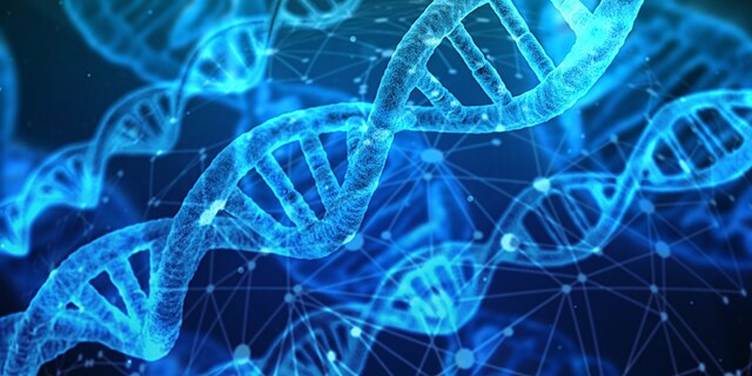
Deoxyribonucleic Acid (DNA) is the molecule that stores the genetic blueprint for all living organisms. It contains the instructions needed to build, operate, and reproduce every cell in the body. See picture below.
Structure of DNA
The Building Blocks — Nucleotides
DNA is a polymer made of repeating units called nucleotides, each consisting of three components:
Component
Description
Deoxyribose sugar
A 5-carbon sugar (missing one oxygen vs. ribose)
Phosphate group
Links nucleotides together forming the backbone
Nitrogenous base
The information-carrying component
The Four Bases of DNA
Adenine (A) — Purine
Thymine (T) — Pyrimidine
Guanine (G) — Purine
Cytosine (C) — Pyrimidine
Base Pairing Rules (Chargaff’s Rules)
Bases pair specifically across the two strands:
A ═══ T (2 hydrogen bonds)
G ≡≡≡ C (3 hydrogen bonds)
The Double Helix
DNA exists as a double-stranded helix — two antiparallel strands wound around each other, described by Watson and Crick in 1953. The strands run in opposite directions:
One strand runs 5′ → 3′
The complementary strand runs 3′ → 5′
5′ — A — T — G — C — A — T — 3′
| | | | | |
3′ — T — A — C — G — T — A — 5′
DNA Organisation in the Cell
Level
Structure
Naked DNA
Double helix
Nucleosome
DNA wrapped around histone proteins
Chromatin fibre
Compacted nucleosomes
Chromosome
Fully condensed chromatin
Human cells contain ~3 billion base pairs
If uncoiled, DNA in a single cell would stretch ~2 metres
Packed into a nucleus just 6 micrometres across
DNA
What is RNA?
Ribonucleic Acid (RNA) is a versatile molecule that acts as an intermediary between DNA and proteins, and performs many other cellular functions. Unlike DNA, RNA is typically single-stranded.
Structure of RNA
RNA nucleotides differ from DNA in two key ways:
Feature
DNA
RNA
Sugar
Deoxyribose
Ribose (has extra –OH)
Bases
A, T, G, C
A, U, G, C (Uracil replaces Thymine)
Strands
Double-stranded
Single-stranded
Stability
Very stable
Relatively unstable
Location
Nucleus (mainly)
Nucleus & cytoplasm
The Three Main Types of RNA
1. Messenger RNA (mRNA)
Carries the genetic message from DNA to the ribosome
Made during transcription in the nucleus
Read in codons (triplets of bases) during translation
Cloverleaf structure with an anticodon loop and amino acid attachment site
Acts as the physical adaptor between nucleic acid language and protein language
~73–93 nucleotides long
3. Ribosomal RNA (rRNA)
Structural and catalytic component of ribosomes
Most abundant RNA in the cell (~80%)
The ribosome’s rRNA acts as a ribozyme — catalysing peptide bond formation
Humans have 4 types: 28S, 18S, 5.8S, 5S
Other Important RNA Types
RNA Type
Function
miRNA (microRNA)
Regulates gene expression by silencing mRNA
siRNA (small interfering RNA)
RNA interference — degrades specific mRNA
snRNA (small nuclear RNA)
Involved in RNA splicing (spliceosome)
lncRNA (long non-coding RNA)
Gene regulation, chromatin remodelling
Ribozymes
RNA molecules with catalytic activity
The Central Dogma of Molecular Biology
The relationship between DNA and RNA underpins all of biology:
Transcription Translation
DNA ──────────────► RNA ──────────────► Protein
▲ │
└────────────────────┘
Reverse Transcription
(retroviruses, e.g. HIV)
Process
Description
Location
Replication
DNA → DNA (copying)
Nucleus
Transcription
DNA → RNA (reading)
Nucleus
Translation
RNA → Protein (building)
Ribosome (cytoplasm)
Reverse Transcription
RNA → DNA (viral)
Cytoplasm
DNA vs RNA — Full Comparison
Feature
DNA
RNA
Full name
Deoxyribonucleic acid
Ribonucleic acid
Sugar
Deoxyribose
Ribose
Bases
A, T, G, C
A, U, G, C
Strands
Double
Single
Helix
Yes (double helix)
Sometimes (hairpins, etc.)
Stability
Very stable
Less stable
Function
Stores genetic info
Expresses genetic info
Location
Nucleus, mitochondria
Nucleus, cytoplasm, ribosomes
Lifespan
Permanent (in cell)
Temporary
Why Does the Difference Matter?
The extra hydroxyl group (–OH) on RNA’s ribose sugar makes RNA:
More chemically reactive
Capable of self-catalysis (ribozymes)
Suitable for short-lived messages (mRNA turns over quickly, allowing rapid gene regulation)
DNA’s missing –OH makes it chemically inert and far more stable — ideal for long-term information storage across generations.
Together, DNA and RNA form the central information processing system of all life on Earth — DNA as the archive, RNA as the working copy and multi-tool executor.
DNA replication is a fascinating intersection of quantum mechanics and biochemistry. Here’s how quantum effects play roles in this fundamental process:
The Classical Foundation
DNA replication involves unwinding the double helix and using each strand as a template to build a complimentary copy, orchestrated by enzymes like helicase, primase, and DNA polymerase.
Where Quantum Effects Come In
1. Proton Tunnelling and Base Pairing
The most significant quantum effect is proton tunnelling in hydrogen bonds between base pairs (A-T and G-C). Hydrogen bonds are maintained partly by protons that can quantum tunnel — passing through energy barriers rather than over them. This tunnelling can cause protons to shift positions (tautomeric shifts), temporarily changing a base’s bonding behaviour. If replication occurs while a base is in a rare tautomeric form, it can cause a point mutation — a mechanism first proposed by Watson and Crick themselves.
2. Electron Delocalization in the Base Stack
DNA’s stacked aromatic bases form a π-electron system running along the helix. Electrons are delocalized across multiple bases simultaneously — a quantum superposition of states. This has implications for how DNA polymerase “reads” the template, as the electronic landscape influences molecular recognition.
3. Enzyme Catalysis via Quantum Tunnelling
DNA polymerase accelerates nucleotide addition dramatically. Part of this catalytic power comes from quantum tunnelling of hydrogen atoms during proton transfer steps in the phosphodiester bond-forming reaction. Enzymes are thought to shape their active sites to enhance tunnelling probability — a field called quantum enzyme catalysis.
4. Van der Waals Forces and Quantum Fluctuations
Base stacking stability relies on London dispersion forces, which arise from quantum fluctuations in electron density (instantaneous dipoles). These zero-point quantum fluctuations contribute meaningfully to the structural integrity of the double helix and affect how polymerase processivity works.
5. The Quantum Measurement Problem in Fidelity
DNA polymerase achieves an error rate of roughly 1 in 10⁷. Part of the fidelity mechanism may involve the enzyme acting like a quantum “measurement device” — the act of selecting and inserting a nucleotide collapses the quantum state of the template base, enforcing correct pairing. This is still an active area of research.
The Bigger Picture
Process
Quantum Effect
Hydrogen bonding
Proton tunnelling → tautomeric shifts
Base stacking
Electron delocalization, Van der Waals
Polymerase catalysis
H-atom tunnelling in bond formation
Structural stability
Zero-point energy fluctuations
Mutation induction
Tunnelling-induced tautomer errors
Current Research Frontier
The field of quantum biology is still maturing. While proton tunnelling in DNA is well-established theoretically, directly measuring these quantum effects in a living, warm, wet biological environment is experimentally challenging. Decoherence — the loss of quantum states due to thermal noise — was long thought to preclude significant quantum effects in biology, but evidence increasingly suggests biology has evolved mechanisms to exploit quantum phenomena even at physiological temperatures.
It’s a remarkable picture: the very molecule that carries the instructions for life operates at the boundary between the quantum and classical worlds.
What is our current scientific explanation of the fertilisation process of human reproductive cells to the formation of an embryo?
Human Fertilisation: From Gametes to Embryo
1. The Gametes — Starting Materials
Sperm (Spermatozoon)
Haploid cell (23 chromosomes)
Three regions: head (nucleus + acrosome), midpiece (mitochondria for energy), flagellum (propulsion)
Acrosome contains hydrolytic enzymes critical for penetrating the egg
Oocyte (Egg)
Also haploid — but actually arrested in Metaphase II of meiosis at ovulation; it only completes meiosis upon fertilisation
Surrounded by the zona pellucida (glycoprotein shell) and corona radiata (follicular cells)
Contains cortical granules just beneath the membrane — essential for blocking polyspermy
2. The Journey & Capacitation
After ejaculation, sperm undergo capacitation in the female reproductive tract — a biochemical maturation process lasting several hours involving:
Removal of cholesterol from the sperm plasma membrane
Hyperpolarisation then hyperactivation (vigorous, whip-like flagellar motion)
Increased intracellular Ca²⁺ signalling
Surface protein remodelling, exposing receptors needed for zona binding
Only capacitated sperm can fertilise an egg. Of ~200–500 million sperm deposited, only a few hundred reach the oocyte in the ampulla of the fallopian tube.
3. Sperm–Egg Binding and the Acrosome Reaction
Step 1 — Corona Radiata Penetration Hyperactivated sperm physically push through the follicular cells using mechanical force and hyaluronidase enzyme activity.
Step 2 — Zona Pellucida Binding Sperm bind to ZP3 glycoproteins on the zona pellucida via complementary receptors. This binding triggers the:
Acrosome Reaction
Ca²⁺ floods into the sperm head
The acrosomal membrane fuses with the sperm plasma membrane
Hydrolytic enzymes (acrosin, proteases) are released
These enzymes digest a path through the zona pellucida
4. Membrane Fusion & Blocks to Polyspermy
When the first sperm reaches the oocyte membrane, proteins IZUMO1 (sperm) and JUNO (egg) bind — the essential molecular handshake for fusion.
The membranes fuse and the sperm nucleus enters the oocyte cytoplasm. This triggers two immediate defence mechanisms against polyspermy (fertilisation by multiple sperm, which is lethal):
Block
Mechanism
Speed
Fast block
Membrane depolarisation (+20mV) via Na⁺ influx
Seconds
Slow block
Cortical reaction — Ca²⁺ wave triggers cortical granule exocytosis, modifying zona pellucida (zona reaction), making it impenetrable
1–2 minutes
5. Completion of Meiosis & Pronuclei Formation
Sperm entry triggers a cascade of intracellular Ca²⁺ oscillations (driven by sperm-introduced PLCζ enzyme), which:
Releases the oocyte from its Metaphase II arrest
The oocyte completes meiosis II, ejecting the second polar body
The egg nucleus becomes the female pronucleus
The sperm nucleus decondenses and becomes the male pronucleus
Both pronuclei swell and replicate their DNA independently. The cell now contains 46 chromosomes (23 pairs) across two separate nuclei — this is the zygote, though the pronuclei haven’t yet fused.
6. Syngamy — The First Mitotic Division
Rather than fusing directly, the two pronuclei:
Migrate toward each other
Their nuclear envelopes break down
Chromosomes from both align on a shared mitotic spindle
The first cell division (cleavage) occurs
This is syngamy — the true genetic union. The zygote divides into 2 blastomeres.
7. Cleavage — Rapid Cell Division
Over the next ~3–4 days, the zygote undergoes rapid mitotic divisions (cleavage) as it travels down the fallopian tube. Crucially, the total volume doesn’t increase — cells get progressively smaller:
At the 8-cell stage, compaction occurs — blastomeres flatten and maximise contact with each other, held by E-cadherin. Gap junctions form, enabling cell-to-cell communication.
8. Blastocyst Formation (Day 5–6)
The morula undergoes cavitation — fluid is pumped into the interior, forming a fluid-filled cavity called the blastocoel. The structure is now a blastocyst, with two distinct cell populations:
Cell Type
Location
Fate
Trophoblast
Outer layer
Placenta, extra embryonic membranes
Inner Cell Mass (ICM) / Epiblast
Interior cluster
The embryo itself
This is the first major cell fate decision in human development — driven by positional signals and transcription factors (OCT4, NANOG, CDX2).
9. Hatching & Implantation (Day 6–10)
The blastocyst hatches from the zona pellucida (using proteases) and attaches to the endometrium (uterine lining, prepared by progesterone).
Implantation proceeds in stages:
Apposition — loose contact with endometrial epithelium
Adhesion — firm attachment via integrins and selectins
Invasion — trophoblast cells differentiate into:
Cytotrophoblast (inner, proliferative)
Syncytiotrophoblast (outer, invasive multinucleate mass that erodes into maternal tissue)
The syncytiotrophoblast begins secreting hCG (human chorionic gonadotropin) — the hormone detected by pregnancy tests — which signals the corpus luteum to keep producing progesterone, maintaining the uterine lining.
10. The Embryo Proper — Bilaminar Disc (Week 2)
By the end of week 2, the inner cell mass reorganises into the bilaminar embryonic disc:
Epiblast (upper layer) → gives rise to all three germ layers
From a single sperm-egg fusion to a structured embryo with distinct cell lineages, this entire process is one of the most precisely choreographed sequences in biology — coordinating quantum-level chemistry, molecular signalling, mechanical forces, and genetic programming across just a matter of days. And yet the average man (man or woman or Biologist: IVF, and so on) believes that they are in control of the process. Obviously, there is freedom of expression, even if what is being expressed is a monumental display of ignorance. If ‘life’ can be created by man, surely man should be able to extend his/her lifespan to infinity, that is, no more diseases, and physical death. The publisher of this article is not holding his/her breath, till that state is achieved by science.
Genesis 1 verses 14-19; And God said, “Let there be lights in the vault of the sky to separate the day from the night, and let them serve as signs to mark sacred times, and days and years, and let them be lights in the vault of the sky to give light on the earth.” And it was so. God made two great lights—the greater light to govern the day and the lesser light to govern the night. He also made the stars. God set them in the vault of the sky to give light on the earth, to govern the day and the night, and to separate light from darkness. And God saw that it was good. And there was evening, and there was morning—the fourth day.
What is time from the perspective of living organisms compared to that of cosmic bodies?
This is a beautifully deep question that sits at the intersection of biology, physics, and philosophy.
What is Time, Fundamentally?
Physically, time is a dimension of the universe — part of the spacetime fabric described by Einstein’s relativity. But experienced time and cosmic time are very different things.
Time from the Perspective of Living Organisms
Time is biological and relative
Living organisms don’t experience time as a fixed constant — they experience it through:
Metabolism — faster metabolism generally correlates with a faster subjective experience of time. A hummingbird’s heart beats ~1,200 times per minute; it likely perceives the world in much finer temporal slices than a tortoise
Circadian rhythms — almost all life on Earth is locked to roughly a 24-hour biological clock, tied to the planet’s rotation
Neural processing speed — the faster an organism processes sensory information, the more “frames per second” of reality it experiences. Small fast animals like flies perceive time more slowly relative to us (they see us moving in slow motion)
Time is purpose-driven for life
For living organisms, time is experienced as:
Survival pressure — immediate, urgent, fleeting
Generational — life measures time in lifespans, seasons, and reproductive cycles
Cellular — at the cellular level, time is measured in chemical reactions, protein folding, and DNA replication — milliseconds to hours
Evolutionary — at the species level, meaningful change happens over thousands to millions of years
Life’s relationship with time is asymmetric
Living organisms have a profound awareness of time’s arrow — birth, growth, decay, death. Entropy is felt personally. Every living thing is essentially a temporary configuration of matter fighting against disorder.
Time from the Perspective of Cosmic Bodies
Time is almost incomprehensibly vast
The Sun is 4.6 billion years old and will live another ~5 billion — a single stellar lifetime dwarfs all of human civilisation millions of times over
A neutron star can complete a full rotation in milliseconds, experiencing enormous amounts of rotational “time” per second
Black holes warp time itself — at the event horizon, time slows to a standstill relative to a distant observer
Galaxies evolve over billions of years; their “events” — collisions, star formation, spiral arm shifts — are invisible on any human timescale
Cosmic bodies don’t experience time
This is perhaps the most striking contrast. A star doesn’t feel its 10-billion-year life. A galaxy doesn’t anticipate its eventual collision with a neighbour. Cosmic time simply passes and accumulates through physics — gravity, nuclear fusion, thermodynamics — without any internal experience.
The Great Contrast
Living Organisms
Cosmic Bodies
Scale
Microseconds to millennia
Millions to billions of years
Experience
Subjective, felt, urgent
None — purely physical
Measurement
Heartbeats, seasons, generations
Light-years, orbital periods
Relationship to entropy
Active resistance
Passive progression
Time’s arrow
Deeply felt
Indifferent
A Philosophical Reflection
There is something remarkable in the contrast: the universe is ancient and vast, yet indifferent to time, while a mayfly lives only one day but experiences that day with full biological urgency and presence.
In a sense, consciousness may be the universe’s only mechanism for actually experiencing time — and living organisms, however brief, are the only things in the cosmos for whom time truly means anything.
As the physicist Carlo Rovelli puts it, time as we feel it — flowing, urgent, personal — may be less a feature of the universe and more a feature of us.
The time scale and timespan of living organisms differs from that of cosmic bodies. How old is the oldest verified living organism?
The oldest verified living organism depends on how you define “individual organism” — the answer changes quite dramatically.
Single Organism (Clonal / Rooted)
Pando — a clonal colony of quaking aspen trees in Utah, USA — is often cited as one of the oldest and most massive living organisms, estimated at around 80,000 years old, though some estimates go higher. It’s technically a single organism connected by one root system.
Oldest Individual Non-human Animal
Jonathan the Seychelles giant tortoise is the oldest known living animal, born around 1832, making him approximately 193 years old as of 2026. He lives on the island of St. Helena.
Oldest Individual Tree
Methuselah, a Great Basin bristlecone pine in California, USA, is approximately 4,855 years old — the oldest known individual (non-clonal) tree.
Oldest Known Living Microorganism
Bacteria revived from ancient salt crystals and permafrost have been claimed to be hundreds of thousands to millions of years old, though these claims are harder to verify and debated scientifically.
Oldest in the Ocean
Ocean quahog clams (Arctica islandica) are among the longest-lived animals — one nicknamed “Ming” was confirmed at 507 years old when it was (unfortunately) killed during the aging process in 2006.
Key takeaway
Life’s longevity record depends heavily on definition — a single rooted tree, a clonal colony, an animal, or a microbe all yield very different answers. But life on Earth has clearly mastered the art of persistence.
The Sun is about 4.6 billion years old, formed from a collapsing cloud of gas and dust in a spiral arm of the Milky Way. It’s currently about halfway through its main-sequence lifetime — it’s expected to continue burning hydrogen for another ~5 billion years before expanding into a red giant.
Earth is also about 4.54 billion years old, forming roughly 50–100 million years after the Sun from the same swirling disk of gas and dust (the solar nebula).
We know this primarily through radiometric dating of the oldest rocks and minerals on Earth (zircon crystals dated to ~4.4 billion years), as well as dating of meteorites from the same era.
The earliest known systematic human anatomical dissections were performed in Alexandria, Egypt, around 300–250 BCE.
The key figures were Herophilus of Chalcedon and Erasistratus of Chios, both working at the famous Library/Museum of Alexandria under the patronage of the Ptolemaic rulers. They are credited with being the first to perform dissections of human cadavers in a systematic, scientific way — and according to some ancient sources (like Celsus), they may have even performed vivisections on condemned criminals, though this remains debated.
Before Alexandria, anatomical knowledge came mainly from:
Animal dissections (e.g., Aristotle dissected many animals but not humans)
Wound observation in warfare and surgery
Hippocratic writings (~400 BCE), which were based on external observation rather than dissection
After the Alexandrian period, human dissection largely fell out of practice in the ancient world due to cultural and religious taboos, and wasn’t systematically revived in Europe until the 13th–14th centuries, with figures like Mondino de Luzzi in Bologna.
During a philosophical discussion with a friend, it was suggested that the modern generation are more intelligent than the older ones. Are the adolescents of the modern generation capable of more brain functioning capacity compared to previous generations?
This is a fascinating and nuanced question. The short answer is: it’s complicated — and depends on what you mean by “brain functioning capacity.”
The Flynn Effect
The most well-documented finding is the Flynn Effect — IQ scores rose steadily across the 20th century in many countries, roughly 3 points per decade. This suggests improvements in certain cognitive abilities like abstract reasoning and pattern recognition, likely due to better nutrition, education, healthcare, and more cognitively stimulating environments.
Where modern adolescents may have an edge
Visual-spatial processing — navigating digital interfaces, reading complex visuals, and multitasking across screens appears stronger
Information access and synthesis — faster at finding and filtering large amounts of information
Tech-native problem solving — intuitive with tools previous generations had to consciously learn
Where there are concerns
Attention span and deep focus — studies suggest sustained concentration may be declining, linked to smartphone and social media use
Memory — reliance on external devices (“Google effect”) may reduce the need to internally store information
The Flynn Effect may be reversing — some Scandinavian and other studies from the 1990s onward suggest IQ gains have plateaued or slightly declined in some developed nations
Mental health — rates of anxiety, depression, and stress are notably higher in Gen Z, which affects cognitive performance
The bigger picture
The brain’s raw biological capacity hasn’t changed — human brains are essentially the same hardware as thousands of years ago. What changes across generations is how that capacity is trained, used, and expressed, shaped by environment, education, technology, nutrition, and culture.
So modern adolescents aren’t necessarily more capable in an absolute sense, but they are differently capable — optimised for the cognitive demands of the world they grew up in. The elephant in the room is; do you subscribe to the school of thought of an evolutionist or that of an intelligent designer/creationist? Follow the evidence.
The Big Bang theory explains how the universe began as a hot, dense point nearly 13.8 billion years ago and has been expanding ever since. Evidence supporting this includes the cosmic microwave background radiation and the observed redshift of galaxies.
Overview of the Big Bang Theory
The Big Bang theory is the leading explanation for the origin of the universe. It posits that the universe began approximately 13.8 billion years ago from an extremely hot and dense point. This initial singularity underwent rapid expansion, leading to the cosmos we observe today.
Key Concepts
Initial Conditions
Singularity: The universe started as a point of infinite density and temperature.
Rapid Expansion: Following the initial explosion, the universe expanded faster than the speed of light.
Evidence Supporting the Theory
Cosmic Microwave Background Radiation (CMB):
This faint glow is the afterglow of the Big Bang, detectable in all directions of space.
It provides a snapshot of the universe when it was about 380,000 years old.
Redshift of Galaxies:
Observations show that galaxies are moving away from us, with more distant galaxies receding faster.
This phenomenon supports the idea that the universe is expanding.
Implications of the Theory
The Big Bang theory explains the abundance of light elements, such as hydrogen and helium, in the universe.
It also accounts for the large-scale structure of the universe and its ongoing expansion.
Conclusion
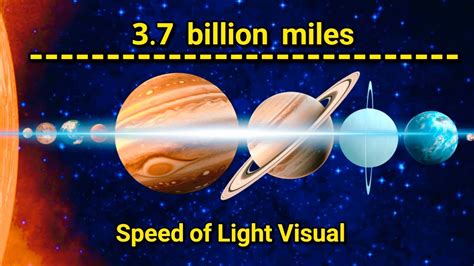
The Big Bang theory remains the most widely accepted model for the origin and evolution of the universe, supported by substantial observational evidence. It describes a dynamic cosmos that has been expanding and evolving for billions of years. The speed of light in a vacuum is exactly 299,792,458 meters per second, which is approximately 186,282 miles per second. This speed is a universal constant denoted by the symbol “c.”
The ONLY EVIDENCE THAT COUNTERACT THIS MODEL FOR THE ORIGIN AND EVOLUTION OF THE UNIVERSE, IS SEEING THE CREATOR IN THE LAND OF THE LIVING (Physical) (This is the difference between Believe and Knowledge). John 4:24; God is spirit, and his worshipers must worship in the Spirit and in truth.” A spirit is a non-physical entity. Without this evidence, there is no knowledge of ‘God’, what you have is ‘believe’ (which has some degree of uncertainty).
The phrase “I will see my Redeemer in the land of the living” is a paraphrase of a key verse found in the Book of Job.
Job 19:25-26
Job 19:25: “I know that my Redeemer lives, and that in the end he will stand upon the earth.”
Job 19:26: “Even after my skin has been destroyed, yet in my flesh I will see God.”
These verses express Job’s profound faith in his Redeemer and his hope of seeing God after death, emphasizing the belief in life beyond the grave. However, since no one has medically died (not coma), and come back to life after three days, and subsequently demonstrated authority over mind and matter, which is definite proof of deity and authority over matter and antimatter, the material that makes up the physical universe.
Mathew 11:29; for I am gentle and humble in heart.
The concept that all things are created by Him, for Him, and in Him is found in Colossians 1:16-17. This passage emphasizes the role of Christ in creation.
Key Verses
Verse Reference
Content
Colossians 1:16
“For by him all things were created, in heaven and on earth, visible and invisible…”
Colossians 1:17
“He is before all things, and in him all things hold together.”
Explanation
By Him: This indicates that Christ is the agent of creation, meaning everything was made through His power.
For Him: This suggests that the purpose of creation is centred around Christ, highlighting His significance in the universe.
In Him: This phrase implies that all things exist within the framework of Christ, emphasizing His sustaining role in creation.
These verses collectively affirm the centrality of Christ in the act of creation and His ongoing relationship with all that exists.
Acts 17: 23-28; to an unknown god. So you are ignorant of the very thing you worship—and this is what I am going to proclaim to you. “The God who made the world and everything in it is the LORD OF HEAVEN AND EARTH AND DOES NOT LIVE IN TEMPLES BUILT BY HUMAN HANDS. And HE IS NOT SERVED BY HUMAN HANDS, AS IF HE NEEDED ANYTHING. Rather, HE HIMSELF GIVES EVERYONE LIFE AND BREATH AND EVERYTHING ELSE. From one man he made all the nations, that they should inhabit the whole earth; and he marked out their appointed times in history and the boundaries of their lands. God did this so that they would seek him and perhaps reach out for him and find him, though he is not far from any one of us. ‘FOR IN HIM WE LIVE AND MOVE AND HAVE OUR BEING.’As some of your own poets have said, ‘We are his offspring.
(Speed of Light in a Vacuum
The speed of light in a vacuum is a fundamental constant of nature, defined as:
Exact Value: 299,792,458 meters per second
Approximate Value: 186,282 miles per second
This speed is commonly denoted by the symbol c.
Importance of the Speed of Light
The speed of light serves several critical roles in physics:
Universal Constant: It is the same for all observers, regardless of their relative motion.
Speed Limit: According to Einstein’s theory of special relativity, nothing can travel faster than light.
Measurement Standards: The meter is defined based on the distance light travels in a vacuum in a specific time interval.
Light in Different Media
While the speed of light in a vacuum is constant, it changes when light travels through different materials:
Medium
Speed of Light (approx.)
Vacuum
299,792,458 m/s
Air
~99.97% of c
Water
~225,000,000 m/s
Glass
~200,000,000 m/s
Diamond
~124,000,000 m/s
In these materials, light travels slower due to interactions with the medium.)
Only a humble and gentle in heart Creator would not scream on the rooftop that He created the visible, seen and beyond the visible universe. Let there be light.