Honesty versus Transparency re Absolute Authority of God

The concept of Honesty depends on questions being asked and answers being given truthfully. While transparency implies redundancy or irrelevance of questions being asked, since nothing is hidden, everything is in the open. Given the omniscience nature of God, who knows the end from the beginning, knows everything, and that nothing is hidden from His gaze. Why would God ask His creations questions about any given situation or circumstances, since He knows everything. Unless one is dealing with a deity that does not know everything. Jesus Christ reassure us about the Most High God knowing everything, to the extent that every single hair on our head is numbered:The exact phrase combining those concepts spans a few key passages in the Gospels, as well as an Old Testament idiom.

1. Luke 21:18

Jesus explicitly links the preservation of a hair on your head to ultimate spiritual protection:

“But not a hair of your head will perish.”

2. Matthew 10:29–30 (and Luke 12:6–7)

Jesus addresses God’s complete awareness of every single hair falling or existing:

“Are not two sparrows sold for a penny? Yet not one of them will fall to the ground outside your Father’s care. And even the very hairs of your head are all numbered.” Demons and or evil spirits inhabit the realm of the dead. Since Jesus Christ said in John 14:6; that He is the way, the truth, and Life, all entities separated from Christ are dead. In the book of Job 26:6, we have an expression about the truth, and circumstances and situation in the Kingdom of God concerning the realm of the dead being transparent before God. While the exact phrase “transparent before him” is a modern phrasing or paraphrase of the idea, the underlying Hebrew text uses imagery describing the realm of the dead as completely uncovered and exposed to God’s sight.

Here is how major translations render Job 26:6:

  • New International Version (NIV): “The realm of the dead is naked before God; Destruction lies uncovered.”
  • Good News Translation (GNT): “The world of the dead lies open to God; no covering shields it from his sight.”
  • English Standard Version (ESV): “Sheol is naked before God, and Abaddon has no covering.”
  • New Living Translation (NLT): “The underworld is naked in God’s presence. The place of destruction is uncovered.”

Context:

In this chapter, Job is describing the majesty and absolute authority of God. His point is that even Sheol (the Hebrew term for the realm of the dead) and Abaddon (the place of destruction/decay), which are hidden and mysterious to human eyes, are completely transparent and fully exposed to God.

James 2:19;

  • New International Version (NIV): “You believe that there is one God. Good! Even the demons believe that—and shudder.”
  • English Standard Version (ESV): “You believe that God is one; you do well. Even the demons believe—and shudder!”
  • King James Version (KJV): “Thou believest that there is one God; thou doest well: the devils also believe, and tremble.”

Context of the passage: In this chapter, James is making the point that intellectual belief alone is not enough to save someone. He points out that even demons acknowledge the reality and power of God with fear, but their belief does not lead to allegiance or righteous action.

John 14:17.

In this passage, Jesus is comforting His disciples during the Last Supper and promising to send the Holy Spirit (the “Spirit of truth”).

Different Bible translations phrase the concept similarly:

  • English Standard Version (ESV): “…even the Spirit of truth, whom the world cannot receive, because it neither sees him nor knows him. You know him, for he dwells with you and will be in you.”
  • New International Version (NIV): “…the Spirit of truth. The world cannot accept him, because it neither sees him nor knows him. But you know him, for he lives with you and will be in you.”
  • King James Version (KJV): “Even the Spirit of truth; whom the world cannot receive, because it seeth him not, neither knoweth him: but ye know him; for he dwelleth with you, and shall be in you.”

Context of the passage: Jesus is explaining to His followers that while the physical world (people detached from God) cannot perceive or understand the Holy Spirit because spiritual truths require spiritual discernment, those who follow Christ already experience His presence.

Related Passage: A similar theme regarding the world not knowing God/Jesus appears earlier in the same gospel:

  • John 1:10: “He was in the world, and the world was made through Him, and the world did not know Him.”

Other inhabitants and or potential inhabitants of the realm of the dead include corrupt people who wrong others without care, such as ill treating widows and orphans, and are referenced in scriptures as devouring God’s people. The text “those who devour my people” appears in Psalm 14:4 and Psalm 53:4 in the Bible. Both passages use the phrase “eat up my people as they eat bread” or “devour my people like bread” to describe corrupt people who wrong others without care.

Psalm 14:4-6; Do all these evildoers know nothing? They devour my people as though eating bread; they never call on the Lord. But there they are, overwhelmed with dread, for God is present in the company of the righteous. You evildoers frustrate the plans of the poor, but the Lord is their refuge.

Psalm 53:4-5; Do all these evildoers know nothing? They devour my people as though eating bread; they never call on God. But there they are, overwhelmed with dread, where there was nothing to dread. God scattered the bones of those who attacked you; you put them to shame, for God despised them.

Verse Details

  • Found in Psalm 14:4 (and repeated almost word-for-word in Psalm 53:4).
  • Part of a song by David about human choices and God.

Key Meanings

  • Evildoers: People who do bad things and ignore God.
  • Like bread: Doing harm as easily and naturally as eating a daily meal.
  • No call on God: Refusing to pray or look to God for right living.

In short, demons, evil spirits, and evil doers, all have one thing in common, they all dread the Lord, plus the truth that evil doers are going to end up in the same place as demons and evil spirits, that is in the realm of the dead, separated from God the Son, God the Holy Spirit, God the Father/the One in whose Hands lies Life and death. There is no contradiction between the text found in the book of James, and what is elsewhere in the scriptures. James talked about demons believing in one God, this does not mean that the demons know God. What you believe, you do not know, while what you know, you do not believe. When an adult individual with a child, is asked whether or not he/she has a child, he/she does not answer with the phrase ‘I believe, I have a child’, therefore what you know, you do not believe. Knowledge is entirely different from belief, knowledge is backed up by facts/truth, and evidences, while belief operate in the realm of abstraction. Therefore there is consistency in the scriptures, entities may believe that there is one God, and at the same time, do not know the True God and cannot see Him, according to Jesus Christ.
Everything under the Heaven

Physical universe, cosmic web, galaxies, black holes, stars, planets (rocky planets and gas giants), asteroids, and comets. All of these bodies are under the Heaven.

Isaiah 45: 5-7; I am the Lord, and there is no other; apart from me there is no God.
I will strengthen you, though you have not acknowledged me, so that from the rising of the sun to the place of its setting people may know there is none besides me. I am the Lord, and there is no other. I form the light and create darkness, I bring prosperity and create disaster; I, the Lord, do all these things.

Psalm 24:1, “The earth is the Lord’s, and everything in it, the world, and all who live in it.”

Other Related Verses

  • Psalm 50:12: “If I were hungry I would not tell you, for the world is mine, and all that is in it.”
  • Job 41:11: “Who has a claim against me that I must pay? Everything under heaven belongs to me.”

Everything under Heaven belongs to God

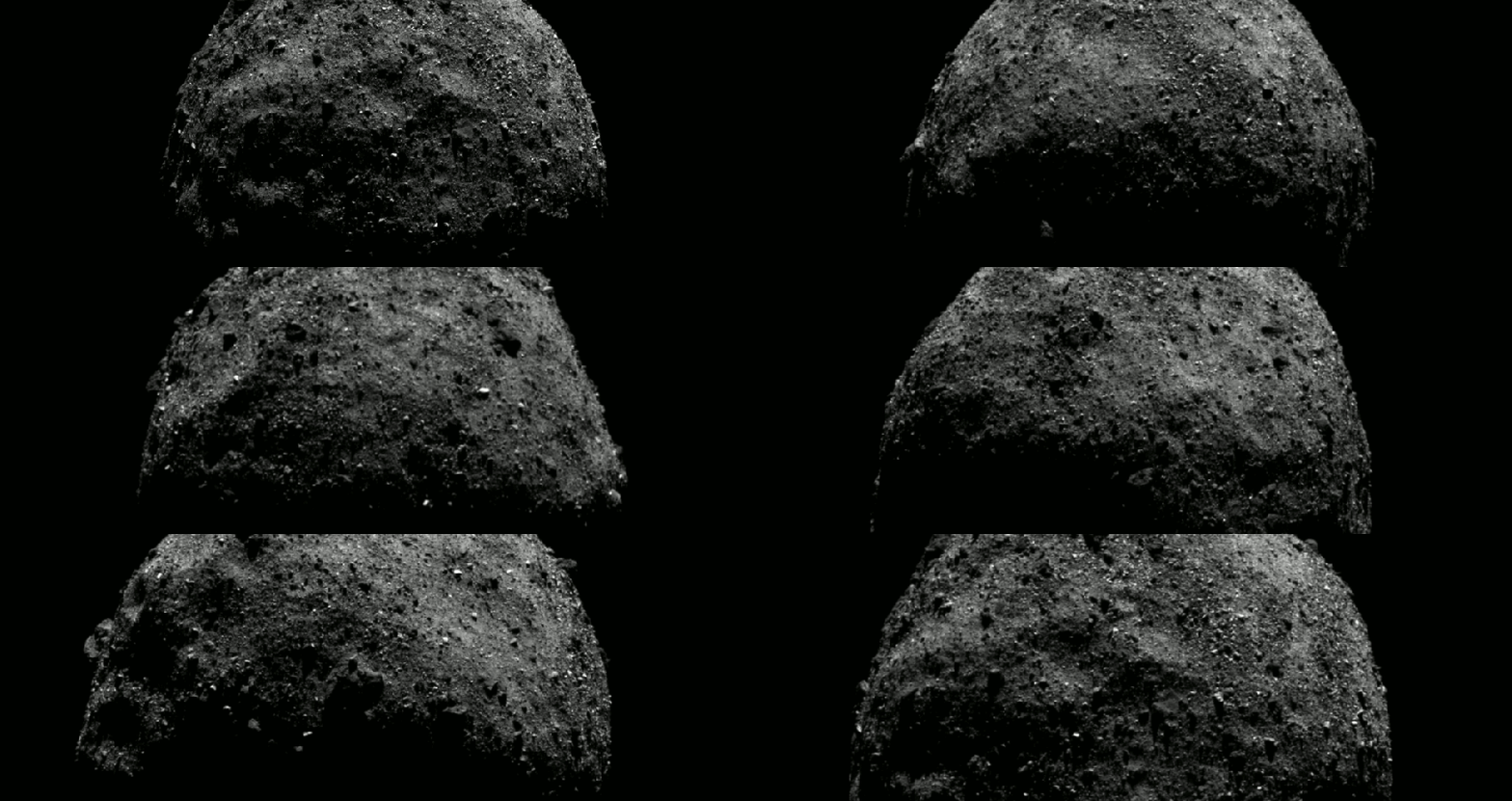
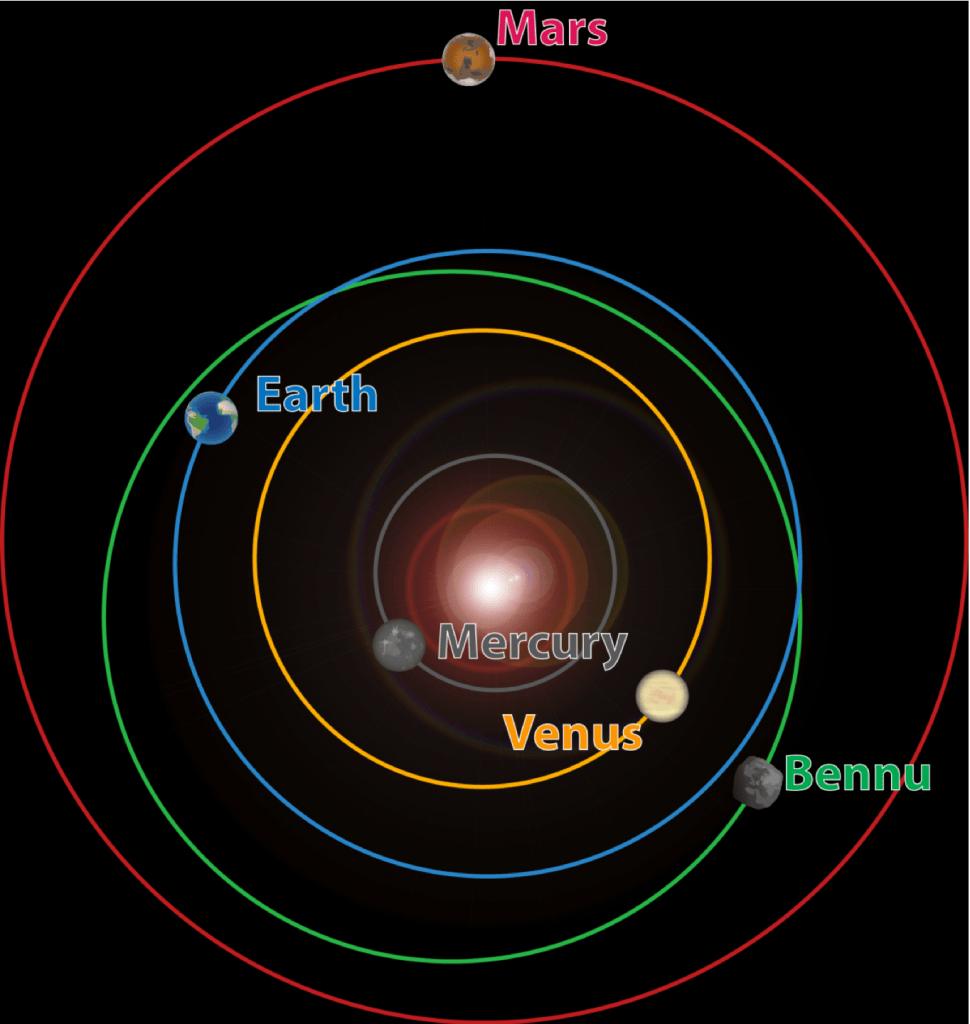
Asteroid 101955 Bennu is classified as an Apollo asteroid—a category of near-Earth objects whose orbits cross Earth’s orbit as they travel around the Sun.

Orbital Layout & Path

  • Orbit Shape: Bennu travels in an elliptical path with an average distance from the Sun of about 1.13 Astronomical Units (AU).
  • Earth Crossing: At its closest point to the Sun (perihelion), Bennu moves inside Earth’s orbit (around 0.90 AU). At its farthest point (aphelion), it swings out past Earth toward Mars (around 1.36 AU).
  • Orbital Period: It completes one full trip around the Sun every 1.2 years (about 437 days), meaning its position relative to Earth changes continuously.

Distance & Periodic Flybys

  • Variable Distance: Depending on where both Earth and Bennu are in their respective orbits, the distance between them ranges from a few hundred thousand kilometres up to over 300 million kilometres. Currently, Bennu is roughly 280 million kilometres (1.88 AU) away from Earth.
  • Close Approaches: Bennu makes a relatively close approach to Earth roughly every 6 years. Its next major close flyby will occur on September 23, 2060, when it passes within about 750,000 kilometres (466,000 miles) of Earth—roughly twice the distance from Earth to the Moon.

Analysis of the 120-gram sample collected from asteroid 101955 Bennu by NASA’s OSIRIS-REx mission (returned to Earth in September 2023) revealed crucial findings about the origins of our solar system and the precursor ingredients for life:

1. Key Ingredients for Life

  • Organic Carbon and Nitrogen: The sample contains unusually high concentrations of carbon and organic compounds.
  • Amino Acids & Nucleobases: Scientists identified 14 of the 20 amino acids used by life on Earth, along with all five nucleobases (adenine, guanine, cytosine, thymine, uracil) essential for storing genetic information in RNA and DNA.
  • Chirality (Handedness): The amino acids present are an equal mixture of “left-handed” and “right-handed” molecules. Because Earth life almost exclusively uses left-handed amino acids, this demonstrates that extraterrestrial organics started as balanced mixes before life emerged on Earth.

2. Evidence of an Ancient Ocean World

  • Hydrated Clay Minerals: Around 80% of the sample’s minerals contain water locked inside their interior structures, formed when melted ice reacted with dust billions of years ago.
  • Evaporite Salts & Water-Soluble Phosphates: Researchers detected magnesium-sodium phosphate, carbonates, halite, and sylvite. These salt crusts indicate that Bennu’s parent body hosted salty, liquid-water brines that dried up over time—similar to hydrothermal environments or ocean crusts on Earth.

3. Mixed Galactic Origins

  • Presolar Stardust: The samples contain pristine “presolar grains” created by dying stars before our solar system formed 4.5 billion years ago.
  • Diverse Assembly: Bennu’s parent body was a “rubble pile” assembled from materials across different regions—high-temperature solids formed close to the Sun, cold icy material from the outer solar system, and organic matter from interstellar space.

4. Rapid Space Weathering

  • Scanning reveals micro-craters and tiny splashes of impact-melted rock caused by micrometeorite bombardments and solar radiation, showing that asteroids without atmospheres weather faster than previously predicted.

The findings strongly support the hypothesis that asteroids like Bennu delivered essential organic precursors and water to early Earth, creating the environment necessary for life to form. However, interestingly enough we have the Holy Spirit speaking through the Psalmist in Psalm 24 verse 1, The earth is the Lord’s, and everything in it, the world, and all who live in it. Furthermore, in the scripture quoted at the head of this article, Isaiah 45 verse 7, the Lord stated through prophet Isaiah, that He created light and darkness (was the Lord talking about the Big Bang, and dark matter, dark energy, and black holes? I suppose the only witness to that would be any entity that was present 13.8 billion years or more ago.).

Luke 13 verses 1-5; Now there were some present at that time who told Jesus about the Galileans whose blood Pilate had mixed with their sacrifices. Jesus answered, “Do you think that these Galileans were worse sinners than all the other Galileans because they suffered this way? I tell you, no! But unless you repent, you too will all perish. Or those eighteen who died when the tower in Siloam fell on them—do you think they were more guilty than all the others living in Jerusalem? I tell you, no! But unless you repent, you too will all perish.”

John 9:1–3 (NIV)

1 As he went along, he saw a man blind from birth.

2 His disciples asked him, “Rabbi, who sinned, this man or his parents, that he was born blind?”

3 “Neither this man nor his parents sinned,” said Jesus, “but this happened so that the works of God might be displayed in him.”

Context

In ancient Jewish culture, it was a widespread assumption that severe physical suffering or disabilities were a direct divine punishment for specific personal or ancestral sins.

When the disciples saw the man, they treated his condition as a theological debate: Was it his fault, or his parents’? Jesus rejected that premise entirely. By clarifying that neither party was to blame for the blindness, He challenged the idea that every misfortune is tied to personal sin and shifted the focus from cause to purpose—using the man’s situation to reveal God’s healing power. The Holy Spirit did state through prophet Isaiah in Isaiah 45 verse 7, that He brings prosperity and disaster. Are there parallels between scriptures and physical cosmology? In any case, there is free will, and freedom of expression, be it that of an atheist, or a religious bigot/zealot, or a naturalist, or that of an intelligent designer, or an evidence-based(faith) realist world/universe view. Just keep an open mind.

Infinite Monkey Cage Heliosphere Hades

The Parable of the Rich Man and Lazarus, found in Luke 16:19–31.

The story, briefly:
A rich man lives in luxury while a poor beggar named Lazarus lies at his gate, covered in sores, longing for scraps from his table. Both die. Lazarus is carried by angels to “Abraham’s side” (often rendered “Abraham’s bosom” in older translations), while the rich man ends up in torment in Hades.

The chasm shows up when the rich man, in agony, begs Abraham to send Lazarus to dip his finger in water and cool his tongue. Abraham refuses, explaining that Lazarus had suffering in life and the rich man had comfort, and now their situations are reversed. Then comes the key verse, Luke 16:26, where Abraham says a great chasm has been fixed between them, so that no one can cross from one side to the other in either direction.

The rich man then asks Abraham to send Lazarus back to warn his five brothers so they don’t end up in the same place. Abraham replies that they have Moses and the Prophets to listen to — and if they won’t listen to those, they won’t be convinced even if someone rises from the dead (a line often read as a foreshadowing of the resistance Jesus’s own resurrection would meet).

A few notes on how this parable is read:

  • Some scholars treat it as a straightforward parable using imagery familiar to Jesus’s audience, not a detailed cartography of the afterlife.
  • Others read it more literally, as a real depiction of the intermediate state of the dead.
  • The term “Abraham’s bosom” became, in later Jewish and Christian tradition, associated with a place of comfort for the righteous dead.

The phrase infinite monkey cage came from Professor Brian Cox. The title of Professor Brian Cox’s BBC Radio 4 show and podcast, The Infinite Monkey Cage (co-hosted with comedian Robin Ince), directly plays on a famous mathematical concept known as the Infinite Monkey Theorem.

1. The Core Concept (The Infinite Monkey Theorem)

The theorem states that a monkey pressing keys at random on a typewriter keyboard for an infinite amount of time will almost surely eventually produce a given text, such as the complete works of William Shakespeare.

  • Probability & Infinity: The idea is that given infinite time or infinite attempts, even an extremely improbable event becomes a certainty.

2. How Cox and the Show Apply the Phrase

Professor Brian Cox and his team adapted this concept to frame their show’s philosophy and format:

  • The “Cage” / Setup: Rather than literal monkeys typing, the show places a mix of physicists, scientists, experts, and comedians in a room together.
  • The “Infinite” Experiment: By throwing diverse minds together—some asking high-level academic questions and others asking simple or nonsensical ones—the show explores whether, through endless discussion and curiosity, profound scientific understanding will naturally emerge out of the chatter.
  • Humour Meets Science: Cox often points out that while comedians and scientists seem like opposite ends of the spectrum, placing them in the same room creates an “anarchic” atmosphere that breaks down complex science into accessible, humorous, and insightful ideas.

In short, Cox’s premise behind The Infinite Monkey Cage is a light-hearted nod to probability: if you gather curious, quirky minds and let them talk about the universe long enough, you’ll inevitably hit on deep scientific truths—and have fun doing it.

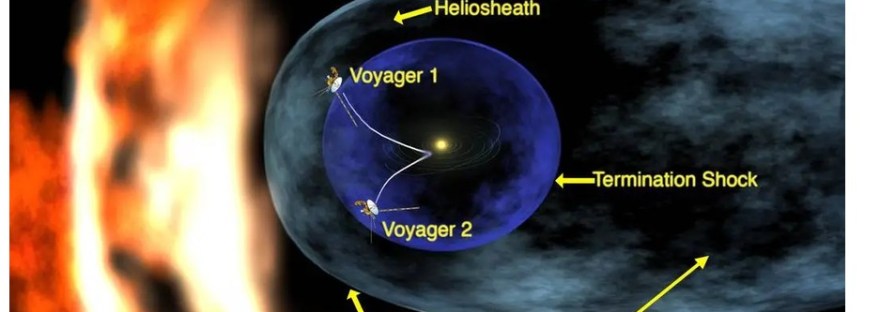
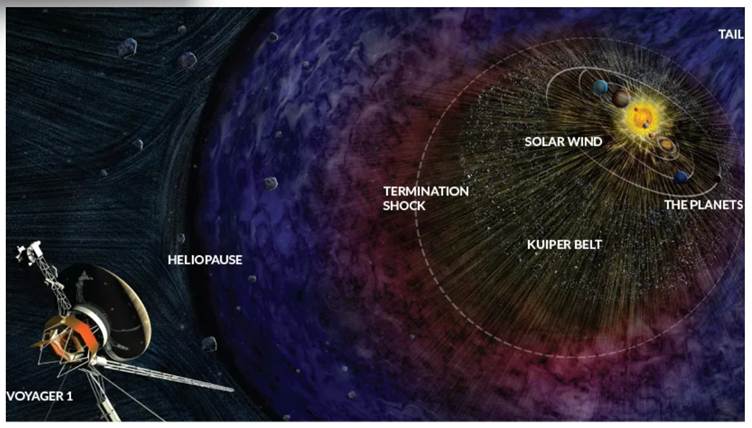
However, when the infinite monkey theorem is applied to man travelling in space and time, then we realize that man is trapped on this star called the Sun. Take the case of the current man-made space crafts at the farthest distance from the earth, Voyager 1 and Voyager 2.

They are continuously hurtling through space and Earth is constantly orbiting the Sun, their exact distances fluctuate second by second.

As of August 2026, their approximate distances from Earth are:

Voyager 1

  • Distance from Earth: ~25.59 billion km (~15.90 billion miles)
  • Astronomical Units (AU): ~171.05 AU (1 AU is the average distance from Earth to the Sun)
  • One-Way Signal Time: It takes light/radio signals about 23 hours and 42 minutes to travel one way between Voyager 1 and Earth.

Fun fact: Voyager 1 is fast approaching a historic milestone—in November 2026, it will become the first human-made object to be a full light-day (about 25.9 billion km) away from Earth.

Voyager 2

  • Distance from Earth: ~21.39 billion km (~13.29 billion miles)
  • Astronomical Units (AU): ~142.96 AU
  • One-Way Signal Time: It takes about 19 hours and 49 minutes for signals to travel one way between Voyager 2 and Earth.

Both probes are travelling through interstellar space (having crossed the heliopause years ago) and are maintained by NASA’s Deep Space Network. Neither Voyager is actually aimed at Proxima Centauri, the nearest star to us — their trajectories were set by planetary flybys decades ago, not by a destination star. But here’s what the numbers look like if you just ask “at their current speed, how long to cover the distance to the nearest star?”

The distance
Proxima Centauri, the nearest star to the Sun, is about 4.24 light-years away — roughly 268,000 AU. Both Voyagers are only around 140–170 AU from the Sun right now, which is a rounding error against that distance, so it barely matters where exactly they are today.

Their speeds

  • Voyager 1: ~17 km/s (~3.6 AU/year) — the faster of the two, currently the most distant human-made object at about 166 AU from the Sun.
  • Voyager 2: ~15.4 km/s (~3.25 AU/year) — currently around 139 AU out.

Travel time to Proxima Centauri

  • Voyager 1: ≈ 268,000 AU ÷ 3.6 AU/yr ≈ 74,000–75,000 years
  • Voyager 2: ≈ 268,000 AU ÷ 3.25 AU/yr ≈ 82,000–83,000 years

A couple of caveats worth keeping in mind:

  1. They’re not headed there. Voyager 1 is drifting roughly toward the constellation Ophiuchus/Camelopardalis direction; Voyager 2 toward Sagittarius/Pavo. Neither path passes anywhere near Proxima Centauri.
  2. The “40,000 years” figure you may have seen refers to a different fact: Voyager 1 will pass within about 1.6 light-years of the star Gliese 445 in roughly 40,000 years — not because it’s heading there on purpose, but because that star happens to be moving toward the general area Voyager 1 is drifting through. Gliese 445 isn’t the nearest star to us today, but it will be closer to Voyager 1’s future path than Proxima Centauri is.
  3. Both spacecraft will run out of power for their instruments and transmitters by around the early-to-mid 2030s, so they’ll be silent, coasting relics for the vast majority of that 74,000–83,000-year journey.

Indeed, the physical man on the planet earth orbiting around the star called the Sun, is trapped in space and time, an infinite monkey cage, that deviates fundamentally from the Infinite Monkey mathematical theorem of a monkey typing the text ‘the complete works of William Shakespeare’, since neither a specific monkey nor a specific man exists ad infinitum. In addition to which, our star, the Sun at the edge of its heliosphere/heliopause is surrounded by the Oort Cloud, Interstellar space filled with gas, mostly hydrogen and helium, dust, radiation, and nebulae. The Oort Cloud is made of trillions of icy space rocks and debris left over from when our solar system formed 4.6 billion years ago. These frozen chunks are mostly made of water ice, methane ice, and ammonia ice, along with small amounts of rocky dust.

Allusions, Perceptions, Reality, and the Unknown God

Faith is the evidence given by the Object/Entity in whom it resides to those/subjects that have placed their trust, belief therein. Hebrews 11v1; Now faith is confidence in what we hope for and assurance about what we do not see. Exodus 33:20; “But,” he said, “you cannot see my face, for no one may see me and live.” Context: Moses asks to see God’s full glory. God protects Moses by placing him in the crevice of a rock, covering him with His hand as He passes by, and only letting Moses see His “back” so he wouldn’t be destroyed by the full magnitude of God’s presence. John 1:18; “No one has ever seen God, but the one and only Son, who is himself God and is in closest relationship with the Father, has made him known.” 1 John 4:12; “No one has ever seen God; but if we love one another, God lives in us and his love is made complete in us.”

An allusion is a brief, indirect reference to a well-known person, place, event, literary work, or piece of art. Instead of explaining something in detail, the writer or speaker assumes you’ll recognize the connection and get the point instantly (think of dreams and visions). Perception is the mental process of organizing, interpreting, and making sense of sensory information from your environment.

While sensation is the raw data collected by your senses (lights, sounds, textures), perception is how your brain decodes that data to give it meaning.

The Two-Step Process

  1. Sensation (The Input): Your eyes detect light waves reflecting off a furry, four-legged animal.
  2. Perception (The Interpretation): Your brain compares that visual data to past experiences and concludes, “That’s a friendly dog.”

Key Factors That Shape Perception

Perception isn’t an exact recording of reality—it’s an interpretation heavily influenced by several factors:

  • Context: A loud bang at a fireworks display feels normal; the same bang in a quiet library triggers fear.
  • Expectations & Bias: We often perceive what we expect to see or hear based on prior beliefs (think of self-fulfilling prophecies).
  • Past Experience: A mechanic hears a subtle engine rattle that a passenger completely misses.
  • Emotional State: When you’re anxious, neutral faces can easily be perceived as hostile or judgemental.

In Short: Sensation is receiving the signal; perception is understanding the message.

Reality is the state of things as they actually exist, independent of human beliefs, concepts, or perceptions.

It encompasses everything that is real—objects, forces, events, and truths—regardless of whether we can see, measure, or understand them.

The Two Dimensions of Reality

When discussing reality, philosophers and scientists generally divide it into two main lenses:

1. Objective Reality (The Physical Universe)

This is reality as it exists on its own. A tree falling in an empty forest makes physical sound waves, whether anyone is around to hear it or not.

  • Key feature: It stays the same regardless of who observes it.
  • Examples: Gravity, light, chemical reactions, the passage of time.

2. Subjective Reality (The Human Experience)

This is reality as filtered through your mind, senses, and personal context. Because no two brains interpret sensory data identically, everyone experiences a slightly different version of the world.

  • Key feature: It depends entirely on individual perception, mood, culture, and memory.
  • Examples: Pain, beauty, taste, personal beliefs, emotional experiences.

Reality vs. Perception

The main tension with reality is that humans never experience pure objective reality directly.

The Bridge: Objective reality is the raw signal (atoms, energy, physical laws). Perception is the map your brain builds to navigate it. The map is useful, but it isn’t the physical territory itself.

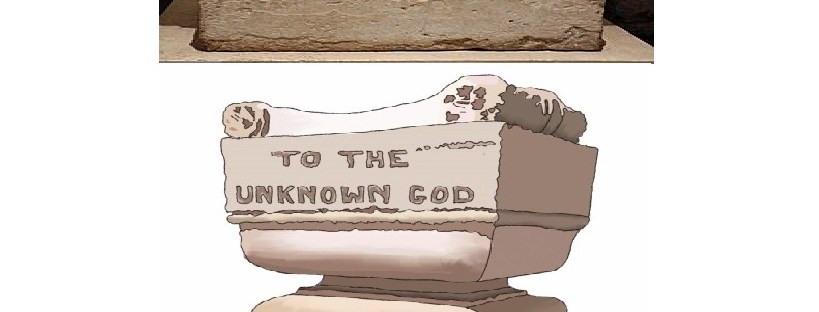
The evidence of a creator Entity lies in the practical demonstration of authority over mind and matter. The Unknown God, this addressing was postulated by Paul to the Athenians in Acts 17:v23; For as I walked around and looked carefully at your objects of worship, I even found an altar with this inscription: to an unknown god. So you are ignorant of the very thing you worship—and this is what I am going to proclaim to you.

Jeremiah 23:16; “Do not listen to what the prophets are prophesying to you; they fill you with false hopes. They speak visions from their own minds, not from the mouth of the Lord.” God warns the people that these prophets are simply projecting their own wishful thinking. They were telling the people “You will have peace” and “No harm will come to you” even while Jerusalem was on the brink of judgment, because that was what people wanted to hear.

Jeremiah 23:28; “‘The prophet who has a dream may tell his dream, but the one who has my word should speak my word faithfully. What has straw in common with wheat?’ declares the Lord.” God draws a sharp contrast between human dreams and His actual Word: Human Dreams (The Chaff/Straw): Lightweight, hollow, and offering zero spiritual nourishment. God’s True Word (The Wheat): Solid, pure, and life-sustaining. God tells them that if someone wants to share a subjective dream, fine—call it a dream. But they must stop dressing up their personal thoughts as absolute divine revelation.

Immediately following the wheat vs. straw comparison, God describes what a real message from Him actually feels like— Jeremiah 23:29:“‘Is not my word like fire,’ declares the Lord, ‘and like a hammer that breaks a rock in pieces?’” While the false prophets used comforting, fake dreams to lull people to sleep, God’s true Word cuts through deception, purifies like fire, and breaks down hard hearts. Jeremiah 23:32; “‘I am against those who prophesy false dreams,’ declares the Lord. ‘They tell them and lead my people astray with their reckless lies, yet I did not send or appoint them.’” God specifically warns that these self-proclaimed dreamers were making the nation forget God’s true laws and character, leading them into spiritual laziness.

In Jeremiah, God makes a clear distinction between subjective human experiences (dreams, internal feelings, personal impressions) and divine truth. He demands that those who claim to speak for Him speak with total integrity rather than passing off their own desires or dreams as a message from God.

Job 19:25-27; “For I know that my Redeemer lives, and at the last he will stand upon the earth. And after my skin has been thus destroyed, yet in my flesh I shall see God, whom I shall see for myself, and my eyes shall behold, and not another.”  Psalm 27:13; “I believe that I shall look upon the goodness of the Lord in the land of the living!” Because both Job 19 and Psalm 27 express an intense hope of seeing God despite suffering, Christians have frequently combined them over the centuries in worship and liturgy. A famous example is the traditional Catholic burial hymn/antiphon “I Know That My Redeemer Lives” (Credo quod Redemptor meus vivit), which pairs Job’s declaration of his Redeemer with Psalm 27’s expectation of seeing God’s goodness in the land of the living.

God appeared to Abraham, Moses (Exodus 33:20;), and Elijah. The account regarding Abraham can be found in Genesis 18:1-15; While they appear as three men, the text makes it clear that this is a divine encounter. One of the figures is identified as the Lord (Yahweh) Himself—often interpreted in Christian theology as a theophany (a physical manifestation of God) or a christophany (an Old Testament appearance of Christ)—while the other two are angels (who later travel to Sodom in Genesis 19).

In the case of Elijah, the account can be found in 1 Kings 19:9-18; After his intense victory over the prophets of Baal on Mount Carmel, Elijah receives a death threat from Queen Jezebel and flees into the wilderness, exhausted and ready to give up. God provides him with food and strength to travel 40 days to Mount Horeb (also known as Mount Sinai), where he takes shelter in a cave. God instructs Elijah to go out and stand on the mountain, for the Lord is about to pass by: A Great Wind tears the mountain apart and shatters the rocks, but the Lord was not in the wind. An Earthquake shakes the ground, but the Lord was not in the earthquake. A Fire passes through, but the Lord was not in the fire. A Gentle Whisper (often translated as “a still small voice”) follows. When Elijah hears the quiet voice, he wraps his face in his cloak and steps to the entrance of the cave to speak with God. God gently reassures the worn-out prophet, reminds him that he is not alone, and gives him his next mission. Matthew 17:1–3 (New Testament): Elijah appears alongside Moses on the mountain during the Transfiguration, speaking directly with Jesus.

The Unknown God, according to Jesus Christ Himself in John 14:16-17; “And I will ask the Father, and he will give you another Helper, to be with you forever, even the Spirit of truth, whom the world cannot receive, because it neither sees him nor knows him. You know him, for he dwells with you and will be in you.” Physical vs. Spiritual Sight: The “world” relies strictly on material, physical senses. Because the Holy Spirit is an invisible, spiritual presence, non-believers who rely only on outward sight cannot perceive or recognize Him. Personal Experience: Jesus contrasts the world with His disciples. While the world lacks spiritual perception, believers “know” the Holy Spirit because He abides with them and lives inside them. John 3:16; For God so loved the world that he gave his one and only Son, that whoever believes in him shall not perish but have eternal life. John 14:12; “Very truly I tell you, whoever believes in me will do the works I have been doing. John 14:15; “If you love me, keep my commands.”John 15:14;“You are my friends if you do what I command.” Luke 6:46;“Why do you call me, ‘Lord, Lord,’ and do not do what I say?” Mathew 22:35-40;According to Jesus, the two most important commandments are to love God with all your heart and to love your neighbour as yourself.When a lawyer asks Jesus which commandment in the law is the greatest, Jesus answers: The First and Greatest Commandment: “‘Love the Lord your God with all your heart and with all your soul and with all your mind.’ This is the first and greatest commandment.” (v. 37–38) The Second Commandment: “And the second is like it: ‘Love your neighbour as yourself.’” (v. 39) Jesus then concludes with a powerful summary: “All the Law and the Prophets hang on these two commandments.” (v. 40) Jesus wasn’t creating brand-new laws from scratch here; He was quoting directly from the Hebrew Scriptures (the Old Testament): The First Commandment quotes Deuteronomy 6:5, part of the central Jewish prayer known as the Shema. The Second Commandment quotes Leviticus 19:18. By bringing these two together, Jesus showed that every other rule in Scripture—including the Ten Commandments—is simply a practical extension of loving God and loving other people. Is God abstract or real to you? If God is real to you, where is your evidence/proof (faith)? With whom lies the burden of proof? You or the One in whom you have faith?

What is Time, Fundamentally

Genesis 1 verses 14-19; And God said, “Let there be lights in the vault of the sky to separate the day from the night, and let them serve as signs to mark sacred times, and days and years, and let them be lights in the vault of the sky to give light on the earth.” And it was so. God made two great lights—the greater light to govern the day and the lesser light to govern the night. He also made the stars. God set them in the vault of the sky to give light on the earth, to govern the day and the night, and to separate light from darkness. And God saw that it was good. And there was evening, and there was morning—the fourth day.

What is time from the perspective of living organisms compared to that of cosmic bodies?

This is a beautifully deep question that sits at the intersection of biology, physics, and philosophy.

What is Time, Fundamentally?

Physically, time is a dimension of the universe — part of the spacetime fabric described by Einstein’s relativity. But experienced time and cosmic time are very different things.


Time from the Perspective of Living Organisms

Time is biological and relative

Living organisms don’t experience time as a fixed constant — they experience it through:

  • Metabolism — faster metabolism generally correlates with a faster subjective experience of time. A hummingbird’s heart beats ~1,200 times per minute; it likely perceives the world in much finer temporal slices than a tortoise
  • Circadian rhythms — almost all life on Earth is locked to roughly a 24-hour biological clock, tied to the planet’s rotation
  • Neural processing speed — the faster an organism processes sensory information, the more “frames per second” of reality it experiences. Small fast animals like flies perceive time more slowly relative to us (they see us moving in slow motion)

Time is purpose-driven for life

For living organisms, time is experienced as:

  • Survival pressure — immediate, urgent, fleeting
  • Generational — life measures time in lifespans, seasons, and reproductive cycles
  • Cellular — at the cellular level, time is measured in chemical reactions, protein folding, and DNA replication — milliseconds to hours
  • Evolutionary — at the species level, meaningful change happens over thousands to millions of years

Life’s relationship with time is asymmetric

Living organisms have a profound awareness of time’s arrow — birth, growth, decay, death. Entropy is felt personally. Every living thing is essentially a temporary configuration of matter fighting against disorder.


Time from the Perspective of Cosmic Bodies

Time is almost incomprehensibly vast

  • The Sun is 4.6 billion years old and will live another ~5 billion — a single stellar lifetime dwarfs all of human civilisation millions of times over
  • A neutron star can complete a full rotation in milliseconds, experiencing enormous amounts of rotational “time” per second
  • Black holes warp time itself — at the event horizon, time slows to a standstill relative to a distant observer
  • Galaxies evolve over billions of years; their “events” — collisions, star formation, spiral arm shifts — are invisible on any human timescale

Cosmic bodies don’t experience time

This is perhaps the most striking contrast. A star doesn’t feel its 10-billion-year life. A galaxy doesn’t anticipate its eventual collision with a neighbour. Cosmic time simply passes and accumulates through physics — gravity, nuclear fusion, thermodynamics — without any internal experience.


The Great Contrast

Living OrganismsCosmic Bodies
ScaleMicroseconds to millenniaMillions to billions of years
ExperienceSubjective, felt, urgentNone — purely physical
MeasurementHeartbeats, seasons, generationsLight-years, orbital periods
Relationship to entropyActive resistancePassive progression
Time’s arrowDeeply feltIndifferent

A Philosophical Reflection

There is something remarkable in the contrast: the universe is ancient and vast, yet indifferent to time, while a mayfly lives only one day but experiences that day with full biological urgency and presence.

In a sense, consciousness may be the universe’s only mechanism for actually experiencing time — and living organisms, however brief, are the only things in the cosmos for whom time truly means anything.

As the physicist Carlo Rovelli puts it, time as we feel it — flowing, urgent, personal — may be less a feature of the universe and more a feature of us.

The time scale and timespan of living organisms differs from that of cosmic bodies. How old is the oldest verified living organism?

The oldest verified living organism depends on how you define “individual organism” — the answer changes quite dramatically.

Single Organism (Clonal / Rooted)

Pando — a clonal colony of quaking aspen trees in Utah, USA — is often cited as one of the oldest and most massive living organisms, estimated at around 80,000 years old, though some estimates go higher. It’s technically a single organism connected by one root system.

Oldest Individual Non-human Animal

Jonathan the Seychelles giant tortoise is the oldest known living animal, born around 1832, making him approximately 193 years old as of 2026. He lives on the island of St. Helena.

Oldest Individual Tree

Methuselah, a Great Basin bristlecone pine in California, USA, is approximately 4,855 years old — the oldest known individual (non-clonal) tree.

Oldest Known Living Microorganism

Bacteria revived from ancient salt crystals and permafrost have been claimed to be hundreds of thousands to millions of years old, though these claims are harder to verify and debated scientifically.

Oldest in the Ocean

Ocean quahog clams (Arctica islandica) are among the longest-lived animals — one nicknamed “Ming” was confirmed at 507 years old when it was (unfortunately) killed during the aging process in 2006.

Key takeaway

Life’s longevity record depends heavily on definition — a single rooted tree, a clonal colony, an animal, or a microbe all yield very different answers. But life on Earth has clearly mastered the art of persistence.

The Sun is about 4.6 billion years old, formed from a collapsing cloud of gas and dust in a spiral arm of the Milky Way. It’s currently about halfway through its main-sequence lifetime — it’s expected to continue burning hydrogen for another ~5 billion years before expanding into a red giant.

Earth is also about 4.54 billion years old, forming roughly 50–100 million years after the Sun from the same swirling disk of gas and dust (the solar nebula).

We know this primarily through radiometric dating of the oldest rocks and minerals on Earth (zircon crystals dated to ~4.4 billion years), as well as dating of meteorites from the same era.

The earliest known systematic human anatomical dissections were performed in Alexandria, Egypt, around 300–250 BCE.

The key figures were Herophilus of Chalcedon and Erasistratus of Chios, both working at the famous Library/Museum of Alexandria under the patronage of the Ptolemaic rulers. They are credited with being the first to perform dissections of human cadavers in a systematic, scientific way — and according to some ancient sources (like Celsus), they may have even performed vivisections on condemned criminals, though this remains debated.

Before Alexandria, anatomical knowledge came mainly from:

  • Animal dissections (e.g., Aristotle dissected many animals but not humans)
  • Wound observation in warfare and surgery
  • Hippocratic writings (~400 BCE), which were based on external observation rather than dissection

After the Alexandrian period, human dissection largely fell out of practice in the ancient world due to cultural and religious taboos, and wasn’t systematically revived in Europe until the 13th–14th centuries, with figures like Mondino de Luzzi in Bologna.

During a philosophical discussion with a friend, it was suggested that the modern generation are more intelligent than the older ones. Are the adolescents of the modern generation capable of more brain functioning capacity compared to previous generations?

This is a fascinating and nuanced question. The short answer is: it’s complicated — and depends on what you mean by “brain functioning capacity.”

The Flynn Effect

The most well-documented finding is the Flynn Effect — IQ scores rose steadily across the 20th century in many countries, roughly 3 points per decade. This suggests improvements in certain cognitive abilities like abstract reasoning and pattern recognition, likely due to better nutrition, education, healthcare, and more cognitively stimulating environments.

Where modern adolescents may have an edge

  • Visual-spatial processing — navigating digital interfaces, reading complex visuals, and multitasking across screens appears stronger
  • Information access and synthesis — faster at finding and filtering large amounts of information
  • Tech-native problem solving — intuitive with tools previous generations had to consciously learn

Where there are concerns

  • Attention span and deep focus — studies suggest sustained concentration may be declining, linked to smartphone and social media use
  • Memory — reliance on external devices (“Google effect”) may reduce the need to internally store information
  • The Flynn Effect may be reversing — some Scandinavian and other studies from the 1990s onward suggest IQ gains have plateaued or slightly declined in some developed nations
  • Mental health — rates of anxiety, depression, and stress are notably higher in Gen Z, which affects cognitive performance

The bigger picture

The brain’s raw biological capacity hasn’t changed — human brains are essentially the same hardware as thousands of years ago. What changes across generations is how that capacity is trained, used, and expressed, shaped by environment, education, technology, nutrition, and culture.

So modern adolescents aren’t necessarily more capable in an absolute sense, but they are differently capable — optimised for the cognitive demands of the world they grew up in. The elephant in the room is; do you subscribe to the school of thought of an evolutionist or that of an intelligent designer/creationist? Follow the evidence.