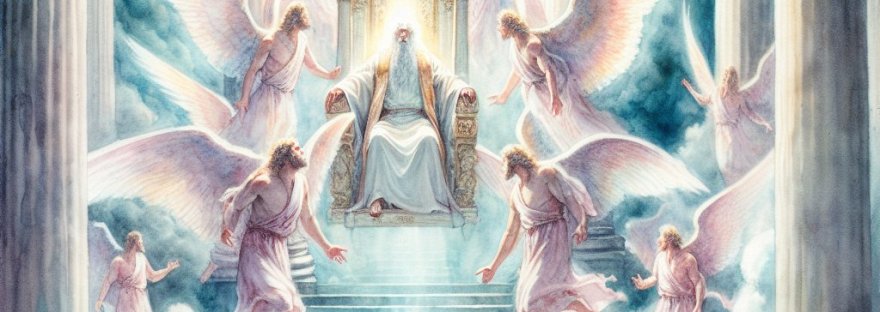
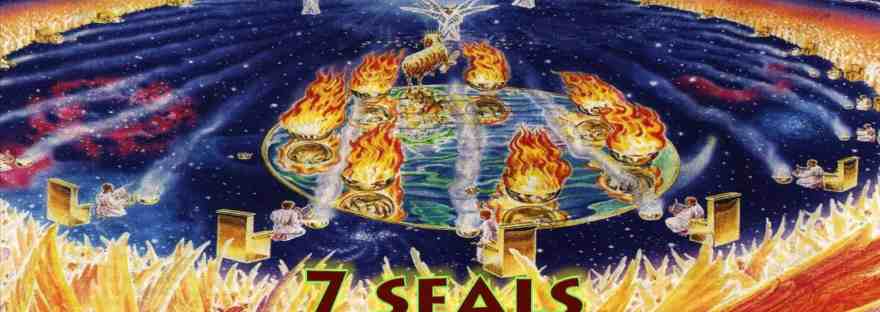
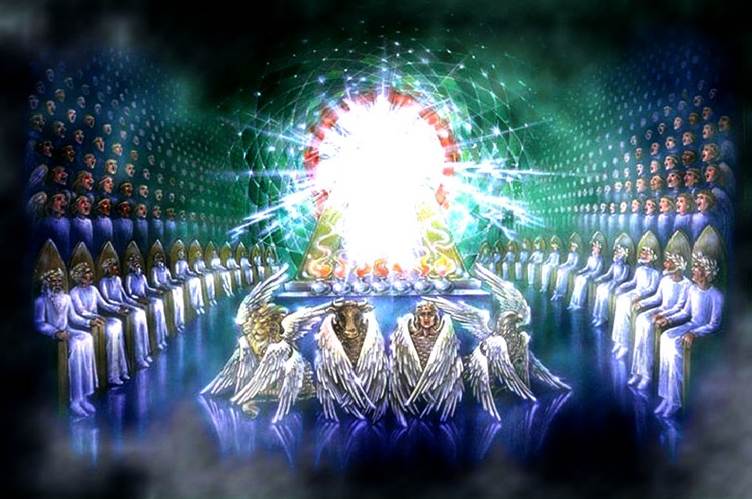
Isaiah 6: 1-4; In the year that King Uzziah died, I saw the Lord sitting upon his throne, high and exalted. The train of his robe filled the Temple. The seraphim stood above him. Each had six wings: with two he covered his face, and with two he covered his feet, and with two he was flying. They kept on calling to each other: “Holy, holy, holy is the Lord of the Heavenly Armies! The whole earth is full of his glory!” The foundations of the thresholds quaked at the sound of those who kept calling out, and the Temple was filled with smoke.
John 4: 24; God is spirit, and those who worship him must worship in spirit and truth.” When it is said that God is transcendental, at its core, transcendental describes anything that goes beyond, surpasses, or exists independent of normal human experience or physical limits. It would therefore be a contradiction of terms, and understanding, to postulate that the temple of God is located within space and time. Physical man is part of the physical universe, subjected to birth, temporal existence, and entropy/death. Therefore to suggest that God the Spirit’s temple is located within a temporal physical object, that is subject to entropy, is implying that the Eternal being has a temple that is not eternal.
Where is God? Is God in the Temple of Jerusalem? Is God in the Vatican? Is God in your local church or Temple? Is God on a particular mountain or hill? Is God in a particular river, stream or valley?
Whenever I ask people this particular question, I get two different answers; some point to the skies, while others point to the area of their heart. There is nothing wrong with both answers. However, the answer as stated by God the Son, Jesus Christ, is [Mathew 6:9], ‘Our Father in heaven’. So God is in Heaven. Furthermore, according to Acts 17:24; The God who made the world and everything in it is the Lord of heaven and earth and does not live in temples built by human hands.
A relative of mine once said “I beg you in the name of God”, I responded by saying; “Never say that to me”. Leave God out of it, God is in Heaven, you and I are here on earth. How can I say that, you may ask. When we take a look at the Scriptures as taught to us by Jesus Christ, in Mathew 5:33-37; “Again, you have heard that it was said to the people long ago, ‘Do not break your oath, but fulfill to the Lord the vows you have made.’ But I tell you, do not swear an oath at all: either by heaven, for it is God’s throne; or by the earth, for it is his footstool; or by Jerusalem, for it is the city of the Great King. And do not swear by your head, for you cannot make even one hair white or black. All you need to say is simply ‘Yes’ or ‘No’; anything beyond this comes from the evil one.
Therefore, this leads us to the next and entirely different question: Where is Heaven? Is Heaven a physical place? The answer to the latter question is; Heaven is not a physical place. While the answer to the former can be found in the Scriptures, as answered by Jesus Christ in Luke 17:20-21; Once, on being asked by the Pharisees when the kingdom of God would come, Jesus replied, “The coming of the kingdom of God is not something that can be observed, nor will people say, ‘Here it is,’ or ‘There it is,’ because the kingdom of God is in your midst [or is within you].” The Kingdom of God or the House of God or Heaven is not a physical place, however it is in our midst. God is omnipresent, Omnipresent means present everywhere at the same time. It comes from the Latin prefix omni- (meaning “all”) and praesens (meaning “present”).In most monotheistic religions (such as Christianity, Judaism, and Islam), omnipresence is one of the classic attributes of God, alongside omniscience (all-knowing) and omnipotence (all-powerful). It implies that the divine nature is not restricted by physical boundaries, location, or time, but is fully present throughout all of creation simultaneously. The temple of God (and is in Heaven where His throne is, not a physical entity, but in the spiritual realm), is a distinct and separate concept from the omnipresence nature of God. God’s house/temple is in Heaven, and not at the Vatican, or any other physical location, that you (a physical being)choose to worship Him. God is spirit, and those that worship Him do so in spirit and in truth. When you peddle in lies and falsehood, you do not worship Him.
Faith is the evidence given by the Object/Entity in whom it resides to those/subjects that have placed their trust, belief therein. Hebrews 11v1; Now faith is confidence in what we hope for and assurance about what we do not see. Exodus 33:20; “But,” he said, “you cannot see my face, for no one may see me and live.” Context: Moses asks to see God’s full glory. God protects Moses by placing him in the crevice of a rock, covering him with His hand as He passes by, and only letting Moses see His “back” so he wouldn’t be destroyed by the full magnitude of God’s presence. John 1:18; “No one has ever seen God, but the one and only Son, who is himself God and is in closest relationship with the Father, has made him known.” 1 John 4:12;“No one has ever seen God; but if we love one another, God lives in us and his love is made complete in us.”
An allusion is a brief, indirect reference to a well-known person, place, event, literary work, or piece of art. Instead of explaining something in detail, the writer or speaker assumes you’ll recognize the connection and get the point instantly (think of dreams and visions). Perception is the mental process of organizing, interpreting, and making sense of sensory information from your environment.
While sensation is the raw data collected by your senses (lights, sounds, textures), perception is how your brain decodes that data to give it meaning.
The Two-Step Process
Sensation (The Input): Your eyes detect light waves reflecting off a furry, four-legged animal.
Perception (The Interpretation): Your brain compares that visual data to past experiences and concludes, “That’s a friendly dog.”
Key Factors That Shape Perception
Perception isn’t an exact recording of reality—it’s an interpretation heavily influenced by several factors:
Context: A loud bang at a fireworks display feels normal; the same bang in a quiet library triggers fear.
Expectations & Bias: We often perceive what we expect to see or hear based on prior beliefs (think of self-fulfilling prophecies).
Past Experience: A mechanic hears a subtle engine rattle that a passenger completely misses.
Emotional State: When you’re anxious, neutral faces can easily be perceived as hostile or judgemental.
In Short: Sensation is receiving the signal; perception is understanding the message.
Reality is the state of things as they actually exist, independent of human beliefs, concepts, or perceptions.
It encompasses everything that is real—objects, forces, events, and truths—regardless of whether we can see, measure, or understand them.
The Two Dimensions of Reality
When discussing reality, philosophers and scientists generally divide it into two main lenses:
1. Objective Reality (The Physical Universe)
This is reality as it exists on its own. A tree falling in an empty forest makes physical sound waves, whether anyone is around to hear it or not.
Key feature: It stays the same regardless of who observes it.
Examples: Gravity, light, chemical reactions, the passage of time.
2. Subjective Reality (The Human Experience)
This is reality as filtered through your mind, senses, and personal context. Because no two brains interpret sensory data identically, everyone experiences a slightly different version of the world.
Key feature: It depends entirely on individual perception, mood, culture, and memory.
Examples: Pain, beauty, taste, personal beliefs, emotional experiences.
Reality vs. Perception
The main tension with reality is that humans never experience pure objective reality directly.
The Bridge: Objective reality is the raw signal (atoms, energy, physical laws). Perception is the map your brain builds to navigate it. The map is useful, but it isn’t the physical territory itself.
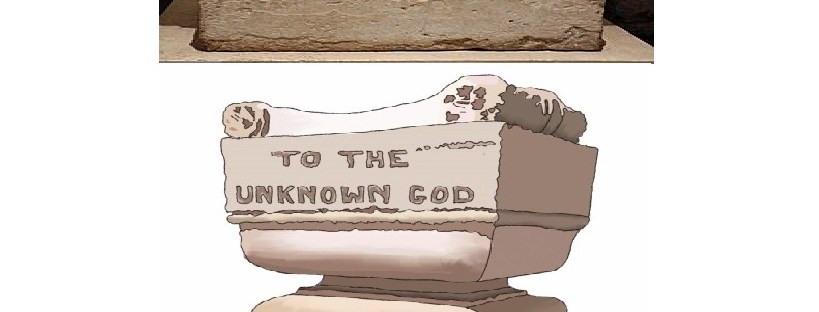
The evidence of a creator Entity lies in the practical demonstration of authority over mind and matter. The Unknown God, this addressing was postulated by Paul to the Athenians in Acts 17:v23; For as I walked around and looked carefully at your objects of worship, I even found an altar with this inscription: to an unknown god. So you are ignorant of the very thing you worship—and this is what I am going to proclaim to you.
Jeremiah 23:16;“Do not listen to what the prophets are prophesying to you; they fill you with false hopes. They speak visions from their own minds, not from the mouth of the Lord.” God warns the people that these prophets are simply projecting their own wishful thinking. They were telling the people “You will have peace” and “No harm will come to you” even while Jerusalem was on the brink of judgment, because that was what people wanted to hear.
Jeremiah 23:28; “‘The prophet who has a dream may tell his dream, but the one who has my word should speak my word faithfully. What has straw in common with wheat?’ declares the Lord.” God draws a sharp contrast between human dreams and His actual Word: Human Dreams (The Chaff/Straw): Lightweight, hollow, and offering zero spiritual nourishment. God’s True Word (The Wheat): Solid, pure, and life-sustaining. God tells them that if someone wants to share a subjective dream, fine—call it a dream. But they must stop dressing up their personal thoughts as absolute divine revelation.
Immediately following the wheat vs. straw comparison, God describes what a real message from Him actually feels like— Jeremiah 23:29:“‘Is not my word like fire,’ declares the Lord, ‘and like a hammer that breaks a rock in pieces?’” While the false prophets used comforting, fake dreams to lull people to sleep, God’s true Word cuts through deception, purifies like fire, and breaks down hard hearts. Jeremiah 23:32;“‘I am against those who prophesy false dreams,’ declares the Lord. ‘They tell them and lead my people astray with their reckless lies, yet I did not send or appoint them.’” God specifically warns that these self-proclaimed dreamers were making the nation forget God’s true laws and character, leading them into spiritual laziness.
In Jeremiah, God makes a clear distinction between subjective human experiences (dreams, internal feelings, personal impressions) and divine truth. He demands that those who claim to speak for Him speak with total integrity rather than passing off their own desires or dreams as a message from God.
Job 19:25-27; “For I know that my Redeemer lives, and at the last he will stand upon the earth. And after my skin has been thus destroyed, yet in my flesh I shall see God, whom I shall see for myself, and my eyes shall behold, and not another.” Psalm 27:13; “I believe that I shall look upon the goodness of the Lord in the land of the living!” Because both Job 19 and Psalm 27 express an intense hope of seeing God despite suffering, Christians have frequently combined them over the centuries in worship and liturgy.A famous example is the traditional Catholic burial hymn/antiphon “I Know That My Redeemer Lives” (Credo quod Redemptor meus vivit), which pairs Job’s declaration of his Redeemer with Psalm 27’s expectation of seeing God’s goodness in the land of the living.
God appeared to Abraham, Moses (Exodus 33:20;), and Elijah. The account regarding Abraham can be found in Genesis 18:1-15; While they appear as three men, the text makes it clear that this is a divine encounter. One of the figures is identified as the Lord (Yahweh) Himself—often interpreted in Christian theology as a theophany (a physical manifestation of God) or a christophany (an Old Testament appearance of Christ)—while the other two are angels (who later travel to Sodom in Genesis 19).
In the case of Elijah, the account can be found in 1 Kings 19:9-18; After his intense victory over the prophets of Baal on Mount Carmel, Elijah receives a death threat from Queen Jezebel and flees into the wilderness, exhausted and ready to give up. God provides him with food and strength to travel 40 days to Mount Horeb (also known as Mount Sinai), where he takes shelter in a cave. God instructs Elijah to go out and stand on the mountain, for the Lord is about to pass by: A Great Wind tears the mountain apart and shatters the rocks, but the Lord was not in the wind. An Earthquake shakes the ground, but the Lord was not in the earthquake. A Fire passes through, but the Lord was not in the fire. A Gentle Whisper (often translated as “a still small voice”) follows. When Elijah hears the quiet voice, he wraps his face in his cloak and steps to the entrance of the cave to speak with God. God gently reassures the worn-out prophet, reminds him that he is not alone, and gives him his next mission. Matthew 17:1–3 (New Testament): Elijah appears alongside Moses on the mountain during the Transfiguration, speaking directly with Jesus.
The Unknown God, according to Jesus Christ Himself in John 14:16-17; “And I will ask the Father, and he will give you another Helper, to be with you forever, even the Spirit of truth, whom the world cannot receive, because it neither sees him nor knows him. You know him, for he dwells with you and will be in you.”Physical vs. Spiritual Sight:The “world” relies strictly on material, physical senses. Because the Holy Spirit is an invisible, spiritual presence, non-believers who rely only on outward sight cannot perceive or recognize Him.Personal Experience:Jesus contrasts the world with His disciples. While the world lacks spiritual perception, believers “know” the Holy Spirit because He abides with them and lives inside them. John 3:16; For God so loved the world that he gave his one and only Son, that whoever believes in him shall not perish but have eternal life. John 14:12; “Very truly I tell you, whoever believes in me will do the works I have been doing. John 14:15; “If you love me, keep my commands.”John 15:14;“You are my friends if you do what I command.” Luke 6:46;“Why do you call me, ‘Lord, Lord,’ and do not do what I say?” Mathew 22:35-40;According to Jesus, the two most important commandments are to love God with all your heart and to love your neighbour as yourself.When a lawyer asks Jesus which commandment in the law is the greatest, Jesus answers: The First and Greatest Commandment: “‘Love the Lord your God with all your heart and with all your soul and with all your mind.’ This is the first and greatest commandment.” (v. 37–38) The Second Commandment: “And the second is like it: ‘Love your neighbour as yourself.’” (v. 39) Jesus then concludes with a powerful summary: “All the Law and the Prophets hang on these two commandments.” (v. 40) Jesus wasn’t creating brand-new laws from scratch here; He was quoting directly from the Hebrew Scriptures (the Old Testament): The First Commandment quotes Deuteronomy 6:5, part of the central Jewish prayer known as the Shema. The Second Commandment quotes Leviticus 19:18. By bringing these two together, Jesus showed that every other rule in Scripture—including the Ten Commandments—is simply a practical extension of loving God and loving other people. Is God abstract or real to you? If God is real to you, where is your evidence/proof (faith)? With whom lies the burden of proof? You or the One in whom you have faith?
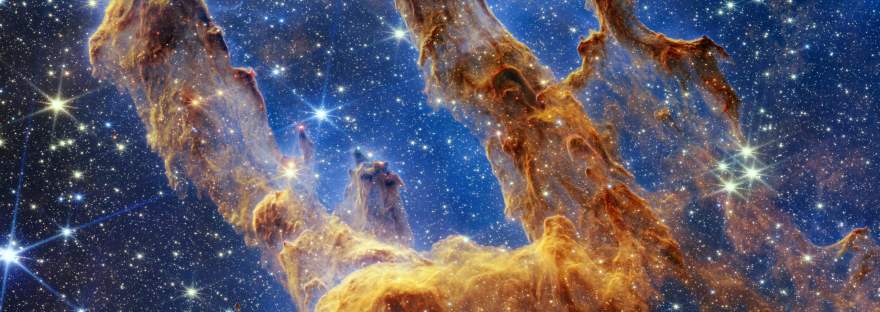
This is the crossroad of physical cosmology, biology, big bang, evolution and faith. The reader is advised to keep an open mind, do a comparative analysis of the facts, and subsequently form their own opinion. Isaiah 45: 6-8; That they may know from the rising of the sun to its setting That there is none besides Me. I am the Lord, and there is no other;I form the light and create darkness, I make peace and create calamity; I, the Lord, do all these things.’ “Rain down, you heavens, from above, And let the skies pour down righteousness; Let the earth open, let them bring forth salvation, And let righteousness spring up together. I, the Lord, have created it.
All living organisms have pulses; algae, viruses, bacteria, plants, and animals. Their life span differs, the truly amazing truth is that cosmic bodies; the planet earth, and other planetary bodies, the stars (such as our star, the Sun), black holes that are usually at the centre of each galaxy, our native galaxy, the Milky way has a black hole known as Sagittarius A, at its centre, all also have pulses. Our Sun has an eleven year cycle (pulse), our planet has a 200000 years to one million years pulse (do the research on the breakaway of the Eastern section of the African continent: East Africa rift valley). Though the frequency of volcanic eruption in various parts of the planet indicate birth pains (formation of new material) on a shorter time span frequency. It’s counter intuitive to our comprehension that cosmic bodies have pulses just like us.
Major characteristics of living organisms: All living organisms share a set of key characteristics that distinguish them from non-living matter. Biologists generally define life through the following major traits:
1. Cellular Organisation
All living things are composed of one or more cells. The cell is the fundamental unit of life.
Unicellular organisms (like bacteria) consist of a single cell.
Multicellular organisms (like humans and trees) are composed of complex networks of specialised cells.
2. Metabolism
Living organisms undergo continuous chemical reactions to sustain life. This total of all chemical reactions is called metabolism, which includes:
Anabolism: Building up complex molecules (e.g., photosynthesis in plants).
Catabolism: Breaking down molecules to release energy (e.g., cellular respiration).
3. Homeostasis
Organisms must maintain a stable, constant internal environment despite changes in their external surroundings. Examples include regulating body temperature, water balance, and pH levels.
4. Growth and Development
All living things grow (increase in size or cell number) and develop (mature through a defined life cycle governed by their genetic material).
5. Reproduction
Living organisms have the ability to produce offspring to ensure the continuation of their species. This can happen in two ways:
Asexual reproduction: A single organism produces an exact genetic copy of itself.
Sexual reproduction: Two parents contribute genetic material to produce unique offspring.
6. Response to Stimuli
Organisms can detect and react to changes in their environment (stimuli). These responses can be behavioural (like a plant bending toward light) or physiological (like a person sweating when hot).
7. Adaptation through Evolution
Over generations, populations of living organisms adapt to their environments. Changes in DNA allow species to evolve via natural selection, ensuring survival in changing world conditions.
Characteristics of living entities exhibited by cosmic bodies. Cosmic bodies (stars, planets, galaxies) don’t actually meet the biological definition of “living,” but they can superficially display a few characteristics we associate with life. Here’s a breakdown of where the comparison holds up and where it breaks down:
Characteristics of Life (Biological Standard)
Living things generally show: growth, reproduction, metabolism, response to stimuli, homeostasis, organisation (cells), and evolution/adaptation.
Where Cosmic Bodies “Mimic” Life-like Traits
1. Growth
Stars accumulate mass from surrounding gas and dust clouds, growing over millions of years.
Planets form and grow through accretion of smaller bodies (planetesimals).
Black holes “grow” by consuming matter and merging with other black holes.
2. Birth and Death (Life Cycles)
Stars are “born” in nebulae, go through a main sequence “life,” and “die” as white dwarfs, neutron stars, or supernovae.
This life-cycle terminology (protostar → main sequence → red giant → death) closely parallels biological life stages, which is why it’s used colloquially.
3. Energy Consumption/Metabolism (loose analogy)
Stars convert hydrogen to helium via fusion, releasing energy — vaguely resembling metabolic energy conversion, though it’s a nuclear process, not a chemical/biological one.
4. Reproduction (very loose analogy)
Supernovae scatter heavy elements that seed the formation of new stars and planetary systems — sometimes called “stellar reproduction,” though it’s not self-directed or genetically informed.
5. Response to Environment
Planetary and stellar systems respond to gravitational influences (e.g., tidal locking, orbital resonance), but this is passive physics, not a biological “response to stimuli.”
6. Structure/Organization
Cosmic bodies have internal layered structure (core, mantle, crust for planets; core, radiative zone, convective zone for stars) — analogous to organised biological systems, but not cellular.
Key Missing Criteria
Cosmic bodies lack:
Self-replication with genetic information
Homeostasis (active self-regulation)
Evolution by natural selection
Response to stimuli in a purposeful/adaptive sense
Metabolism in the biochemical sense
Bottom Line
The similarities are largely metaphorical and process-based (growth, cycles, transformation) rather than functional in the biological sense. Scientists use “life cycle” language for stars and galaxies as a useful analogy for teaching and visualisation — not because these bodies are literally alive.
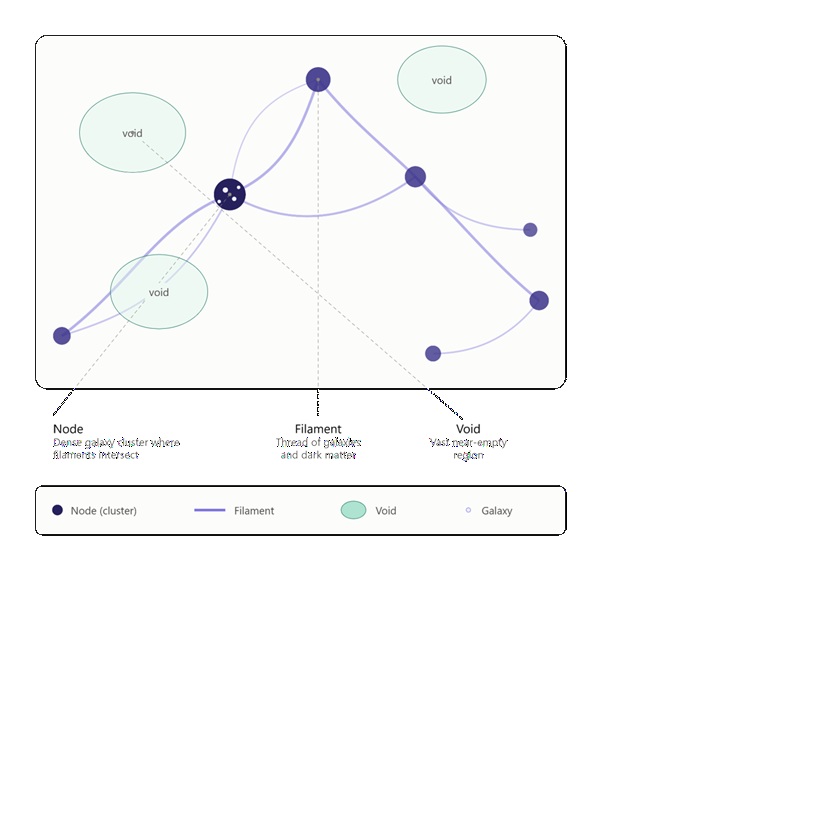
The cosmic web is the large-scale structure of the universe — the way matter (both visible and dark matter) is arranged across space on the grandest scales, forming a pattern that resembles a three-dimensional spiderweb or a sponge-like network.
Structure of the Cosmic Web
It has four main components:
1. Filaments
Long, thread-like structures made of galaxies, gas, and dark matter.
These are the “strands” of the web, often hundreds of millions of light-years long.
Galaxies tend to flow along these filaments, pulled by gravity.
2. Nodes (Clusters)
Dense regions where filaments intersect.
These host massive galaxy clusters — some of the largest gravitationally bound structures in the universe.
3. Walls (Sheets)
Flattened, sheet-like structures of galaxies, less dense than filaments but denser than voids.
An example is the “Great Wall,” a massive sheet-like arrangement of galaxies.
4. Voids
Enormous, roughly spherical regions that are nearly empty of galaxies and matter.
Voids can span tens to hundreds of millions of light-years and make up most of the universe’s volume.
How It Formed
The cosmic web originated from tiny density fluctuations in the early universe (visible in the Cosmic Microwave Background). Over billions of years:
Regions with slightly more matter attracted more matter via gravity.
Dark matter, which vastly outweighs normal matter, formed the initial gravitational scaffolding.
Normal (baryonic) matter — gas and eventually galaxies — fell into this scaffolding, tracing out the filaments, nodes, and walls we observe today.
Why It Matters
It reveals the role of dark matter (reference Isaiah 45: 6-8), since the web’s structure is shaped predominantly by dark matter’s gravity, even though we can’t see it directly.
It helps cosmologists test models of the universe’s evolution (e.g., using simulations like the Millennium Simulation or Illustris).
Studying the cosmic web helps explain how galaxies form, migrate, and cluster over cosmic time.
That’s the basic layout: filaments (the purple threads) carry galaxies along them like beads on a string, converging at nodes — the densest points, where massive galaxy clusters form. Between the filaments and walls are the voids, vast nearly-empty bubbles that make up most of the universe’s volume.
A useful way to picture it: imagine soap bubbles packed together. The thin films and edges where bubbles meet are the filaments and walls (matter concentrates there), while the hollow interior of each bubble is a void. The whole pattern is invisible in normal light on this scale — what actually holds the shape together is dark matter’s gravity, with visible galaxies just tracing the underlying scaffold.
Expansion of the universe refers to the observation that the space between galaxies (on large scales) is continuously stretching over time — galaxies aren’t just moving through space, but the fabric of space itself is growing.
Key Points
1. It’s not an explosion into empty space
A common misconception is that the universe expanded like a bomb going off, with galaxies flying outward from a central point into pre-existing empty space.
In reality, space itself is stretching everywhere, uniformly. There is no center and no edge — every point moves away from every other point.
2. The raisin bread analogy
Picture raisin bread dough rising in an oven. Each raisin (galaxy) doesn’t move through the dough — but as the dough expands, every raisin gets farther from every other raisin.
The farther apart two raisins start, the faster they separate as the loaf expands — this mirrors what we observe with galaxies.
3. Discovered through redshift
In the 1920s, Edwin Hubble observed that light from distant galaxies is shifted toward longer (redder) wavelengths — called redshift.
This happens because space stretches while light travels through it, stretching the light’s wavelength too.
Crucially, more distant galaxies show greater redshift, meaning they’re receding faster — this relationship is Hubble’s Law.
4. Hubble’s Law
Recession velocity = H₀ × distance (where H₀ is the Hubble constant, roughly 70 km/s per megaparsec).
This means space is expanding at a consistent rate everywhere — it’s not that galaxies are “running away” from a specific spot.
5. Accelerating expansion
Observations in the late 1990s (using distant supernovae) revealed the expansion isn’t slowing down due to gravity, as expected — it’s actually speeding up.
This acceleration is attributed to dark energy, a mysterious force that makes up roughly 68% of the universe’s total energy content, though its nature is still not well understood.
6. What isn’t expanding
Locally bound systems — galaxies, solar systems, planets, even you — don’t expand, because gravity (and other forces) hold them together tightly enough to resist the stretching of space.
Expansion only becomes significant on very large scales, between galaxies and galaxy clusters that aren’t gravitationally bound to each other.
Bottom Line
Expansion means the space between cosmic structures is growing over time, carrying galaxies apart from one another — not because they’re moving through a fixed space, but because the space itself is stretching, and this stretching is accelerating due to dark energy. Psalm 19: 1-6; The heavens declare the glory of God; And the firmament shows His handiwork. Day unto day utters speech, And night unto night reveals knowledge. There is no speech nor language Where their voice is not heard. Their line has gone out through all the earth, And their words to the end of the world. In them He has set a tabernacle for the sun,Which is like a bridegroom coming out of his chamber, And rejoices like a strong man to run its race. Its rising is from one end of heaven, And its circuit to the other end; And there is nothing hidden from its heat. What do we have here, faith in God who says, He created light and darkness, physical cosmology that says there is matter and anti-matter, light/stars, galaxies and dark energy, cosmic web, is there a parallel to be seen, well the rest is up to the reader to form their opinion on this piece.
In a philosophical/theological discussion that incorporates the efficacy of prayer, and with whom lies the initiative of being born again by the Holy Spirit, a school of thought strongly advocates persistent prayer (see doctrines advocated by Paul), and suggests that the initiative lies with man. However, this contradicts the teachings of Christ, and the summation of the prophets in the Hebrew Bible (Old Testament). In the opposing schools of thought between Pauline doctrine, and the teachings of Christ, the tie-breaker lies in the scriptures in Proverbs 2:6; For the Lord gives wisdom; from his mouth come knowledge and understanding.
Let us dive in, Jesus Christ is quoted in Matthew 7: 7-8; “Ask and it will be given to you; seek and you will find; knock and the door will be opened to you.For everyone who asks receives; the one who seeks finds; and to the one who knocks, the door will be opened. This was pointed out by the party espousing that the initiative lies with man, to seek, and to knock. Furthermore, in Matthew 6:33; But seek first his kingdom and his righteousness, and all these things will be given to you as well. However, there is a caveat, Jesus Christ taught that prayers should be short, concise, and sincere, in Mark 12: 38-40; As he taught, Jesus said, “Watch out for the teachers of the law. They like to walk around in flowing robes and be greeted with respect in the marketplaces, and have the most important seats in the synagogues and the places of honour at banquets. They devour widows’ houses and for a show make lengthy prayers. These men will be punished most severely.” In Matthew 6:5-8; “And when you pray, do not be like the hypocrites, for they love to pray standing in the synagogues and on the street corners to be seen by others. Truly I tell you, they have received their reward in full. But when you pray, go into your room, close the door and pray to your Father, who is unseen. Then your Father, who sees what is done in secret, will reward you. And when you pray, do not keep on babbling like pagans, for they think they will be heard because of their many words. Do not be like them, for your Father knows what you need before you ask him.
In approaching the issue of seeking God, the Holy Spirit in the Book of Psalms, Psalm 24: 3-6; Who may ascend the mountain of the Lord? Who may stand in his holy place? The one who has clean hands and a pure heart, who does not trust in an idol or swear by a false god. They will receive blessing from the Lord and vindication from God their Saviour. Such is the generation of those who seek him, who seek your face, God of Jacob. This brings us to a conundrum, where is the man, whose hands are clean, and whose heart is pure. Where is the man, who has never had an impure thought? Because as Christ said even our thoughts will be judged. Therefore, who is the man who by his own volition can seek God, and appear in His presence. And before we start engaging in tautology generated by Christ being the Son of God (though Christ mostly refer to himself as Son of Man), it is the Holy Spirit who gives birth to new spirit beings, and not beings that are dead or separated from God the Holy Spirit, that calls forth their own spiritual birth. So what is the way out of this spiritual and philosophical cul-de-sac?
The word of God, informs us in Jeremiah 31: 34-35; “Behold, the days are coming, says the Lord, when I will make a new covenant with the house of Israel and with the house of Judah— not according to the covenant that I made with their fathers in the day that I took them by the hand to lead them out of the land of Egypt, My covenant which they broke, though I was a husband to them, says the Lord.But this is the covenant that I will make with the house of Israel after those days, says the Lord: I will put My law in their minds, and write it on their hearts; and I will be their God, and they shall be My people. No more shall every man teach his neighbour, and every man his brother, saying, ‘Know the Lord,’ for they all shall know Me, from the least of them to the greatest of them, says the Lord. For I will forgive their iniquity, and their sin I will remember no more.”
However, before God writes on man’s heart, we are informed in Ezekiel 11:19; “I will give them an undivided heart and put a new spirit in them; I will remove from them their heart of stone and give them a heart of flesh.” This is a clear statement from Jesus Christ, the Holy Spirit, that the initiative lies with the Holy Spirit, and not with man. This perspective is leading us out of the cul-de-sac, in John 3: 3-6; Jesus answered and said to him, “Most assuredly, I say to you, unless one is born again, he cannot see the kingdom of God.” Nicodemus said to Him, “How can a man be born when he is old? Can he enter a second time into his mother’s womb and be born?” Jesus answered, “Most assuredly, I say to you, unless one is born of water and the Spirit, he cannot enter the kingdom of God. That which is born of the flesh is flesh (cue, the pastors, prophets, and church leaders baptising with water, citing literal and specific instructions given by Jesus Christ to specific disciples), and that which is born of the Spirit is spirit.
Finally, in John 3:13; No one has ascended to heaven but He who came down from heaven, that is, the Son of Man who is in heaven. Does this mean that Jesus Christ, the Son of Man is God the Father, God the Son, and God the Holy Spirit? In Matthew 5: 34-35; But I say to you, do not swear at all: neither by heaven, for it is God’s throne;nor by the earth, for it is His footstool; nor by Jerusalem, for it is the city of the great King. I suppose those who seek Him out of their own volition, would have to pose the question to Him, when they find Him. This publisher is not advocating not seeking God.
John chapter 14 verse 6;Jesus answered, “I am the way and the truth and the life. Obviously this statement/text spoken by Jesus Christ is a metaphor, however, is there a literal meaning behind it? If so, let us examine the literal aspect. That is, instead of approaching ‘the life’ as a ‘who’, approaching it as a ‘what’.
Let us literarily examine what is life, how does it start? What is the technical process involved? Do we really know how life begins physically/technically? What do we know scientifically, and what do we not know (scientific ignorance)? What are the unproven theories we have in this field? And what are our best explanation of the quantum biochemical process of DNA replication.
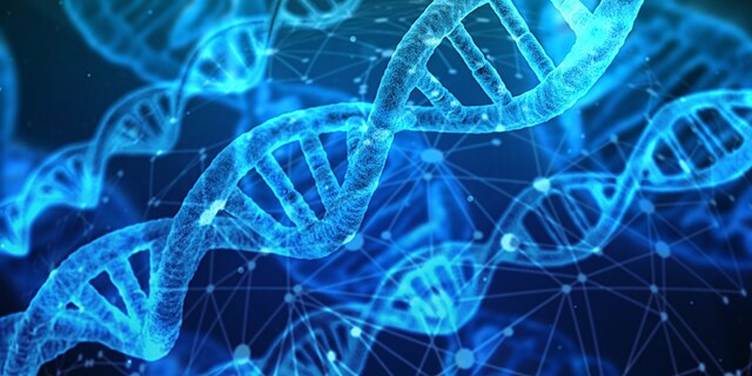
Deoxyribonucleic Acid (DNA) is the molecule that stores the genetic blueprint for all living organisms. It contains the instructions needed to build, operate, and reproduce every cell in the body. See picture below.
Structure of DNA
The Building Blocks — Nucleotides
DNA is a polymer made of repeating units called nucleotides, each consisting of three components:
Component
Description
Deoxyribose sugar
A 5-carbon sugar (missing one oxygen vs. ribose)
Phosphate group
Links nucleotides together forming the backbone
Nitrogenous base
The information-carrying component
The Four Bases of DNA
Adenine (A) — Purine
Thymine (T) — Pyrimidine
Guanine (G) — Purine
Cytosine (C) — Pyrimidine
Base Pairing Rules (Chargaff’s Rules)
Bases pair specifically across the two strands:
A ═══ T (2 hydrogen bonds)
G ≡≡≡ C (3 hydrogen bonds)
The Double Helix
DNA exists as a double-stranded helix — two antiparallel strands wound around each other, described by Watson and Crick in 1953. The strands run in opposite directions:
One strand runs 5′ → 3′
The complementary strand runs 3′ → 5′
5′ — A — T — G — C — A — T — 3′
| | | | | |
3′ — T — A — C — G — T — A — 5′
DNA Organisation in the Cell
Level
Structure
Naked DNA
Double helix
Nucleosome
DNA wrapped around histone proteins
Chromatin fibre
Compacted nucleosomes
Chromosome
Fully condensed chromatin
Human cells contain ~3 billion base pairs
If uncoiled, DNA in a single cell would stretch ~2 metres
Packed into a nucleus just 6 micrometres across
DNA
What is RNA?
Ribonucleic Acid (RNA) is a versatile molecule that acts as an intermediary between DNA and proteins, and performs many other cellular functions. Unlike DNA, RNA is typically single-stranded.
Structure of RNA
RNA nucleotides differ from DNA in two key ways:
Feature
DNA
RNA
Sugar
Deoxyribose
Ribose (has extra –OH)
Bases
A, T, G, C
A, U, G, C (Uracil replaces Thymine)
Strands
Double-stranded
Single-stranded
Stability
Very stable
Relatively unstable
Location
Nucleus (mainly)
Nucleus & cytoplasm
The Three Main Types of RNA
1. Messenger RNA (mRNA)
Carries the genetic message from DNA to the ribosome
Made during transcription in the nucleus
Read in codons (triplets of bases) during translation
Cloverleaf structure with an anticodon loop and amino acid attachment site
Acts as the physical adaptor between nucleic acid language and protein language
~73–93 nucleotides long
3. Ribosomal RNA (rRNA)
Structural and catalytic component of ribosomes
Most abundant RNA in the cell (~80%)
The ribosome’s rRNA acts as a ribozyme — catalysing peptide bond formation
Humans have 4 types: 28S, 18S, 5.8S, 5S
Other Important RNA Types
RNA Type
Function
miRNA (microRNA)
Regulates gene expression by silencing mRNA
siRNA (small interfering RNA)
RNA interference — degrades specific mRNA
snRNA (small nuclear RNA)
Involved in RNA splicing (spliceosome)
lncRNA (long non-coding RNA)
Gene regulation, chromatin remodelling
Ribozymes
RNA molecules with catalytic activity
The Central Dogma of Molecular Biology
The relationship between DNA and RNA underpins all of biology:
Transcription Translation
DNA ──────────────► RNA ──────────────► Protein
▲ │
└────────────────────┘
Reverse Transcription
(retroviruses, e.g. HIV)
Process
Description
Location
Replication
DNA → DNA (copying)
Nucleus
Transcription
DNA → RNA (reading)
Nucleus
Translation
RNA → Protein (building)
Ribosome (cytoplasm)
Reverse Transcription
RNA → DNA (viral)
Cytoplasm
DNA vs RNA — Full Comparison
Feature
DNA
RNA
Full name
Deoxyribonucleic acid
Ribonucleic acid
Sugar
Deoxyribose
Ribose
Bases
A, T, G, C
A, U, G, C
Strands
Double
Single
Helix
Yes (double helix)
Sometimes (hairpins, etc.)
Stability
Very stable
Less stable
Function
Stores genetic info
Expresses genetic info
Location
Nucleus, mitochondria
Nucleus, cytoplasm, ribosomes
Lifespan
Permanent (in cell)
Temporary
Why Does the Difference Matter?
The extra hydroxyl group (–OH) on RNA’s ribose sugar makes RNA:
More chemically reactive
Capable of self-catalysis (ribozymes)
Suitable for short-lived messages (mRNA turns over quickly, allowing rapid gene regulation)
DNA’s missing –OH makes it chemically inert and far more stable — ideal for long-term information storage across generations.
Together, DNA and RNA form the central information processing system of all life on Earth — DNA as the archive, RNA as the working copy and multi-tool executor.
DNA replication is a fascinating intersection of quantum mechanics and biochemistry. Here’s how quantum effects play roles in this fundamental process:
The Classical Foundation
DNA replication involves unwinding the double helix and using each strand as a template to build a complimentary copy, orchestrated by enzymes like helicase, primase, and DNA polymerase.
Where Quantum Effects Come In
1. Proton Tunnelling and Base Pairing
The most significant quantum effect is proton tunnelling in hydrogen bonds between base pairs (A-T and G-C). Hydrogen bonds are maintained partly by protons that can quantum tunnel — passing through energy barriers rather than over them. This tunnelling can cause protons to shift positions (tautomeric shifts), temporarily changing a base’s bonding behaviour. If replication occurs while a base is in a rare tautomeric form, it can cause a point mutation — a mechanism first proposed by Watson and Crick themselves.
2. Electron Delocalization in the Base Stack
DNA’s stacked aromatic bases form a π-electron system running along the helix. Electrons are delocalized across multiple bases simultaneously — a quantum superposition of states. This has implications for how DNA polymerase “reads” the template, as the electronic landscape influences molecular recognition.
3. Enzyme Catalysis via Quantum Tunnelling
DNA polymerase accelerates nucleotide addition dramatically. Part of this catalytic power comes from quantum tunnelling of hydrogen atoms during proton transfer steps in the phosphodiester bond-forming reaction. Enzymes are thought to shape their active sites to enhance tunnelling probability — a field called quantum enzyme catalysis.
4. Van der Waals Forces and Quantum Fluctuations
Base stacking stability relies on London dispersion forces, which arise from quantum fluctuations in electron density (instantaneous dipoles). These zero-point quantum fluctuations contribute meaningfully to the structural integrity of the double helix and affect how polymerase processivity works.
5. The Quantum Measurement Problem in Fidelity
DNA polymerase achieves an error rate of roughly 1 in 10⁷. Part of the fidelity mechanism may involve the enzyme acting like a quantum “measurement device” — the act of selecting and inserting a nucleotide collapses the quantum state of the template base, enforcing correct pairing. This is still an active area of research.
The Bigger Picture
Process
Quantum Effect
Hydrogen bonding
Proton tunnelling → tautomeric shifts
Base stacking
Electron delocalization, Van der Waals
Polymerase catalysis
H-atom tunnelling in bond formation
Structural stability
Zero-point energy fluctuations
Mutation induction
Tunnelling-induced tautomer errors
Current Research Frontier
The field of quantum biology is still maturing. While proton tunnelling in DNA is well-established theoretically, directly measuring these quantum effects in a living, warm, wet biological environment is experimentally challenging. Decoherence — the loss of quantum states due to thermal noise — was long thought to preclude significant quantum effects in biology, but evidence increasingly suggests biology has evolved mechanisms to exploit quantum phenomena even at physiological temperatures.
It’s a remarkable picture: the very molecule that carries the instructions for life operates at the boundary between the quantum and classical worlds.
What is our current scientific explanation of the fertilisation process of human reproductive cells to the formation of an embryo?
Human Fertilisation: From Gametes to Embryo
1. The Gametes — Starting Materials
Sperm (Spermatozoon)
Haploid cell (23 chromosomes)
Three regions: head (nucleus + acrosome), midpiece (mitochondria for energy), flagellum (propulsion)
Acrosome contains hydrolytic enzymes critical for penetrating the egg
Oocyte (Egg)
Also haploid — but actually arrested in Metaphase II of meiosis at ovulation; it only completes meiosis upon fertilisation
Surrounded by the zona pellucida (glycoprotein shell) and corona radiata (follicular cells)
Contains cortical granules just beneath the membrane — essential for blocking polyspermy
2. The Journey & Capacitation
After ejaculation, sperm undergo capacitation in the female reproductive tract — a biochemical maturation process lasting several hours involving:
Removal of cholesterol from the sperm plasma membrane
Hyperpolarisation then hyperactivation (vigorous, whip-like flagellar motion)
Increased intracellular Ca²⁺ signalling
Surface protein remodelling, exposing receptors needed for zona binding
Only capacitated sperm can fertilise an egg. Of ~200–500 million sperm deposited, only a few hundred reach the oocyte in the ampulla of the fallopian tube.
3. Sperm–Egg Binding and the Acrosome Reaction
Step 1 — Corona Radiata Penetration Hyperactivated sperm physically push through the follicular cells using mechanical force and hyaluronidase enzyme activity.
Step 2 — Zona Pellucida Binding Sperm bind to ZP3 glycoproteins on the zona pellucida via complementary receptors. This binding triggers the:
Acrosome Reaction
Ca²⁺ floods into the sperm head
The acrosomal membrane fuses with the sperm plasma membrane
Hydrolytic enzymes (acrosin, proteases) are released
These enzymes digest a path through the zona pellucida
4. Membrane Fusion & Blocks to Polyspermy
When the first sperm reaches the oocyte membrane, proteins IZUMO1 (sperm) and JUNO (egg) bind — the essential molecular handshake for fusion.
The membranes fuse and the sperm nucleus enters the oocyte cytoplasm. This triggers two immediate defence mechanisms against polyspermy (fertilisation by multiple sperm, which is lethal):
Block
Mechanism
Speed
Fast block
Membrane depolarisation (+20mV) via Na⁺ influx
Seconds
Slow block
Cortical reaction — Ca²⁺ wave triggers cortical granule exocytosis, modifying zona pellucida (zona reaction), making it impenetrable
1–2 minutes
5. Completion of Meiosis & Pronuclei Formation
Sperm entry triggers a cascade of intracellular Ca²⁺ oscillations (driven by sperm-introduced PLCζ enzyme), which:
Releases the oocyte from its Metaphase II arrest
The oocyte completes meiosis II, ejecting the second polar body
The egg nucleus becomes the female pronucleus
The sperm nucleus decondenses and becomes the male pronucleus
Both pronuclei swell and replicate their DNA independently. The cell now contains 46 chromosomes (23 pairs) across two separate nuclei — this is the zygote, though the pronuclei haven’t yet fused.
6. Syngamy — The First Mitotic Division
Rather than fusing directly, the two pronuclei:
Migrate toward each other
Their nuclear envelopes break down
Chromosomes from both align on a shared mitotic spindle
The first cell division (cleavage) occurs
This is syngamy — the true genetic union. The zygote divides into 2 blastomeres.
7. Cleavage — Rapid Cell Division
Over the next ~3–4 days, the zygote undergoes rapid mitotic divisions (cleavage) as it travels down the fallopian tube. Crucially, the total volume doesn’t increase — cells get progressively smaller:
At the 8-cell stage, compaction occurs — blastomeres flatten and maximise contact with each other, held by E-cadherin. Gap junctions form, enabling cell-to-cell communication.
8. Blastocyst Formation (Day 5–6)
The morula undergoes cavitation — fluid is pumped into the interior, forming a fluid-filled cavity called the blastocoel. The structure is now a blastocyst, with two distinct cell populations:
Cell Type
Location
Fate
Trophoblast
Outer layer
Placenta, extra embryonic membranes
Inner Cell Mass (ICM) / Epiblast
Interior cluster
The embryo itself
This is the first major cell fate decision in human development — driven by positional signals and transcription factors (OCT4, NANOG, CDX2).
9. Hatching & Implantation (Day 6–10)
The blastocyst hatches from the zona pellucida (using proteases) and attaches to the endometrium (uterine lining, prepared by progesterone).
Implantation proceeds in stages:
Apposition — loose contact with endometrial epithelium
Adhesion — firm attachment via integrins and selectins
Invasion — trophoblast cells differentiate into:
Cytotrophoblast (inner, proliferative)
Syncytiotrophoblast (outer, invasive multinucleate mass that erodes into maternal tissue)
The syncytiotrophoblast begins secreting hCG (human chorionic gonadotropin) — the hormone detected by pregnancy tests — which signals the corpus luteum to keep producing progesterone, maintaining the uterine lining.
10. The Embryo Proper — Bilaminar Disc (Week 2)
By the end of week 2, the inner cell mass reorganises into the bilaminar embryonic disc:
Epiblast (upper layer) → gives rise to all three germ layers
From a single sperm-egg fusion to a structured embryo with distinct cell lineages, this entire process is one of the most precisely choreographed sequences in biology — coordinating quantum-level chemistry, molecular signalling, mechanical forces, and genetic programming across just a matter of days. And yet the average man (man or woman or Biologist: IVF, and so on) believes that they are in control of the process. Obviously, there is freedom of expression, even if what is being expressed is a monumental display of ignorance. If ‘life’ can be created by man, surely man should be able to extend his/her lifespan to infinity, that is, no more diseases, and physical death. The publisher of this article is not holding his/her breath, till that state is achieved by science.